Home
All Models
Following
MakerLab
Contests
Crowdfunding
Explore
Maker's Supply
CyberBrick
Community
Forum
Privacy
Terms
Guidelines
FAQ
Cookie Settings
Hot Searches
© 2026 MakerWorld
Search models, users, collections, and posts
Log In
XPrinter
@
user_1729563119
0
Followers
10
Following
0
9
9
4
Follow
Home
Collections
3D Models (3)
Laser & Cut Models
Crowdfunding (0)
Posts (2)
Recent Models
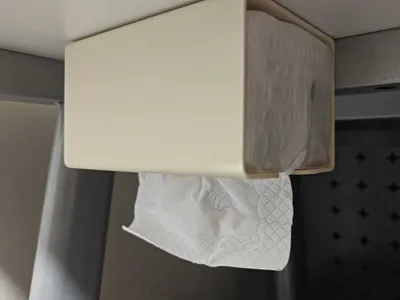
Super Simple Parametric Inverted Tissue Box
0
0
1
0
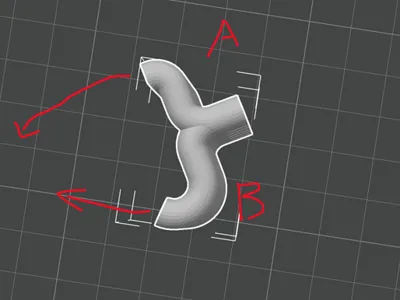
P2S Dual Gooseneck Air Outlet / P2S双鹅颈出风口
9
0
6
4
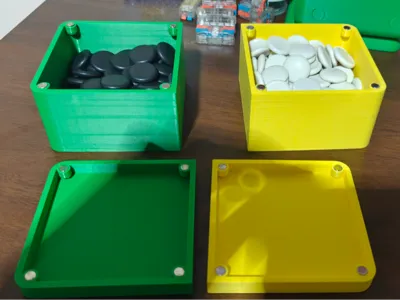
A pair of fully magnetic lidded boxes for children's Go pieces
0
0
2
0
Explore All 3 Models
Recent Article
H2C: Multi-Material Heat, Not Toolchanging
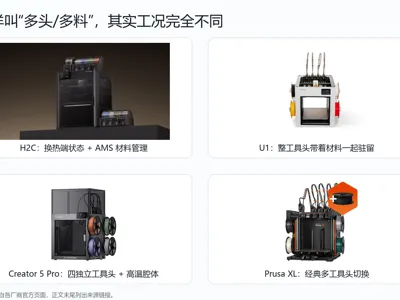
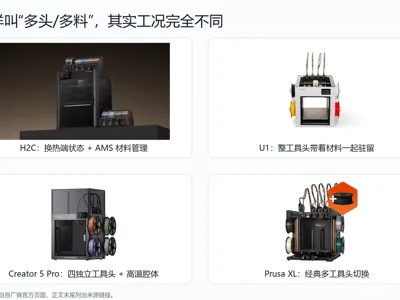
Quick caveat first: when I mention "different nozzle sizes," I am talking about a future Level 3 requirement. I am not claiming that the current H2C can already mix different nozzle diameters in one print. The main point of this post is simpler: H2C and Snapmaker U1 are aimed at very different operating conditions, so comparing only toolchange speed misses the real question.People often compare H2C, Snapmaker U1, Prusa XL, and Flashforge Creator 5 Pro by asking: which one changes tools faster, which one wastes less filament, and which one looks more like a "real" multi-tool system? That comparison is useful, but if we only look at toolchange speed, I think we miss the most important part.My view is that H2C is not a compromise because Bambu "could not change the whole toolhead." It is also not just a trick to sell more AMS units. It redefines the problem: multi-material printing is not mainly about hanging more nozzles on the machine. It is about switching between materials that live in very different temperature windows, without making the system unreliable.If we are only talking about PLA multicolor, I would happily give U1 / XL a lot of credit. Whole-toolhead switching can be fast, clean, and low-waste. But once we talk about PLA + ABS, PLA + PC, PLA + PAHT, or engineering materials plus support materials, we are no longer playing the same game. If different nozzle diameters eventually join the same job, that becomes an even higher-level future scenario.Three Levels Of DemandLevel 1: multicolor with the same or similar-temperature material. PLA multicolor, PETG multicolor, same nozzle diameter. The key metrics are toolchange speed, waste, and slicer experience. Whole-toolhead systems like U1 / XL can be extremely strong here.Level 2: true multi-material, with large temperature gaps. PLA + ABS / PC / PAHT, or support material + engineering material. The key metrics become chamber temperature, where the inactive material stays, cooling strategy, and clog risk.Level 3: future layer, multicolor + multi-material + different nozzles. This is not a claim that current H2C already supports mixed nozzle diameters. It is a future demand: fine outer walls, stronger inner walls and infill, and maybe even different filament diameters in the long run.The Tall PTFE Tubes On U1 Already Tell Part Of The StoryU1 is a fascinating machine. Its top-mounted PTFE tubes are very visible, and the material effectively lives with the corresponding toolhead. That is exactly why the system can feel so good in PLA multicolor: when a toolhead is swapped, the material path goes with it, and the next tool is ready to work.But this design has a boundary. If you enclose the machine and heat the chamber for a high-temperature material, the low-temperature material is no longer just "waiting." It is also sitting in or near the warm toolhead path. PLA does not need to melt to become a problem. As it approaches its softening / heat-deflection range, it can expand, deform, get sticky, increase friction, and eventually stop feeding smoothly.Snapmaker's own U1 Top Cover FAQ makes this boundary clear: high-temperature and low-temperature materials are not recommended in the same print because low-temperature material may soften in a high-temperature chamber and clog the nozzle. This is not forum speculation. It is an operating-condition limit of that architecture.The Real Dividing Line Is Chamber TemperatureH2C is specified with an actively heated chamber up to 65 C and a hotend up to 350 C. That matters for PC, PAHT, ABS/ASA and other engineering materials, because a stable thermal environment reduces warping, internal stress, cracking, and weak layer bonding. But PLA's heat-deflection / softening window is around the 50-60 C range depending on formulation. PC enjoys that warm chamber; PLA may not.Bambu's own H2C manual also separates high-temperature and low-temperature materials, and warns that low-temperature materials can soften and deform in the extruder or hotend at higher chamber temperatures, increasing clog risk. It also does not recommend mixing high-temperature and low-temperature materials. In other words, this is not a "flaw" of one brand. It is a real boundary of cross-temperature multi-material printing.This does not mean "PLA clogs at exactly 57 C." Real risk depends on dwell time, cooling, tube constraints, retraction, humidity, brand, and where the material sits. But as an engineering rule of thumb, PLA sitting for a long time in a chamber near or above 60 C should be treated as high risk.H2C's Compromise May Actually Be The Future-Facing ChoiceWhole-toolhead switching says: bundle nozzle, extrusion, fan, sensors, and material path into one tool, then pick up whichever tool is needed. That is great for same-temperature multicolor printing.The H2C / Vortek idea is different: instead of moving the entire toolhead, it manages the hotend state as a swappable and remembered unit, while AMS handles filament storage, drying, feeding, and retraction. In that framing, H2C is not "bad at changing the whole toolhead." It is trying to avoid leaving long runs of low-temperature material parked in a hot chamber, while separating material state, hotend state, and nozzle state.This is also why I put "different nozzle sizes" into the future-trend bucket. A fine nozzle can make outer walls cleaner; a larger nozzle can make inner walls, load-bearing structures, and infill stronger and faster. In the future, even filament diameter might diverge for different jobs. Under that level of complexity, switching nozzle / hotend state may be more practical than moving an entire toolhead, its material path, and its parked thermal environment together.My Own Experience: Getting Good At Fixing Clogs Is Not A FeatureI have not bought a U1, but I have seen a friend's enclosed U1 run into similar issues: low-temperature material is affected by the warm path, and extrusion becomes unreliable afterward. I have also run into this while testing multi-material paths on X2D. When low-temperature material stays too long in a tube or auxiliary extrusion path, clog probability can become very high.You can get good at repairing it. I did. In plain words: I became painfully good at it. But being good at repair does not make it a reliable solution. A good multi-material system should reduce the chance that users have to deal with this kind of low-temperature-material-in-hot-environment failure in the first place.This Is Not About One Machine Destroying Another- Snapmaker U1: very strong for PLA multicolor and similar-temperature materials. The boundary appears when low-temperature material has to wait in a high-temperature environment. - Prusa XL: an excellent multi-tool benchmark, but not the only answer for actively heated cross-temperature material conditions. - Flashforge Creator 5 Pro: four independent toolheads plus an actively heated chamber. It proves that heated chambers and multi-tools can coexist, but at a higher machine class and cost. - Bambu H2C: strongest today in Level 2 conditions: cross-material printing, support materials, and heated-chamber engineering materials. Level 3 mixed nozzle sizes are a future extension direction, not a current claim.ConclusionH2C may not win every PLA multicolor speed demo. It may not look as mechanically dramatic as a full toolchanger. But as multi-material printing moves forward, the hard problem becomes high-temperature engineering material + low-temperature interface/support material + multiple colors + different drying requirements, all running reliably for many hours.At that point, simply hanging more full toolheads on the machine does not automatically solve the problem. We have to ask: where does the low-temperature material wait? How long does it wait? What happens when the chamber reaches 60 C or more? Does the material need to cool before the next use? How do we handle hot-material residue in the nozzle? And if future systems allow different nozzle diameters, how do we calibrate strength, flow, and surface quality?If you only print PLA multicolor, I totally understand choosing U1 / XL. But if the task is PC or PAHT as the main material plus PLA/support material, how do you keep the low-temperature material from sitting too long in a 65 C chamber? And if the future brings different nozzles, different interfaces, and maybe even different filament diameters, the state that a whole-toolhead system has to manage will only get heavier.Sources1. Bambu Lab H2C official blog: https://blog.bambulab.com/bambu-lab-h2c-where-multi-material-vortek-system-meets-engineering-precision/ 2. Bambu Lab H2C specs: https://bambulab.com/en/h2c/specs 3. Snapmaker U1 product page: https://www.snapmaker.com/en-US/snapmaker-u1 4. Snapmaker U1 Top Cover FAQ: https://us.snapmaker.com/products/top-cover-for-snapmaker-u1 5. Bambu PLA Basic technical data sheet: https://store.bblcdn.com/s1/default/58b85d0f3db94878854a28fdb8a0006e/Bambu_PLA_Basic_Technical_Data_Sheet.pdf 6. Bambu PC material page: https://bambulab.com/en-us/filament/pc 7. Bambu PAHT-CF material page: https://bambulab.com/en/filament/paht-cf 8. Bambu Lab H2C user manual: https://csm.bblcdn.com/hub/eff78da43720461787dc8bbe5fa0372d.pdfImage notes: the following images correspond to the demand levels, U1 top cover and tube layout, thermal risk window, architecture comparison, and H2C hotend information.
H2C 不是不会换头:它解决的是多材料热工况
先打一个补丁:文中提到“不同喷嘴口径”是未来 Level 3 需求判断,不是说当前 H2C 已经能混不同喷嘴尺寸打印。本文当前要讨论的重点,仍然是 H2C 和 Snapmaker U1 面对的工况完全不同,所以只拿它们比换头速度,其实意义不大。最近很多人把 H2C、Snapmaker U1、Prusa XL、Flashforge Creator 5 Pro 这类方案放在一起比:谁换头快,谁废料少,谁看起来更像“真·多头”。这个比较当然有价值,但如果只盯着换头速度,我觉得会把最关键的问题漏掉。我的判断是:H2C 不是一个“不会换整头所以退而求其次”的方案,也不只是为了多卖 AMS。它更像是把问题重新定义了:多材料打印的难点,不在于把几个喷嘴挂到机器上,而在于不同材料在不同温度窗口里怎么安全、稳定地切换。如果只是 PLA 多色,U1/XL 这类整工具头切换非常强,甚至更爽。但一旦进入 PLA + ABS、PLA + PC、PLA + PAHT,或者工程材料 + 支撑材料,那就已经不是一个游戏了。再往后,如果多喷嘴口径也进入同一个任务,那会是更高一层的未来工况。把需求先分成三层Level 1:多色,同材或近温材料。 PLA 多色、PETG 多色、同一喷嘴口径。核心指标是换色速度、废料、切片体验。U1 / XL 这类整工具头切换会非常强。Level 2:多材料,且材料温差很大。 PLA + ABS / PC / PAHT,或者支撑材料 + 工程材料。核心指标变成:腔温、材料驻留位置、降温策略、堵头概率。Level 3:未来层,多色 + 多材料 + 不同喷嘴。 这不是说当前 H2C 已经能混喷嘴口径打印,而是未来需求判断:外墙要细,内墙和填充要强,甚至进料线径也可能分化。U1 顶部那几根长 PTFE 管,其实已经把答案写在机器上了U1 很有意思。你看它的结构,会看到顶部有几根明显挑高的 PTFE 管,材料要“住”在对应的工具头里。这样做的好处很直接:工具头切换时,材料路径和工具头一起被拿走,下一把工具头拿起来就能干活,这也是它能把换头体验做得很爽的原因。但这个设计也带来一个边界:如果你把机器封得很热,或者让高温材料把腔体温度带起来,低温材料就不再只是“停在那里等下一次出场”。它会在管路里、喷嘴附近、工具头里一起被加热。PLA 这类材料一旦接近软化/热变形区,问题不是马上熔掉,而是变粗、变黏、变形、摩擦变大,最后变成挤不动或卡住。Snapmaker 自己的 U1 Top Cover FAQ 就把边界写得很清楚:不建议高温材料和低温材料同次打印,因为低温材料在高温腔体里可能软化并堵喷嘴。这不是网友脑补,而是这个架构的真实热边界。真正的分水岭是腔温:65°C 对 PC 很舒服,对 PLA 就不礼貌了H2C 官方规格里主动腔温最高 65°C,喷嘴最高 350°C;这对 PC、PAHT、ABS/ASA 这类工程材料很重要,因为它们需要更稳定的热环境来降低翘曲、层间应力和开裂。问题是,PLA 的热变形温度本来就在 50 多摄氏度附近。你让 PC 住进温泉,它会说舒服;你让 PLA 也陪着泡,就很难保证它还规规矩矩。更有意思的是,Bambu 自己的 H2C 手册也把材料分成高温材料和低温材料,并提醒低温材料在较高腔温下可能在挤出机或热端内软化变形,增加堵塞风险;高温材料和低温材料也不建议混打。换句话说,这不是某一家机器的“黑点”,而是跨温多材料共同面对的热边界。这里不是说“PLA 到 57°C 必堵”。真实打印里还要看驻留时间、风道、管路约束、回抽距离、是否在喷嘴里受热、材料品牌和湿度。但作为工程判断,PLA 长时间待在 60°C 左右的热环境里,本来就应该被视为高风险。所以 H2C 的妥协,反而是面向未来工况的选择整工具头切换的逻辑是:我把喷嘴、挤出、风扇、传感、材料路径都打包成一个工具头,要用哪个就拿哪个。这在多色同材里很爽,因为材料温度窗口接近,工具头只要快、准、少废料就行。H2C / Vortek 的逻辑更像是:我不急着把整个工具头都换掉,而是优先把“热端状态”做成可切换、可记忆、可管理的单元;材料卷、干燥、送料和回抽仍由 AMS 体系负责。这样看,它不是不会换整头,而是在避免把低温材料的长驻留路径塞进高温腔体里,让材料状态、热端状态、喷嘴状态分开管理。这也是为什么我会把“不同喷嘴尺寸”放到未来趋势里:外墙可以用更细喷嘴保证表面和细节,内墙、承力结构和填充可以用更大喷嘴提高强度和效率;未来甚至不排除不同线径的 filament 进入同一台机器。面对这种复杂状态,换喷嘴/换热端状态,往往比把完整工具头、材料路径和驻留热环境一起搬来搬去更实际。我自己的经验:堵到熟练,其实不是好事我没有买 U1,但我身边有朋友的 U1 在封箱后遇到过类似问题:低温材料在管路里被热环境影响,后面挤出就不顺。更早我自己在 X2D 上测试多材料时也踩过坑:只要低温材料在管子或辅助挤出路径里停留太久,堵的概率就会非常高。这个维修当然可以练出来。我当时修到什么程度?用一句俗话说,就是熟练得让人心疼。但熟练维修不等于这是可靠方案。真正好的多材料系统,应该尽量让用户少碰这类“低温料热驻留”的雷。不是谁把谁吊打,而是谁适合哪个工况- Snapmaker U1:PLA 多色、近温材料、少废料体验很强。边界是高温/低温材料同次混打时,低温材料驻留风险会变成核心问题。 - Prusa XL:优秀的多工具头基准,但默认并不是主动热腔跨温材料的唯一答案。 - Flashforge Creator 5 Pro:4 独立工具头 + 主动高温腔体,更像专业路线,证明高温腔体和多工具头可以并存,但代价也更高。 - Bambu H2C:当前强项在 Level 2:跨材料、支撑材料和高温腔体共存;Level 3 的多喷嘴口径属于未来扩展方向。结论H2C 不一定在每一个 PLA 多色样件里最快,也不一定看起来最“机械臂炫技”。但多材料打印继续往前走,真正难的场景会是:高温工程料 + 低温界面料、可溶/易剥支撑、多颜色、不同干燥需求,同时还要稳定地跑完几十个小时。再往未来走,才会叠加不同喷嘴口径,甚至不同进料线径。到了这个阶段,单纯把更多工具头挂上去并不能自动解决问题。你要回答的是:低温材料在哪里等?它等多久?腔温升到 60°C 以上时它会不会软化?下一次出场之前要不要降温?喷嘴里残留的高温材料怎么处理?如果未来开放不同喷嘴口径,又该怎么校准强度、流量和外观?如果只打 PLA 多色,我完全理解你选 U1 / XL。但如果任务是 PC 或 PAHT 主体 + PLA/支撑材料,你会怎么避免低温材料在 65°C 腔体里长时间驻留?至于不同喷嘴口径,我把它当作未来 Level 3 问题:如果以后外墙、内墙、填充、支撑界面都要不同喷嘴甚至不同线径,整工具头路线要管理的状态会越来越重。资料来源1. Bambu Lab H2C 官方博客:https://blog.bambulab.com/bambu-lab-h2c-where-multi-material-vortek-system-meets-engineering-precision/ 2. Bambu Lab H2C 规格页:https://bambulab.com/en/h2c/specs 3. Snapmaker U1 官方产品页:https://www.snapmaker.com/en-US/snapmaker-u1 4. Snapmaker U1 Top Cover FAQ:https://us.snapmaker.com/products/top-cover-for-snapmaker-u1 5. Bambu PLA Basic 技术数据表:https://store.bblcdn.com/s1/default/58b85d0f3db94878854a28fdb8a0006e/Bambu_PLA_Basic_Technical_Data_Sheet.pdf 6. Bambu PC 材料页:https://bambulab.com/en-us/filament/pc 7. Bambu PAHT-CF 材料页:https://bambulab.com/en/filament/paht-cf 8. Bambu Lab H2C 用户手册:https://csm.bblcdn.com/hub/eff78da43720461787dc8bbe5fa0372d.pdf配图补充:下面几张图分别对应本文提到的需求层级、U1 顶盖与管路、热窗口、换头架构,以及 H2C 热端信息。
Explore All Posts