
Bistable Compliant Switch
Print Profile(1)

Description
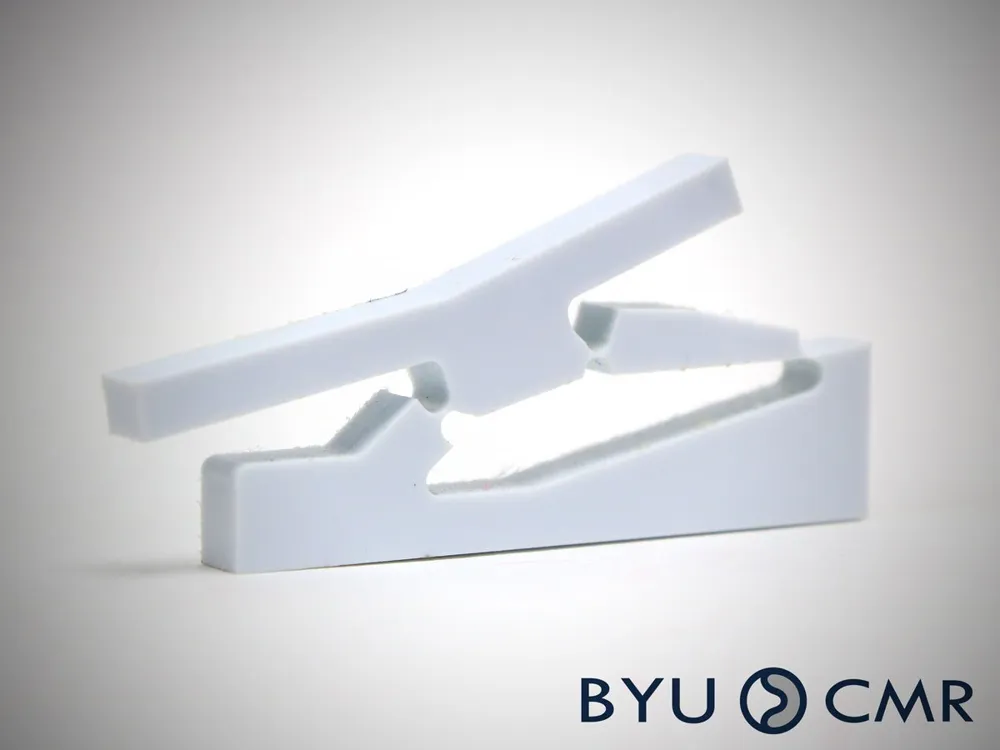
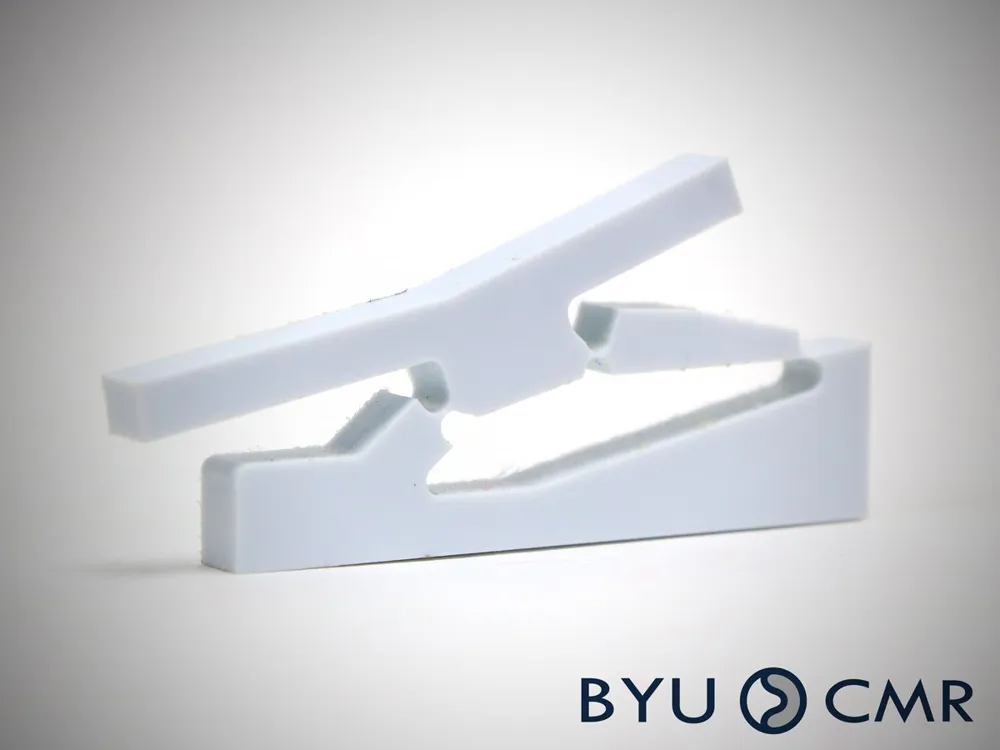
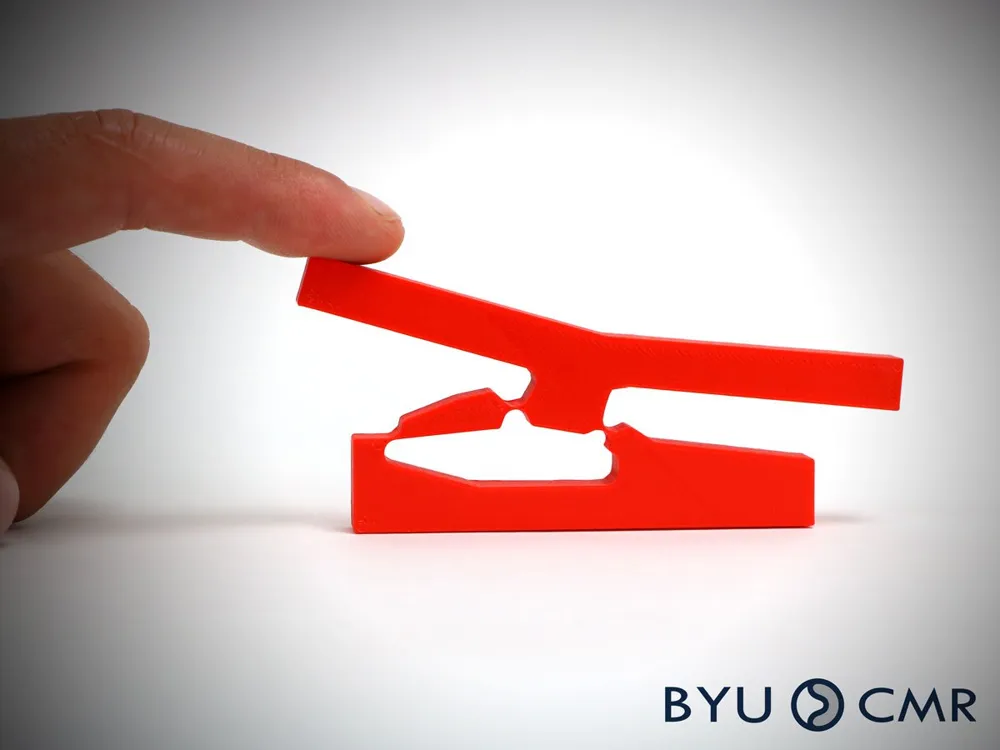
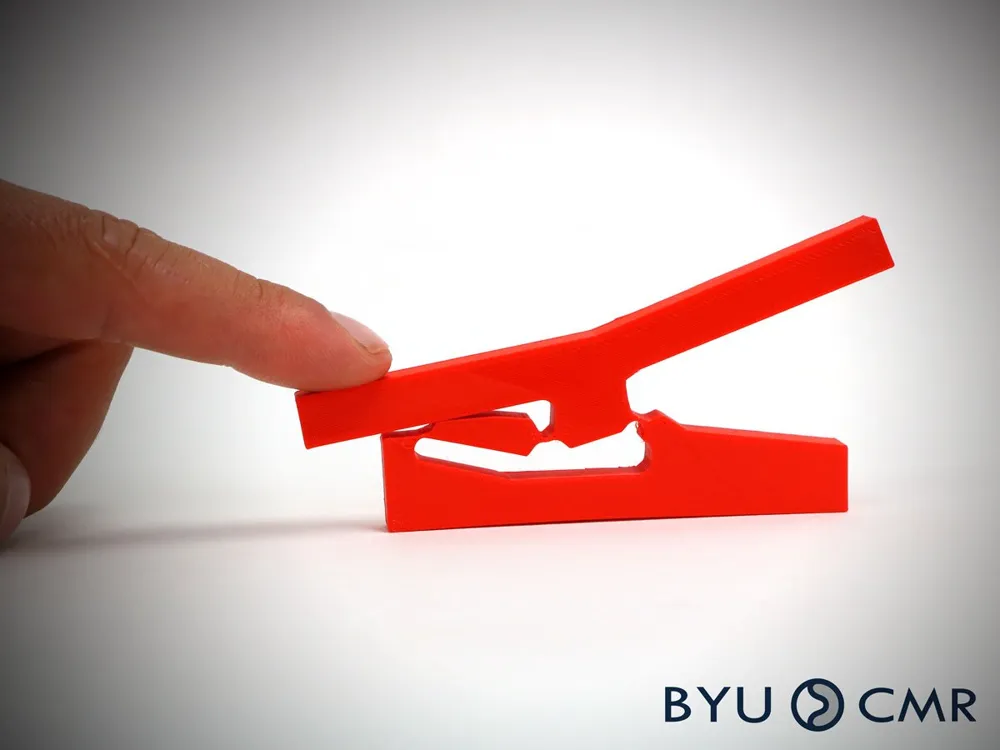
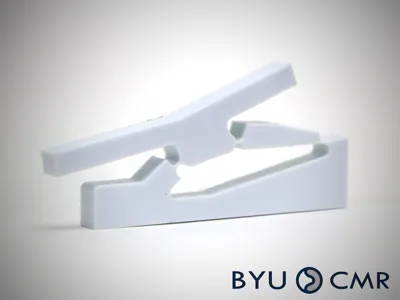
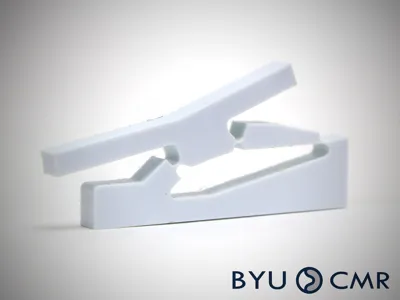
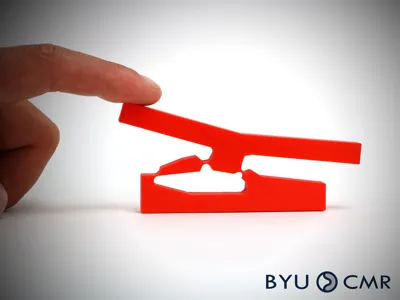
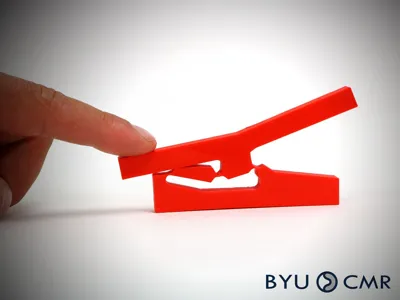
This bistable switch is an example of a compliant mechanism with a four-bar mechanism pseudo-rigid-body model. A contact force is created by causing the contacts to connect before the second stable equilibrium position is reached. Living hinges are used at the other joints. This mechanism could be used as a fully compliant electrical switch, or for other applications, such as on cabinet door hinges.
This can be 3D printed or milled. For ideal use, milling or cutting with polypropylene results in the best performance.
If 3D printing, the filament you use and its fatigue/flex properties will determine the number of cycles it can handle.
This design was developed by the Compliant Mechanisms Research Group (CMR) from Brigham Young University (BYU). Follow us at @byucmr on Instagram, @CompliantMechanismsResearchGroup on Facebook, or visit the BYU Compliant Mechanisms Research (CMR) website to learn more about compliant mechanisms.
To learn more about compliant mechanisms in general, see the following textbook resources: Compliant Mechanisms, Handbook of Compliant Mechanisms.
See our article in Nature Communications about how and why we share these maker resources.

Why use compliant mechanisms for bistable systems?
Just like any mechanism, a compliant mechanism also transfers or transforms motions, force, or energy. However, unlike rigid-linked mechanisms, it uses its own flexible members to gain mobility by storing strain energy internally, similar to potential energy stored in a deflected spring.
REDUCE PART COUNT AND COST
Using compliant mechanisms can be extremely advantageous because it reduces the number of parts required. This can make it easier, faster, and more affordable to manufacture and assemble. In the case of this compliant switch, you only need a single part to perform the task while a traditional switch may require multiple pieces such as springs, hinges, pins, etc. The compliant switch uses its own members to store energy to simulate the springs found in other switches.
REDUCE WEAR
Because of the reduced part count, there are also fewer movable joints which reduce wear and need for lubrication.
INCREASE PRECISION
It can also increase precision because backlash is reduced or even eliminated since there is no "play" or "wobble" between separate parts.
REDUCE WEIGHT
By minimizing how many separate parts are needed in the design, the overall weight can be decreased significantly. This is very beneficial for aerospace and many other applications where weight is an issue. It can also help companies save money on shipping costs on consumer products.
SIZE REDUCTION
Compliant mechanisms can easily be scaled down to miniature versions. It is impractical to create microscopic rigid body mechanisms that include pins and multiple assembly parts, because it is difficult to manufacture and assemble on such a small scale. it is more feasible to use compliant mechanisms in micro mechanisms because of the reduction of parts and joints as it reduces the need for assembly and separate part manufacturing.
For in-depth technical information, see the following publication:
Jensen, B.D. and Howell, L.L., “Identification of Compliant Pseudo-Rigid-Body Four-Link Mechanism Configurations Resulting in Bistable Behavior,” Journal of Mechanical Design, Trans. ASME, Vol. 125, No. 4, pp. 701-708, 2003.
To learn more about compliant mechanisms, see the BYU Compliant Mechanisms Research (CMR) website or these books: Compliant Mechanisms, Handbook of Compliant Mechanisms
Intellectual Property
The downloadable 3D print files provided here may be used, modified, and enjoyed for noncommercial use. To license this technology for commercial applications, contact:
BYU Technology Transfer Office
3760 Harold B. Lee Library
Brigham Young University
Provo, UT 84602
Phone: (801) 422-6266
[https://techtransfer.byu.edu/contact](https://techtransfer.byu.edu/contact)
License

You shall not share, sub-license, sell, rent, host, transfer, or distribute in any way the digital or 3D printed versions of this object, nor any other derivative work of this object in its digital or physical format (including - but not limited to - remixes of this object, and hosting on other digital platforms). The objects may not be used without permission in any way whatsoever in which you charge money, or collect fees.


Comment & Rating (23)