
Optical Illusion Spinning Disk
Print Profile(1)




Description
Optical Illusion Spinning Disk
Optical illusions are fascinating phenomena that trick our visual perception, often revealing how our brains process visual information. They occur when there's a disconnect between what our eyes see and what our brain interprets. This can happen due to the way our visual system processes stimuli, influenced by factors like color, light, patterns, or perspective.
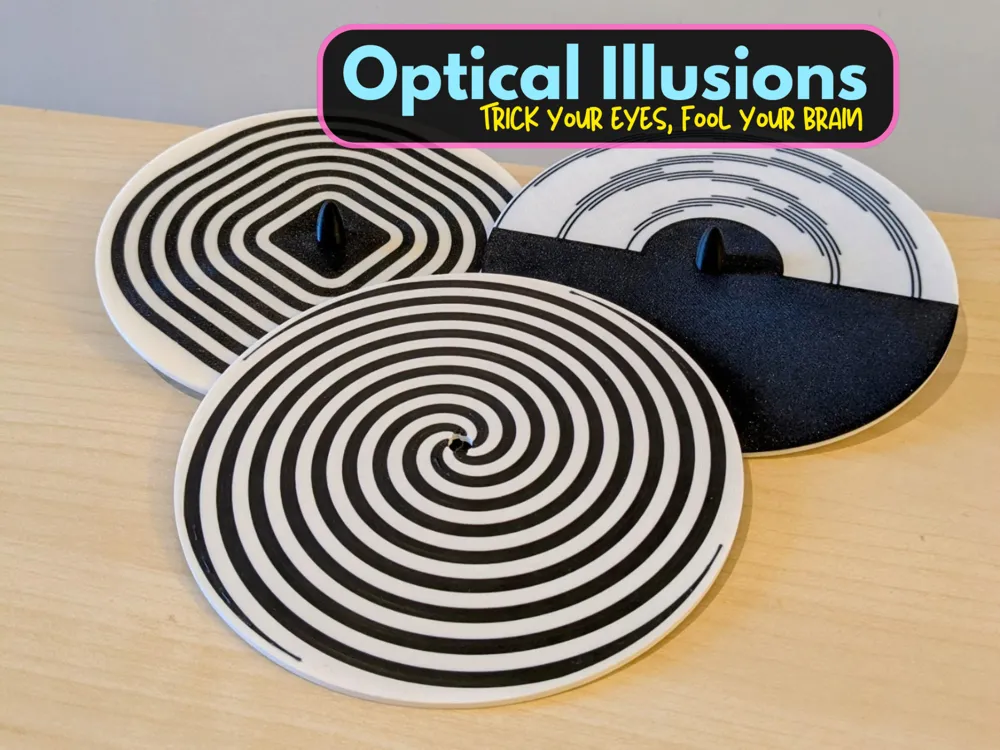
You will find 4 types of optical illusions:
- 2 Benham's disks
When spun, it can lead to the perception of colors (typically shades of yellow, green, and red) even though the disk only contains black and white. The colors appear due to differential responses of color-sensitive cones in the retina to the rapid alternation of light and dark areas. These are not real colors but rather an optical illusion known as "Fechner colors" or "Pattern-Induced Flicker Colors" (PIFCs).
The illusion of color occurs because:
- Different cones respond at different speeds to the flashing patterns.
- The persistence of response (how long each cone continues to signal after stimulation) also varies among the cone types.
This differential response leads the brain to interpret the signals as colors, even though only black and white are present on the disk. The specific colors seen can vary from person to person and may depend on the speed and direction of the spin.



- 2 Stereokinetic effect (also discovered by Benussi and studied by Mussatti)
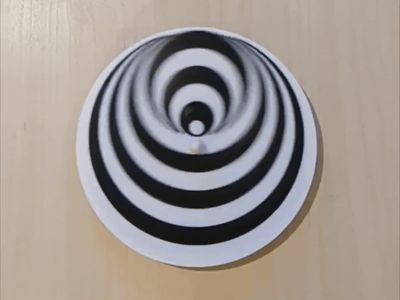
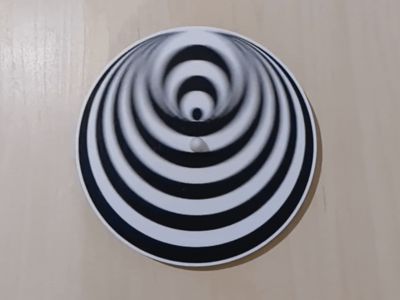
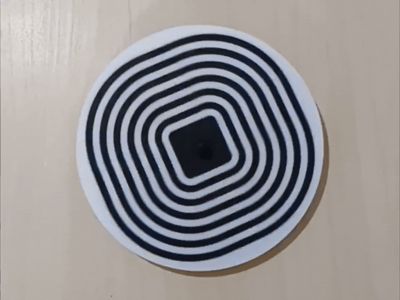
The stereokinetic effect occurs when a flat, two-dimensional figure, typically consisting of concentric circles or other geometric shapes, is rotated. This rotation causes the observer to perceive the figure as having depth, making it appear three-dimensional. This illusion is not due to stereopsis (depth perception arising from the different perspectives each eye has of a three-dimensional scene, known as binocular disparity), but rather from the motion of the figure itself.
- 1 Spiral with Motion after effect
This pattern, when spun, can create the illusion of motion where the center seems to be moving inward or outward, depending on the direction of rotation. This is known as the spiral aftereffect or peripheral drift illusion. When you stare at the spinning spiral for a while and then look at a fixed point, that point might appear to expand or contract.
- 1 Radial lines for Benussi and Musatti effects
Benussi effect: this effect typically involves a perception of motion or change in size due to the arrangement or movement of visual elements. When observing the pattern with radial lines, the brain might interpret motion even when there's none, or might perceive a change in size or direction that isn't actually occurring.
Mussatti effect: This effect deals with how we perceive transparency or layering in visual patterns. When two patterns overlap, and one moves over the other, our brain might interpret one as being transparent over the other, even if both are solid. This can lead to perceptions of depth or the illusion of one pattern moving beneath another, which isn't physically happening.
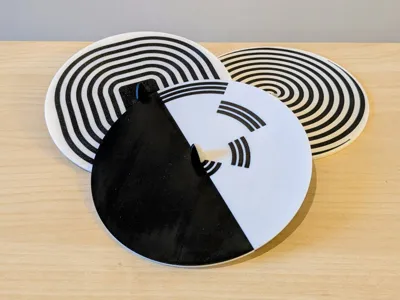
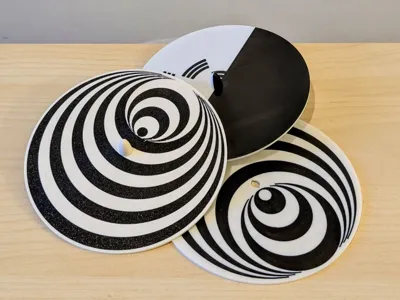
Dimensions in mm are Ø144x2.4
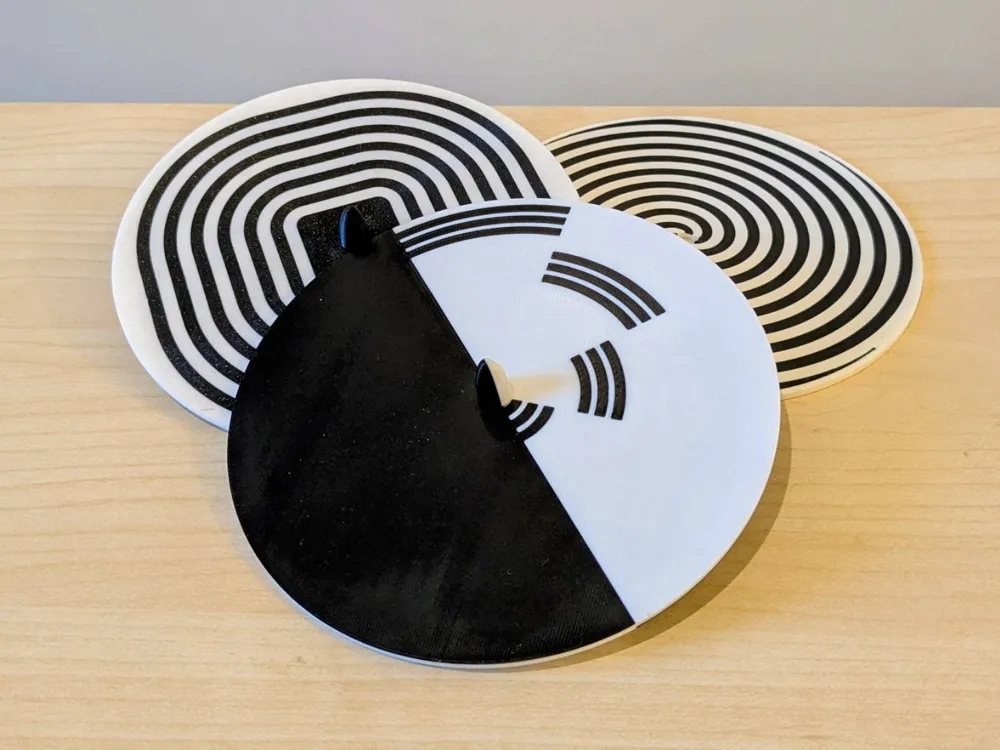
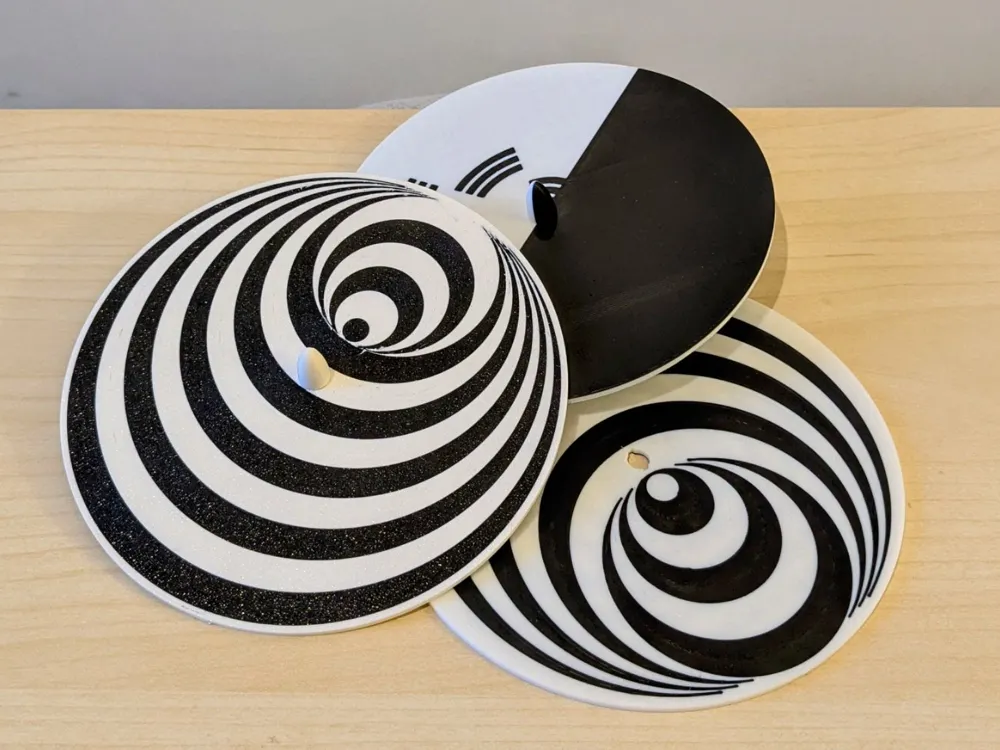
- Plate 1 contains Spiral motion after effect and Stereokinetic effect.
- Plate 2 has Benham's disk
- Plate 3 Contains the Radial lines and the second Stereokinetic Effect
Filaments I used for this print are:
- White Jade (10100)
- Black (10101)
Each plate contains their respective buttons on which the disc spins. I recommend gluing the buttons with super glue.
For the Benham’s disk and the spiral, the effects are visible once the disk is spinning.
For optimal visibility of the radial lines and the stereokinetic effect, I recommend that you record the spin with a phone’s camera with slow motion mode enabled. The effect is most visible at such low speed that the top can barely sustain spinning for long, and the camera will help show the effect from higher speed. The effect is also visible by rotating the button in between your fingers but I find it less enjoyable.
You can learn more about those effects and other here.
Boost Me (for free)
Did you like it? Rate my model and send me a boost. Trouble with the print, Leave a comment. Boost and feedback are greatly appreciated
Notes
Notes
- Includes bambu studio 3mf file.
- All photos uploaded are of the actual printed model, and are copyright protected
- If you enjoy this model please consider to buy me a coffee
- If you prefer you can send me sats instead.
License

You shall not share, sub-license, sell, rent, host, transfer, or distribute in any way the digital or 3D printed versions of this object, nor any other derivative work of this object in its digital or physical format (including - but not limited to - remixes of this object, and hosting on other digital platforms). The objects may not be used without permission in any way whatsoever in which you charge money, or collect fees.


Comment & Rating (5)