
Apollo Instrument Panel (Functional with ESP-Home)

Print Profile(1)

Bill of Materials
- KY-040 Rotary Encoder x 1: https://www.amazon.it/gp/product/B07TKK4QQD/ref=ppx_yo_dt_b_search_asin_title?ie=UTF8&psc=1
- Mini SPST Toggle Switch x 3: https://www.amazon.it/Senven®5pcs-Interruttore-Professionale-Pre-Wired-2-Position/dp/B07QLYVT4G/ref=rvi_d_sccl_2/261-4297484-3447625?pd_rd_w=0ek87&content-id=amzn1.sym.547ce61e-33fb-4876-9984-dcdd97a99f53&pf_rd_p=547ce61e-33fb-4876-9984-dcdd97a99f53&pf_rd_r=GAB5Y97Z5SQ5QKE42QN5&pd_rd_wg=Rzmzy&pd_rd_r=d1918dd6-587f-4c8b-ad62-9d94e8c7be37&pd_rd_i=B07QLYVT4G&psc=1
- D1Mini x 1:
Description
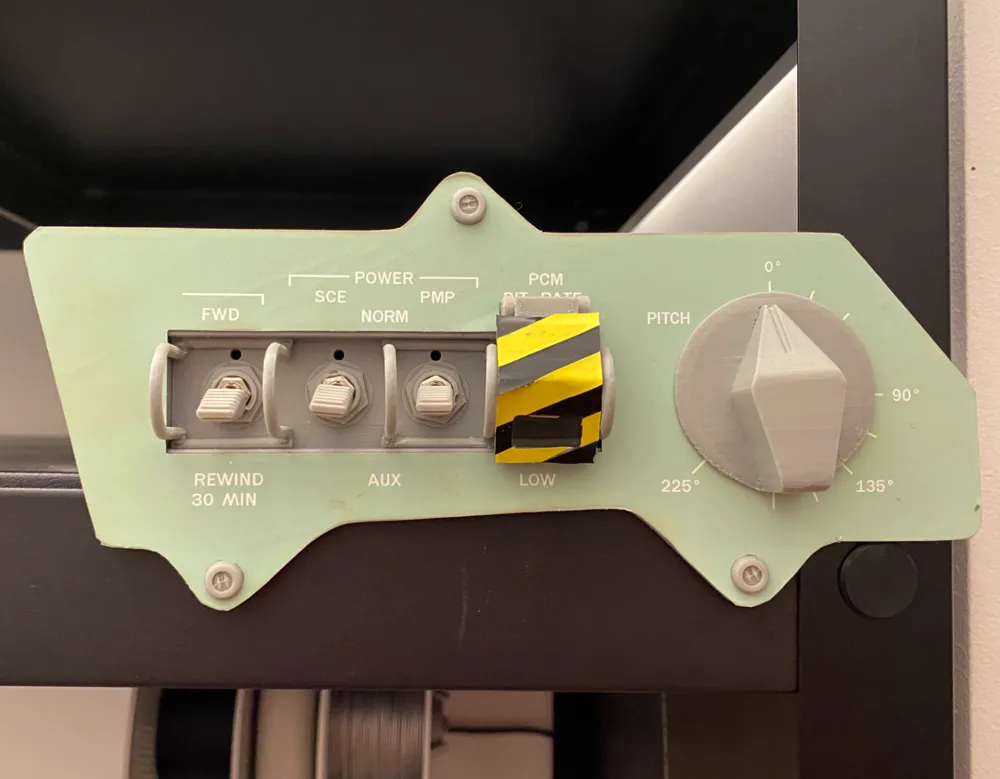

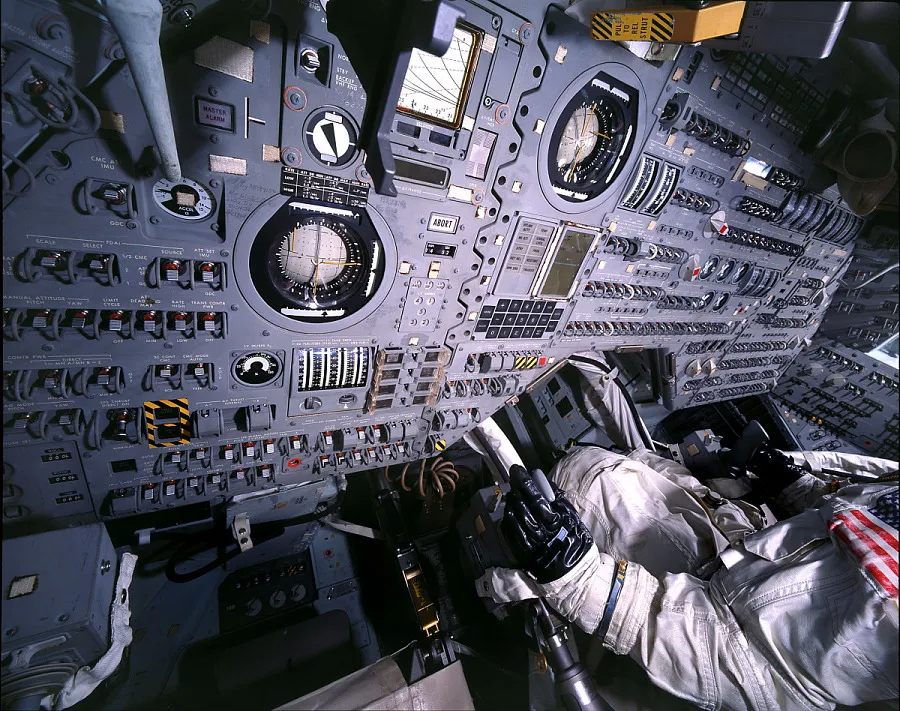
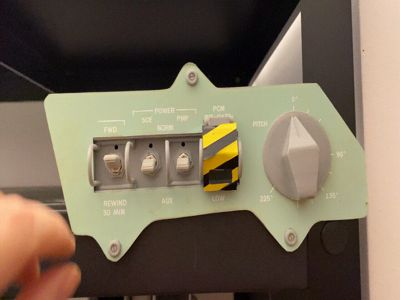
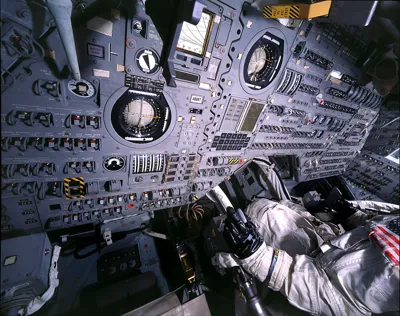
A working replica of part of the Apollo control panel.
Using a D1 mini connected to 3 mini toggle switches and a ky-040 rotary encoder, programming it through ESP-Home in Home Assistant, it is possible to use it in automations to turn lights and/or devices on or off.
A bit of history:
Launch of the APOLLO 12
Lightning struck the Saturn V 36.5 seconds after lift-off, triggered by the vehicle itself. The static discharge caused a voltage transient that knocked all three fuel cells offline, meaning the spacecraft was being powered entirely from its batteries, which could not supply enough current to meet demand. A second strike at 52 seconds knocked out the "8-ball" attitude indicator. The telemetry stream at Mission Control was garbled, but the Saturn V continued to fly normally; the strikes had not affected the Saturn V instrument unit guidance system, which functioned independently from the CSM. The astronauts unexpectedly had a board red with caution and warning lights, but could not tell exactly what was wrong.
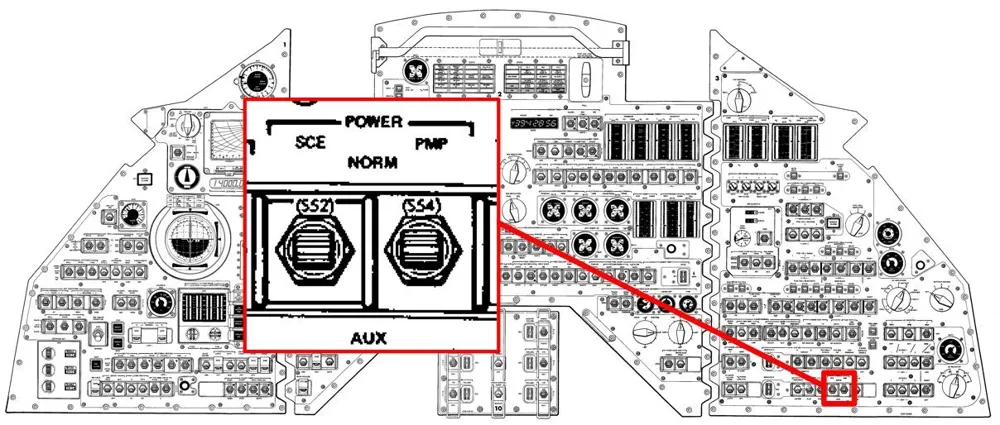
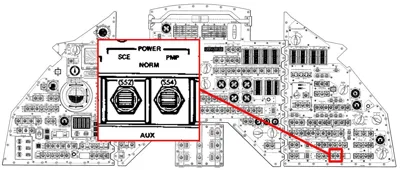
The Electrical, Environmental and Consumables Manager (EECOM) in Mission Control, John Aaron, remembered the telemetry failure pattern from an earlier test when a power loss caused a malfunction in the CSM signal conditioning electronics (SCE), which converted raw signals from instrumentation to data that could be displayed on Mission Control's consoles, and knew how to fix it.
Aaron made a call:
“Flight, EECOM. Try SCE to Aux”
The switch was fairly obscure, and neither Flight Director Gerald Griffin, CAPCOM Gerald P. Carr, nor Conrad knew what it was; Bean, who as LMP was the spacecraft's engineer, knew where to find it and threw the switch, after which the telemetry came back online, revealing no significant malfunctions. Bean put the fuel cells back online, and the mission continued.
Once in Earth parking orbit, the crew carefully checked out their spacecraft before re-igniting the S-IVB third stage for trans-lunar injection. The lightning strikes caused no serious permanent damage.
Documentation (3)


License

You shall not share, sub-license, sell, rent, host, transfer, or distribute in any way the digital or 3D printed versions of this object, nor any other derivative work of this object in its digital or physical format (including - but not limited to - remixes of this object, and hosting on other digital platforms). The objects may not be used without permission in any way whatsoever in which you charge money, or collect fees.


Comment & Rating (6)