
Mini Billard Model / Mini Pool Table Model
Print Profile(0)
Description
Hello :D
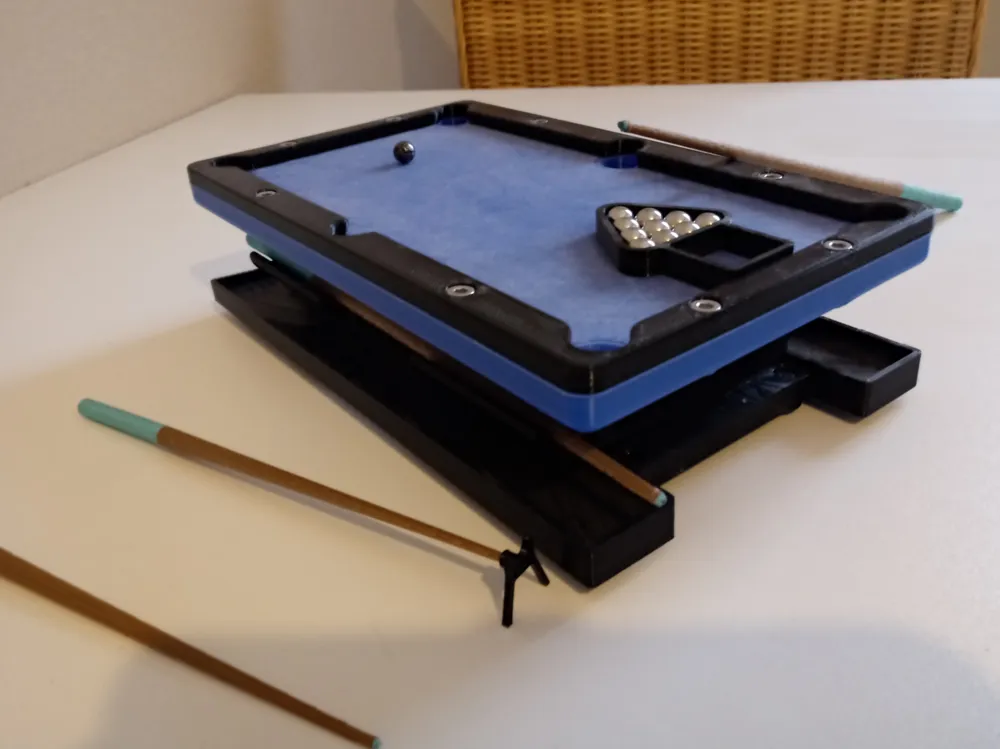
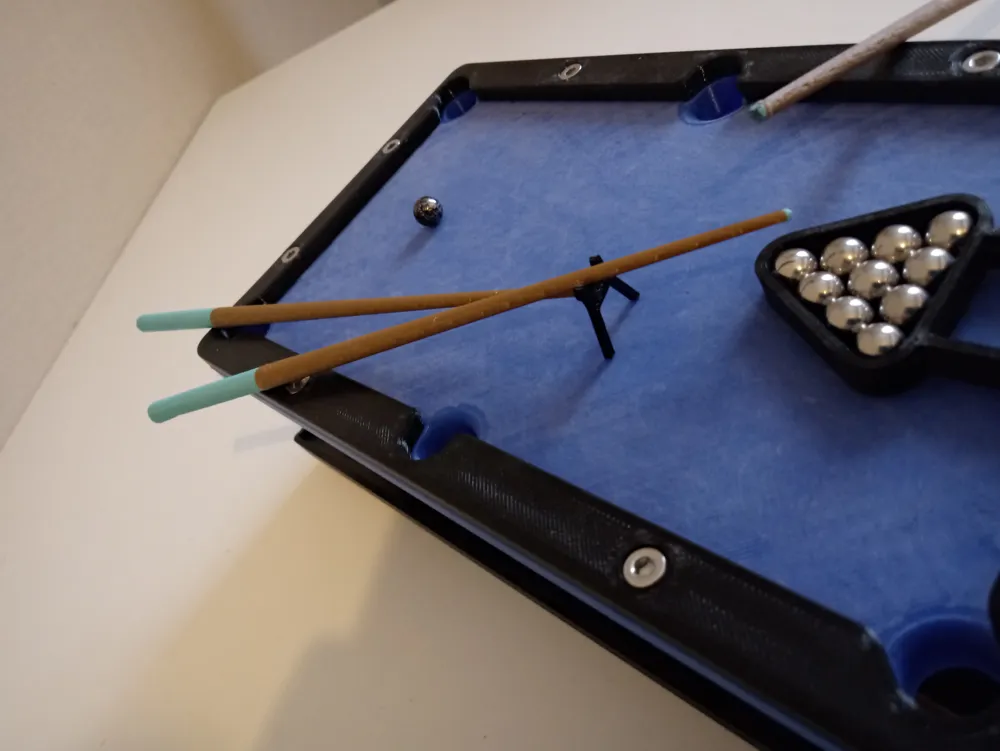
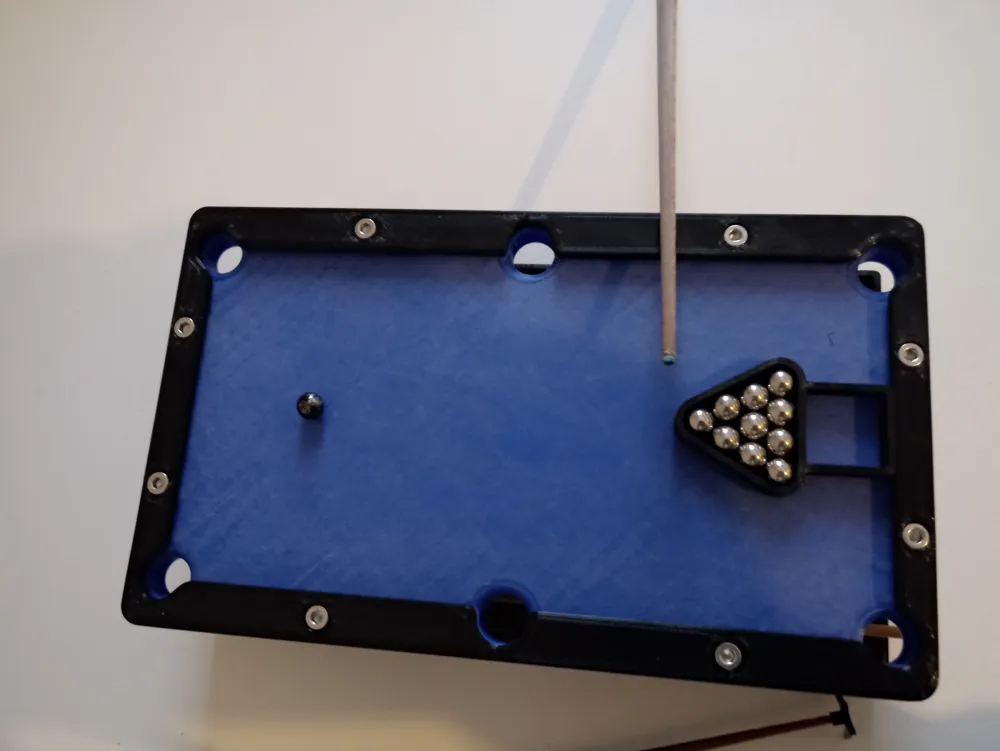
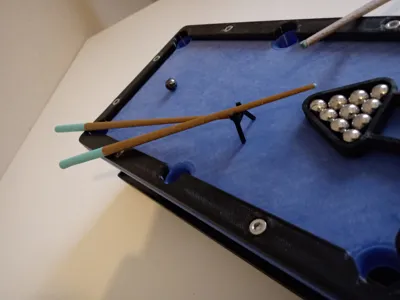
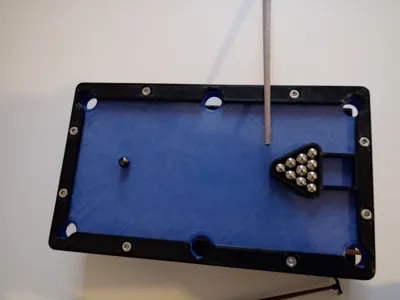
This model consists of several 3D printed parts that together form a miniature billiard table. Below you will find important printing and assembly details to achieve optimal results:
Printing Instructions:
- Warping: For main parts such as the Mini_Billard_Grundplatte_V2 and other larger components, warping should be avoided as much as possible. For this, you can use a draft shield, apply glue stick/adhesive spray to the print bed, or choose a material that is less prone to warping. An enclosed build chamber is best, of course.
- Supports: Support structures are only required for the cues.
- Material: Soft TPU is ideal for the cue grips.
- Feet (Mini_Billiard_Fus_V2): It is recommended to test the scaling of the feet in the X and Y directions. These parts are screwed into the bottom of the Mini_Billard_Basis_V2 part, however, tolerances here are highly dependent on the printer.
Assembly Instructions:
- Surface Preparation: The billiard surface of the Mini_Billard_Grundplatte_V2 part should be lightly sanded smooth for the best finish.
- Frame Assembly: The Mini_Billard_Rahmen_V2 part is screwed to the Mini_Billard_Grundplatte_V2 part with eight 10mm long M4 cylindrical screws. Alternatively, the frame can also be glued on.
- Attach Spacers: After the frame has been secured, turn the billiard table element over and attach the two spacers Mini_Billiard_Erhoehungsaufsatz_V2 (print 2x). The Mini_Billard_Basis_V2 is then placed upside down on top of it.
- Final Assembly: Now you can push four M4 x 30mm cylindrical screws through the through-holes in the spacers, which then screw into the base plate. Alternatively, everything can also be glued here.
- Attach Feet: Finally, the four Mini_Billard_Fus_V2 (print 4x) are screwed into the bottom. These are designed so that the table can be leveled if necessary.
- After screwing or gluing the main table, the Mini_Billiard_Schubfach_V2 can be inserted into the middle empty part of the table.
Cue Assembly:
- The cues are available in two versions: 170mm and 213mm. You can try both to find the length that suits you.
- To assemble the cue, simply slide the Mini_Billard_Cue_Griff_213mm part onto the cue stick part Mini_Billard_Cue_Stab_213mm.
- For the tip of the cue, it is recommended to cut a small piece of soft 1.75mm TPU filament and glue it directly to the tip. This improves grip when striking the balls.
- For an auxiliary cue, another cue with a length of 170mm must be printed. You can apply some glue to its tip and then attach the Mini_Billard_Oma_Spitze to the cue.
Recommended Balls:
For gameplay, I recommend using 11 8mm diameter ball bearing balls or stainless steel balls. Clay balls are also an option, but in my experience, they are often not perfectly round, which can affect playability.
Further Notes:
The prototype is shown in the images, but various improvements have been implemented in the provided STL files that have not yet been tested. I look forward to your feedback and experience reports!
Have fun with your self-made mini billiard table and enjoy playing!
_____________________________________________
This model consists of several 3D printed parts designed to create a miniature pool table. Below are important printing and assembly details to ensure optimal results:
Printing Considerations:
- Warping: For the main parts such as the Mini_Billard_Grundplatte_V2 and other larger components, it is important to minimize warping. To achieve this, consider using a draft shield, applying a glue stick to the print bed, and using materials that are less prone to warping.
- Supports: Only the cue sticks require support structures during printing.
- Material: The cue grips are ideal for TPU due to its flexibility.
- Foot Parts (Mini_Billiard_Fus_V2): It is recommended to test the scaling of the foot parts in the X and Y directions. These parts screw into the base of the table (Mini_Billard_Basis_V2), but the tolerances can vary depending on the printer.
Assembly Instructions:
- Surface Preparation: For the part Mini_Billard_Grundplatte_V2 (the pool table surface), it is suggested to smooth the surface with sandpaper for the best finish.
- Frame Assembly: The part Mini_Billard_Rahmen_V2 is attached to the Mini_Billard_Grundplatte_V2 using eight 10mm long M4 cylindrical screws. Alternatively, you can glue the frame onto the base.
- Adding Spacers: After securing the frame, flip the table over and attach the two spacers (Mini_Billiard_Erhoehungsaufsatz_V2) in position. Then, place the Mini_Billard_Basis_V2 on top.
- Final Assembly: Insert four M4 x 30mm cylindrical screws through the through-holes in the spacers, which will then screw into the base. Alternatively, this step can also be done using glue.
- Attaching Feet: Finally, screw in the four Mini_Billiard_Fus_V2 parts into the base. These are designed to be screwable so that you can place the table horizontal.
- After screwing or gluing the main table together, the Mini_Billiard_Schubfach_V2 can be inserted into the middle empty compartment of the table.
Cue Assembly:
- The cue sticks come in two versions: 170mm and 213mm. You can test both to see which one fits your preference.
- To assemble the cue, simply slide the Mini_Billard_Cue_Griff_213mm part onto the cue stick part Mini_Billard_Cue_Stab_213mm.
- For the tip of the cue, I recommend using a small piece of soft 1.75mm TPU filament. Cut it to size and glue it directly onto the tip. This will increase grip when striking the balls.
- For a cue stick extension, another cue of 170mm in length needs to be printed. The tip oft the cue stick should be glued, and then inserted into the Mini_Billard_Oma_Spitze.
Recommended Balls:
For gameplay, use 11 8mm diameter ball bearings or stainless steel balls. Although ceramic balls are an option, they are not always perfectly round, which can affect the gameplay.
Additional Notes:
The prototype shown in the images has been updated in the included STL files with various improvements, although these changes have not yet been tested. Feel free to provide feedback or share your experiences after printing.
Enjoy your custom mini pool table and happy playing!
License



Comment & Rating (4)