
Modular control panel

Print Profile(11)


Bill of Materials
- 10K OHM Linear Taper Potentiometer Solder Lugs Round Shaft Dia: 6.35mm x 1: https://www.taydaelectronics.com/b10k-ohm-linear-taper-potentiometer-round-shaft-solder-lugs-l.html
- MAX7219 Dot Matrix LED-displaymodule x 1:
- NeoPixel Stick - 8 x WS2812 x 1:
- 409B-M4 joystick x 1:
- LED Arcade Buttons x 1:
- mini rocker switch 10x15mm x 1:
Description
🛠️ Modular Test Case for Electronics & Prototyping
Meet your new best friend on the workbench.
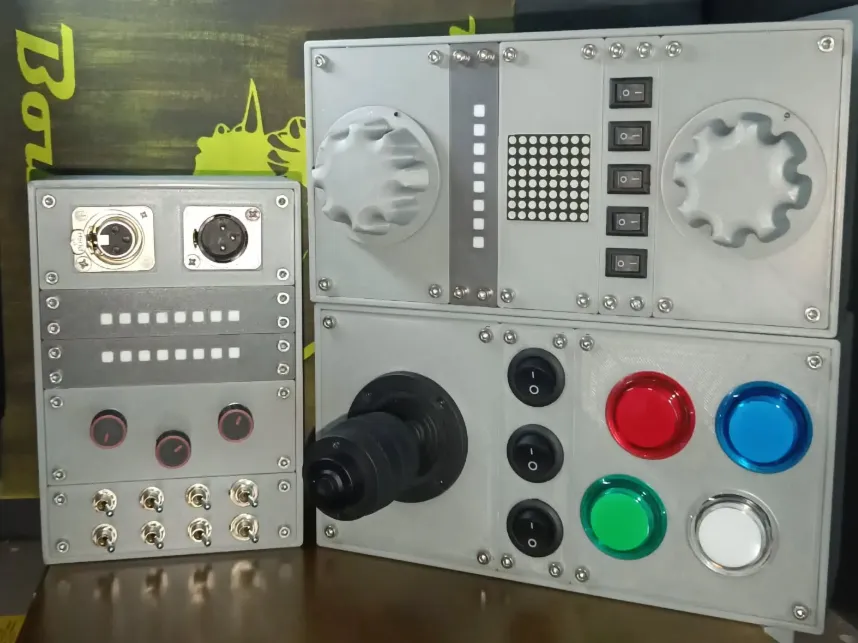
This modular test case is a flexible, 3D-printable enclosure designed for fast prototyping with a clean finish. Say goodbye to permanently drilled boxes. Now you can develop, debug, and demo your electronics projects without locking yourself into a single layout. Whether you're testing custom PCBs, working with ESP32 boards, teaching STEM, or hacking in your garage: this case has your back — and it’s built to grow with you.
🧱 Origin Story
This project started from a real classroom pain point.
Students were buying off-the-shelf enclosures and drilling holes… only to find out they'd made layout mistakes. Once drilled, there was no turning back.
We wanted something reusable, adjustable, and modular.
Now, with this case, students (and professionals) can:
- Swap out front panels to test different layouts
- Quickly iterate their designs
- Discuss layouts with teammates, teachers, or clients — visually and clearly
It’s like K'Nex for electronics enclosures.
🔌 Features
- Large rotary knobs for analog input (e.g., potentiometers, encoders)
- LED bar & dot matrix displays for output feedback
- Joystick & arcade-style buttons for UI prototyping
- Toggle switches to simulate inputs or states
- XLR connectors for test equipment interfacing
- Colored panel-mount buttons for quick signaling
- Robust 3D-printed housing with industrial aesthetics
- Swappable front panels for layout freedom
🧩 Modular & Parametric Design
This case is completely modular, so you can add, remove, or rearrange components however you like. It’s also parametric, meaning you can resize it with just a few variables.
✨ Fusion 360 vs Tinkercad — Why Both?
Originally designed in Fusion 360 for full parametric control.
But after feedback from the community, we added a Tinkercad version for accessibility and quick edits.
- 👉 Fusion 360 file: https://a360.co/3HmZ7jt
You can resize it with just a few variables:- userWidth: Width of the case (defines how many front panel slots you have)
- userDepth: Depth of the enclosure
- Panel height is fixed at 100 mm for universal compatibility
- 👉 Tinkercad parametric version: https://www.tinkercad.com/codeblocks/0s0TAbgGR4O-modular-test-case
In Tinkercad, just change the variable units:- 1 unit = 10 mm panel width
- Due to constraints of Tinkercad the max width is 19 units. For larger cases use the Fusion 360 file
- Leave other variables untouched for best results
🖨️ Print Info
- Printed on a Bambu Lab X1 Carbon
- Material: PLA
- Use M3 bolts to secure panels in place
- No glue required — but glue works fine for permanent components
🎯 Use Cases
- STEM education: electronics labs & hands-on learning
- Workshops: teach soldering, sensors, and layout logic
- Industry: prototype machine interfaces or sensor hubs
- IoT: modular dashboards and user control interfaces
- Game dev: custom controller testing setups
🚀 Built to Grow
Want to add:
- OLED displays?
- RFID readers?
- Piezo buzzers?
- Haptic motors?
This case is made for experimentation.
If you can mount it — you can make it modular.
📦 Files & Community
- 👉 Source & STL files on GitHub: https://github.com/Boutsman/ModularControlPanel
- 👉 Kanban project board: https://github.com/users/Boutsman/projects/2
Got ideas? Fork it. Remix it. Break it. Improve it.
Let’s make prototyping smoother — one test case at a time.
Documentation (1)
License



Comment & Rating (21)