
Parametric Spur Gear Generator (Multi-Hole types)
Print Profile(1)

Description
Boost Me (for free)
Please consider boosting me if it's helpful for you. It would be a great support for me.
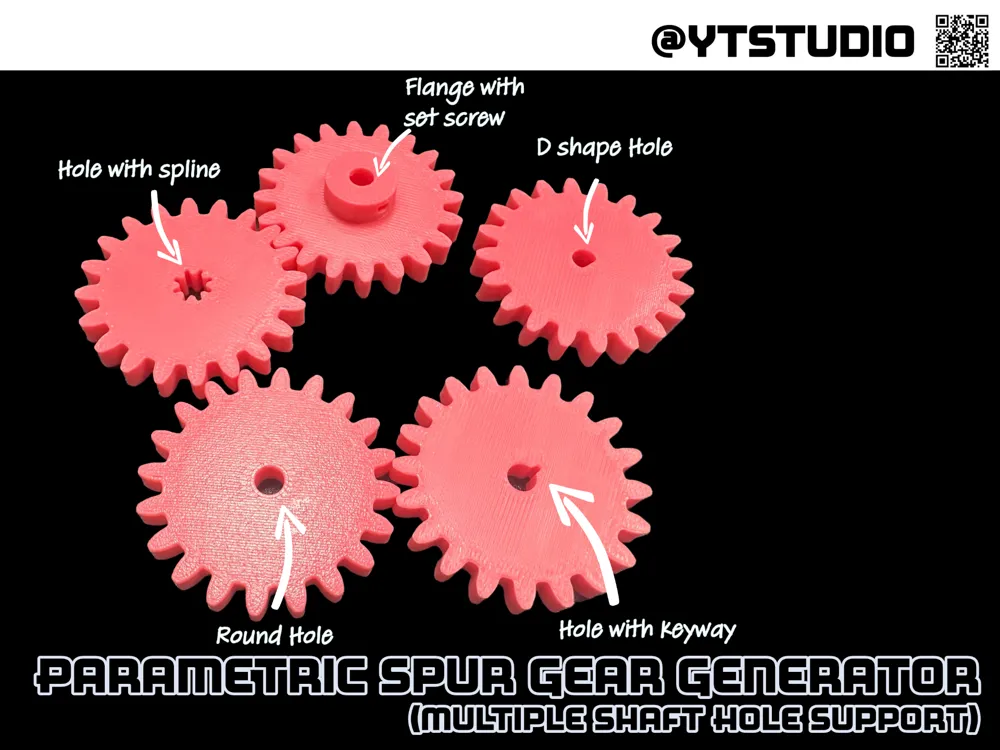
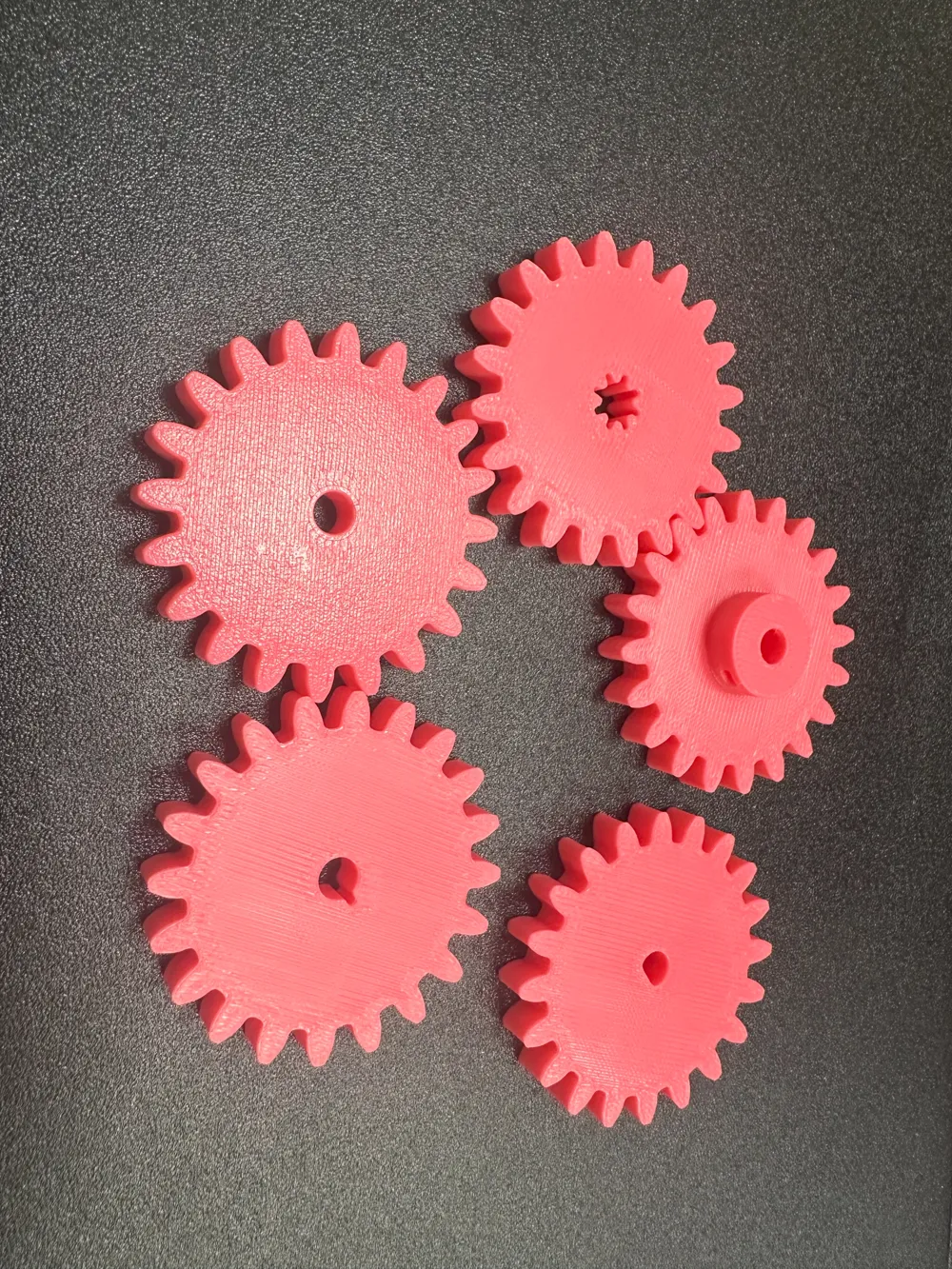
This version focuses specifically on generating Spur Gears and significantly expands the range of shaft hole options available, allowing you to more easily customize gears to fit different types of motors and components.
Supported Shaft Hole Types:
This version particularly enhances the customization of shaft holes, supporting the following common connection types:
- Round Hole: A standard cylindrical shaft hole.
- D-Hole: Suitable for shafts with a D-shaped cross-section, providing improved torque transmission.
- Keyway Hole: Designed for shafts using a key and keyway connection, capable of transmitting significant torque.
- Spline Hole: For spline shafts, offering multiple contact surfaces, stronger torque transmission capability, and better centering.
- Flange with Setscrew: Includes a flange structure for stable mounting, typically secured onto a smooth shaft using setscrews.
Design Rationale:
First and foremost, a huge thank you to Jason Koolman for developing the excellent Gear Generator - Parametric Gears & Racks by KoolmMakerWorld: Download Free 3D Models . It's been a great inspiration and a very useful tool for many creators.
However, in my own projects, which frequently involve Spur Gears and often require precise mounting onto various motors or integration with specific parts, I found a limitation in the original design. While it effectively generates gears, it primarily supports gears with round shaft holes. This is sufficient for many basic applications. Still, when needing to connect to motors with features like D-shafts, keyways, or requiring spline connections, or mounting methods like flanges with setscrews, the options were limited.
Furthermore, although MakerLab's customization feature is convenient, the output 3MF or STL file formats are not easily used for subsequent parametric modifications, especially when complex adjustments to the shaft hole shape are needed.
Based on the open-source spirit of MakerLab, I referenced Jason Koolman's original code and combined it with assistance from modern AI tools. After dedicating a few days to research and practice, I successfully modified and expanded the functionality of the original design.
Design Tip: Leveraging AI/LLM for Gear Design Assistance
When designing gear systems, it's often necessary to perform calculations (e.g., determining the center distance between two gears, selecting appropriate modules and tooth counts for a given center distance, finding standard sizes for specific shaft holes, etc.). If you are not familiar with these calculations or want to quickly verify design ideas, you can try seeking help from a Large Language Model (LLM AI), like the one you are currently using!
You can ask questions like:
- "I want to design a 3D printed gearbox system with a total gear ratio of 100:1 and a center distance of 90mm between the input and output shafts. How should I approach this? What module and number of teeth should I consider for each stage?"
- "I need to replace a broken spur gear from a plastic mechanism. It has 45 teeth and its outer diameter is roughly 69mm. It's 3D printed. How can I estimate its Module and Pitch Diameter so I can create a replacement?" (Helps with reverse engineering parameters).
- "What are the pros and cons of using a smaller Module versus a larger Module for 3D printed gears? I'm trying to decide between Module 1.0 and Module 1.5 for a gear with 30 teeth." (Helps understand the implications of parameter choices for 3D printing).
- "I'm designing a pair of 3D printed spur gears (Module 1.0, 20 teeth and 40 teeth). What's the ideal center distance? How much tolerance should I add to the center distance for 3D printing?" (Combines standard calculation with 3D printing considerations).
- "I need to design a gear with a spline bore for a specific shaft (e.g., a servo motor output shaft). What information do I need about the shaft (number of splines, pitch, etc.), and how does that translate into designing the gear bore?" (Specific to the spline shaft feature).
- "When designing a gear with a setscrew flange for 3D printing, what factors should I consider for the flange thickness, diameter, and setscrew size to ensure it holds securely on a smooth shaft?" (Specific to the flange + setscrew feature).
- "Here is a list of parameters from a 3D printable gear generator: mod, teeth, thickness, pressure_angle, shaft_diam, hellical, herringbone, backlash, clearance. What do these parameters control, and can you give me suggestions on what values to use for typical 3D printing applications?"
Boost Me (for free)
Please consider boosting me if it's helpful for you. It would be a great support for me.
This remix is based on


License



Comment & Rating (18)