Search models, users, collections, and posts
jajaum3d
@jajaum3d
3.3 k
39.3 k
87.6 k
65.5 k
Social Media Links
Bio
Hi there! I'm a 3D printing enthusiast with over a decade of hands-on experience, and my passion for this innovative technology hasn't waned a bit. My designs are born from inspiration and brought to life through extensive testing and refinement. Whether it's a whimsical fantasy piece or a practical everyday item, if an idea sparks my interest, I'll turn it into reality. I hope you'll find joy and utility in my creations, just as I do in designing them. Happy printing!
Achievements

MakerWorld Guardian
Active more than 20 days out of last 30 days UTC time

Featured Creator
5 models are featured by MakerWorld.

Popular Model
5 models more than 5,000 successful prints.

Popular Creator
More than 1,000 followers.

Pioneer Maker
Print successful 141 different models and 2,448 hours
Recent Article
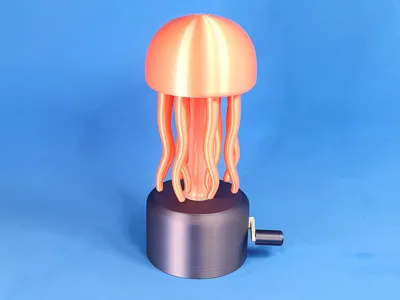
Mechanical Jellyfish from Another 3D Printing Era
Mechanical Jellyfish from Another 3D Printing EraWhen 3D printers were still… Frankenstein machinesThis mechanical jellyfish was originally created for the Printables Mechanical Marvels contest in 2022, where it ended up taking a somewhat controversial second place. Back then, the 3D printing landscape looked very different.Bambu Lab was still a Kickstarter project, just beginning to ship its first machines. Most printers in the community were closer to Frankenstein builds made from mixed parts than to the refined machines we see today. Printing successfully required a lot more work.Calibration was manual.Bed leveling was manual.Tuning profiles often meant trial and error.Users had to go through a long learning curve before reaching the kind of results that modern printers deliver almost automatically.Even the hardware constraints were very different.At the time, I was designing using a small delta printer that barely offered 150 mm of build volume, and the entire project had to be designed around those limitations. Despite that, the jellyfish worked surprisingly well and became one of my most successful mechanical models.Then a comment made me revisit the entire projectRecently, a user left this comment:“plssssss make an a1 mini version! I beg u!”For me, printing has always meant downloading the STL files, organizing them in the slicer and preparing the prints manually. But things have changed.Modern printers are dramatically easier to use, and platforms like MakerWorld allow true one-click printing through print profiles.In many ways, printers became smarter — while the workflow became simpler. And honestly, that’s a good thing.A good print profile allows the designer to define how the model should be printed, ensuring better reliability while making the process easier for everyone.That comment made me realize it was time to revisit this design.Simplifying the entire printing experienceInstead of the old workflow — long STL lists and technical slicer instructions — the model now includes a fully prepared print profile designed to work across all supported machines. The project is now organized into five print plates, which simplifies both printing and color planning.The system is flexible:2 colors already produce a good result3–4 colors create a richer look5 colors allow full separation of componentsThe goal was not to increase complexity, but to make the model easier and more accessible to print.Fixing the most common source of confusionWhile revisiting the project, I also addressed one of the most common assembly problems reported by users.The jellyfish mechanism uses two sets of components:4 internal gears and tentacles8 external gears and tentaclesThe gears must be installed in the correct positions for the mechanism to work properly.The tentacles can technically fit anywhere, but the visual effect works best when they follow the intended configuration.To make this clearer, I added direct markings on the parts:I → Internal partsO → Outer partsThis makes identification immediate during assembly.Assembly is easier than it looksEven though the mechanism looks complex, the assembly process is quite straightforward.The parts fit together mechanically, and the model can also be disassembled if needed, making the build quite forgiving.An assembly video is also included to guide the process.What should the next version be?Revisiting this design made me think about a modern version of the jellyfish.There are a few directions this could go:a motorized versionintegrated lighting effectsor possibly bothEach option changes the design quite a bit, so I'm curious: What would you prefer to see in a future version?Let me know in the comments.The updated versionAfter this revision, the project now includes:simplified instructionsa universal print profileclearer assembly guidanceimproved part identificationAnd yes — it now works perfectly with machines like the A1 Mini.I hope you enjoy printing it.