Search models, users, collections, and posts
Recommendation
Creator’s Club
Creators & Fans
Show Your Make
Off Topic
Post Details
DFRobot Gravity SFA40 Readings

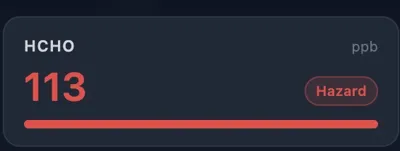
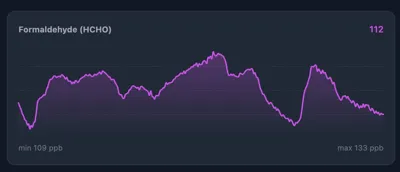
I have already received several reports about possibly incorrect SFA40 readings, so I want to collect all information in one place and understand how widespread the issue is.

We need to determine how many users are seeing consistently elevated HCHO readings. I may release a special diagnostic firmware version that will show additional data:
 

- whether the HCHO reading is ready or still warming up;
- the internal SFA40 measurement status;
- basic communication health information;
- the sensor module identifier, if available;
- the temperature and humidity measured near the SFA40;
- the direct HCHO value before it is shown in the UI.

Diagnostic beta firmware

A beta firmware build with the SFA40 diagnostic page is available here:

DFRobot Gravity SFA40: elevated HCHO readings and diagnostic reports
 

With this data, we will be able to contact DFRobot/Sensirion with specific evidence. If the issue is confirmed to be related to a module or batch, we can raise it properly with supporting data.

As I have already replied in private messages, the current driver implementation follows the standard algorithm from the Sensirion datasheet. At this point, I do not see a conversion error or a clear deviation from the documentation in the firmware. The manufacturer’s specified SFA40 accuracy is ±20 ppb or ±20%. It is also important to note that during the first up to 10 minutes after startup, readings may be unstable, but after warmup they should settle.

If you are experiencing this issue, please leave a comment here and include:

  • what stable HCHO readings you see after 15-30 minutes of operation;
  • what filament did you use to print the enclosure;
  • whether you tried placing the device near fresh air / an open window for 30 minutes;
  • whether you tried running Aura without the enclosure, to rule out plastic/glue/enclosure materials as the source;
  • whether you compared the readings with another device or another Aura unit in the same room, if possible.

This will help determine whether the issue is caused by the environment, the enclosure, a specific sensor batch, cable/power, or firmware.

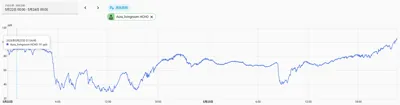
(Edited)
Share
4
41
0
Comment (41)
@Mercury1013 I’m having the same issue too, which coincides with temperature changes. Additionally, the temperature is 2°C higher than normal.I'm going to try switching to another room.
2
Reply
@Dezran I realize it was a month ago, but this is exactly what I'm seeing too. In the morning, the readings are pretty much normal, around ~40ppb. In the summer, the room I have it in gets warmer in the afternoon due to the sun coming straight through the windows from ~1pm until just before sunset. By that time, the readings are well above normal at ~100ppb
0
Reply
@lutzelodeon Q: what stable HCHO readings you see after 15-30 minutes of operation A: ~120ppb Q: what filament did you use to print the enclosure; A: White PETG HF, Bambulab, printed some weeks ago Q: whether you tried placing the device near fresh air / an open window for 30 minutes; A: Yes, near an open window. Readings dropped to ~66ppb Q: whether you tried running Aura without the enclosure, to rule out plastic/glue/enclosure materials as the source; A: No, I haven't Q: whether you compared the readings with another device or another Aura unit in the same room, if possible. A: Not possible
poster
1
Reply
@jakecovert +1 Q: what stable HCHO readings you see after 15-30 minutes of operation: A: ~90-100. Just enough to be red 1/2 the time. Q: what filament did you use to print the enclosure; A: PLA white / black. Unsure of vendor, tbh Q: whether you tried placing the device near fresh air / an open window for 30 minutes; A: Yes, drops to a floor of ~50-ish. But "most" anywhere where there's isn't super fresh air, it's 80-100. Q: whether you tried running Aura without the enclosure, to rule out plastic/glue/enclosure materials as the source; A: No. I haven't. Q: whether you compared the readings with another device or another Aura unit in the same room, if possible. A: Not poss
poster
1
Reply
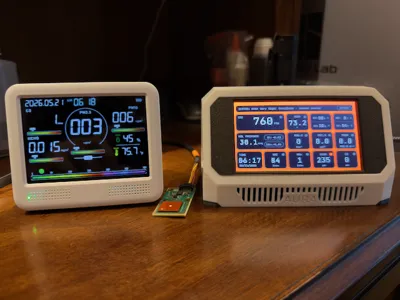
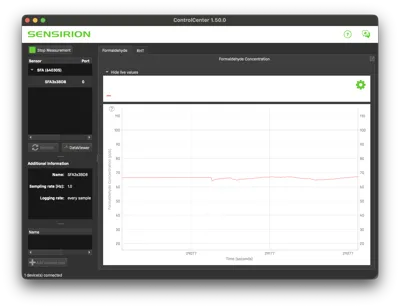
@JovianV I also believe that the SFA40 sensor is not working correctly. I am getting over 200 Here's the details: SFA40 - 235 ppb. (.288 mg/m3 using google) SFA30 - 67 ppb AK23 - .015 mg/m3 (12.2 ppb) Enclosure printed in Bambu PLA Basic and font side pieces in Bambu PLA Metal.
The poster has replied
1
Reply
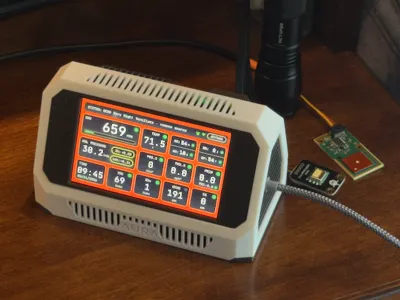
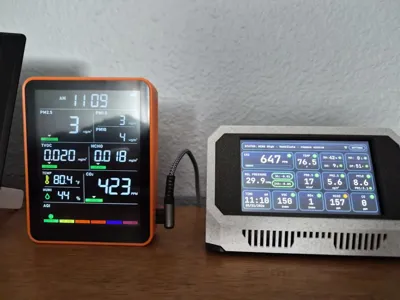
@JovianV @21CNCStudio : I moved the sensor outside the housing. Not as high as before, but I have noticed that the values trend upward, slowly, for a while after start. This has been running for about 90 minutes. The SFA30 is reading about 65 ppb when the photo was taken.
0
Reply
@21CNCStudio This is a great comparison — with both the SFA30 and the AK23 showing much lower readings, it does look like a faulty SFA40.
0
Reply
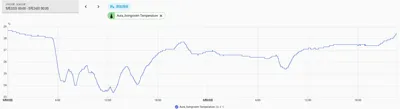
@user_3460015963 Stable indoor HCHO after 20+ min: see attached, including readings over the last 24 hours Filament: Most enclosure = Bambu Lab PLA Matte, Sensirion SEN66 mounting bracket = Sunlu transparent PETG Using original enclosure Fresh air / open window test: Haven't tried. Located in main living area. No-enclosure test: Haven't tried Setup: [classic modules, 4.3" ] Planning to load diagnostic firmware Happy to run any other tests.
0
Reply
@lscottmunoz Q: what stable HCHO readings you see after 15-30 minutes of operation A: ~130ppb Q: what filament did you use to print the enclosure; A: 2 shades of green and a black, all Sunlu PLA printed several weeks ago. Q: whether you tried placing the device near fresh air / an open window for 30 minutes; A: No, I haven't Q: whether you tried running Aura without the enclosure, to rule out plastic/glue/enclosure materials as the source; A: No, I haven't Q: whether you compared the readings with another device or another Aura unit in the same room, if possible. A: No other device to compare to
The poster has replied
0
Reply
@21CNCStudio Please add report to the GitHub issue here: https://github.com/21cncstudio/project_aura/issues/113
0
Reply
@Dezran I've been running mine for a couple days at this point, and I'm seeing a baseline throughout the house of ~60-65ppb. I let it sit in each room for 30 minutes. Q: what stable HCHO readings you see after 15-30 minutes of operation A: With nothing printing: Indoors: 65-75ppb, Outdoor: 40-45ppb While printing PLA in the room, 5-10 feet from the printer, ~100ppb Q: what filament did you use to print the enclosure; A: Panchroma PLA Galaxy Dark Blue & Eryone Liquid Gold Silk PLA Q: whether you tried placing the device near fresh air / an open window for 30 minutes; A: Yes By an open window, dropped to ~80ppb Out on my back deck with a good breeze, dropped to ~40-45ppb Q: whether you tried running Aura without the enclosure, to rule out plastic/glue/enclosure materials as the source; A: Not yet Q: whether you compared the readings with another device or another Aura unit in the same room, if possible. A: Nothing to compare with.
The poster has replied
0
Reply
@21CNCStudio Please add report to the GitHub issue here: https://github.com/21cncstudio/project_aura/issues/113
0
Reply
@Dezran Quick update. I left it outside for a few hours. Nice clear day with a breeze, and the level never dropped below 38. Not nearly as far off as some, but outside on a clear day, it should be registering lower than that.
0
Reply
@buildintechie Q: what stable HCHO readings you see after 15-30 minutes of operation A: Levels staying around 220-240. Q: what filament did you use to print the enclosure; A: Black and White Bambulab PLA. I printed the whole enclosure a couple months ago, printed the HCHO bracket about a month and a half ago, but my chip was delayed awhile and only got a couple weeks ago. , printed some weeks ago Q: whether you tried placing the device near fresh air / an open window for 30 minutes; A: Yes, placed outside in a screened in porch about 90ppb Q: whether you tried running Aura without the enclosure, to rule out plastic/glue/enclosure materials as the source; A: Yes, no change. Q: whether you compared the readings with another device or another Aura unit in the same room, if possible. A: Don't have another device.
The poster has replied
0
Reply
@21CNCStudio Please leave your report on GitHub. Link in the comments.
0
Reply
@user_1499151331 Same here getting a reading anywhere from 150 to 190, outside about 60, next to open window 80. I have just placed a small fan next to Aura to force air movement and it now reads 75
The poster has replied
0
Reply
@user_1378866658 Q: what filament did you use to print the enclosure; A: Bambu PLA Marble, Bambu PLA Matte Q: whether you tried placing the device near fresh air / an open window for 30 minutes; A: Yes, at an open window. The HCHO drops down to less than 20ppb. But it quickly ramps up to well over 100 when moved away from the window. Q: whether you tried running Aura without the enclosure, to rule out plastic/glue/enclosure materials as the source; A: No, I haven't Q: whether you compared the readings with another device or another Aura unit in the same room, if possible. A: Yes. With two2 Auras the HCHO reading were with 10% of each other. I also compared it to an AQItech "Professional Indoor Air Quality Monitor". Multiplying the mg/m3 reading by 814 converts it to ppb. Given that, the AQItech is consistently displaying HCHO in the range of 16-18ppb while the Aura next to it is displaying over 150ppb. To me it seems that the Aura's response to HCHO isn't linear and seems to ramp up too fast.
0
Reply
Trend
PrintClinic
Hideandseekchallenge
1
the Great Benchy Nations
2.9 k
2
Theprintertribes
2.7 k
3
Questions
1.5 k
4
Renew MakerWorld
1.2 k
5
Newmodel
837
6
Revivemakerworld
824
7
Stopnsfw
771
8
Contests
720