
Black Hole Accretion Disk - M87* (Meisier 87)


Print Profile(1)

Description
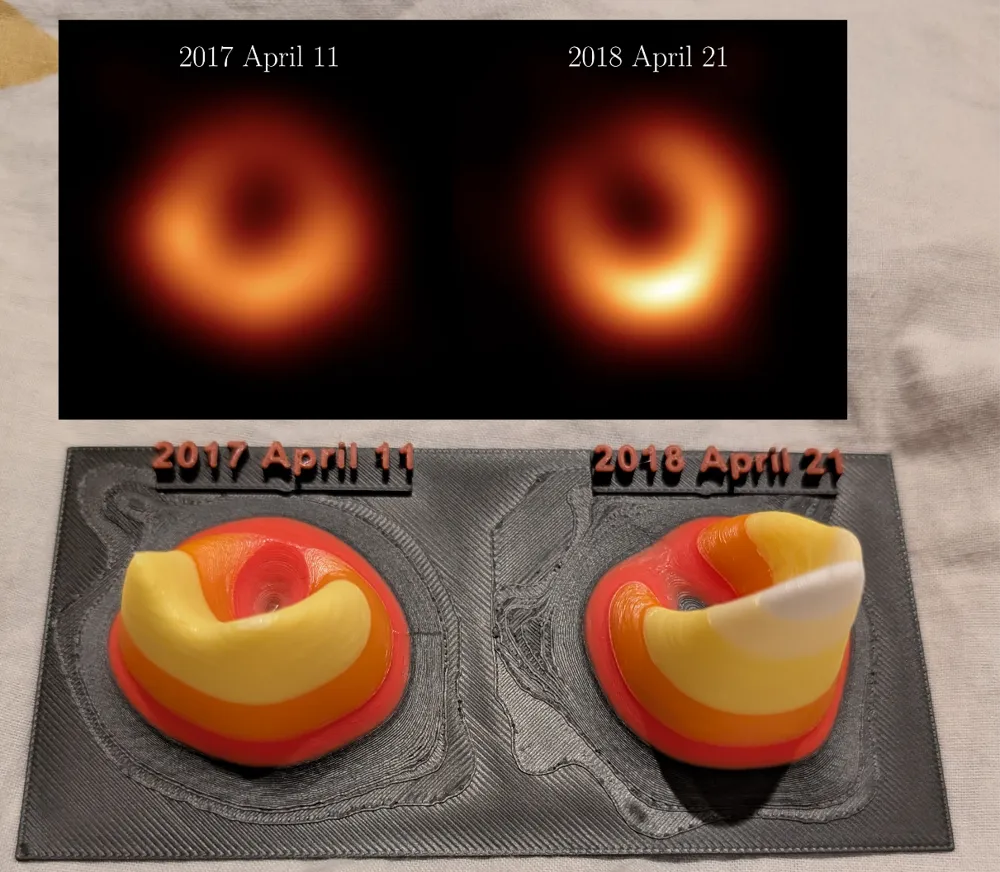
Description of the 3D Model: The Evolution of M87 Black Hole Imagery*
This 3D model is a representation of the two iconic images of M87*, the supermassive black hole located at the center of the galaxy Messier 87. The original images were produced using observational data from the Event Horizon Telescope (EHT) in April 2017 and April 2018, respectively. The model captures the distinct features of M87* as revealed in these groundbreaking scientific achievements and provides a comprehensive educational tool to visualize and understand black hole physics.
Key Features of the 3D Model
- The 2017 Image Representation:
- The model replicates the first-ever black hole image released on April 10, 2019, showing a luminous, crescent-shaped ring of emission surrounding a central dark region (the black hole’s shadow).
- The asymmetry in brightness of the ring reflects the relativistic effects of gas orbiting at near-light speeds, with the brighter region caused by Doppler beaming.
- The 2018 Image Representation:
- This part of the model illustrates the refined observations, released on January 18, 2024, which revealed dynamic changes in the bright region of the ring over time.
- The structure remains consistent in size, reaffirming the predictions of Einstein’s general relativity, but highlights shifts in the gas dynamics around the event horizon.
- Accurate Depiction of the Event Horizon and Shadow:
- The model includes the central dark area, corresponding to the shadow of the black hole, which results from the extreme bending of light and the capture of photons by the event horizon.
- Visualized Relativistic Effects:
- Light bending, gravitational redshift, and relativistic beaming effects are vividly incorporated into the 3D model to emphasize the extreme physical conditions near a black hole.
Process Behind the Creation of the Original Images
- Observations with the Event Horizon Telescope (EHT):
- The EHT is a global network of radio telescopes that utilizes Very Long Baseline Interferometry (VLBI). This technique synchronizes observatories around the world to act as a virtual Earth-sized telescope.
- Observations of M87* were conducted in April 2017 and April 2018, collecting petabytes of data from participating telescopes.
- Data Processing and Imaging:
- The raw data were processed using advanced computational techniques to combine signals from all telescopes, yielding the unprecedented resolution needed to image the black hole.
- Algorithms reconstructed the image by analyzing the interference patterns of the radio waves emitted by the superheated plasma surrounding the black hole.
- Collaborative Effort:
- Over 200 scientists from around the globe collaborated to ensure the accuracy and integrity of the data and analysis.
Black Hole Physics Explained
- What is a Black Hole?
- A black hole is a region of spacetime where gravity is so strong that nothing, not even light, can escape. Its boundary, called the event horizon, marks the point of no return.
- The Shadow and the Event Horizon:
- The shadow is not the black hole itself but a silhouette created by the bending of light around the event horizon.
- Photons (light particles) orbit the black hole in a region known as the photon ring, contributing to the bright ring observed in the images.
- Accretion Disk and Plasma Dynamics:
- Surrounding the black hole is an accretion disk of superheated gas and plasma. The material spirals inward due to intense gravitational forces, emitting electromagnetic radiation detectable by telescopes.
- The observed asymmetry in the brightness of the ring is caused by the relativistic motion of the gas, where the side moving toward the observer appears brighter due to Doppler beaming.
- Relativity at Work:
- The images provide a real-world test of Einstein’s theory of general relativity, demonstrating how massive objects warp spacetime and influence the path of light.
Educational Value of the 3D Model
This 3D model offers:
- Scientific Insight: A tangible way to visualize the extreme environments near a supermassive black hole.
- Dynamic Evolution: A clear comparison of the changes observed between the 2017 and 2018 data.
- Gravitational Physics: An intuitive understanding of concepts like light bending, event horizons, and accretion dynamics.
References
- Event Horizon Telescope Collaboration. (2019). "First M87 Event Horizon Telescope Results. I. The Shadow of the Supermassive Black Hole." The Astrophysical Journal Letters.
- Event Horizon Telescope Collaboration. (2024). "Refined Observations of M87*: Revealing Dynamic Plasma Motion." Press Release and Journal Publication.
- Einstein, A. (1916). "The Foundation of the General Theory of Relativity." Annalen der Physik.
- National Science Foundation. "Event Horizon Telescope: Imaging a Black Hole." Available at: https://www.nsf.gov/news/.
- Harvard-Smithsonian Center for Astrophysics. "Understanding Black Holes with the EHT."
License

You shall not share, sub-license, sell, rent, host, transfer, or distribute in any way the digital or 3D printed versions of this object, nor any other derivative work of this object in its digital or physical format (including - but not limited to - remixes of this object, and hosting on other digital platforms). The objects may not be used without permission in any way whatsoever in which you charge money, or collect fees.


Comment & Rating (1)