
MEXICAN TRAIN GAME - Bookcase Edition
Print Profile(1)
Description
MEXICAN TRAIN BOOKCASE EDITION
VERSION 1 - Traditional Dominoes with dots.
For version 2 with numerals see: Mexican Train (Numerals)
Mexican Train is an extremely popular domino game that’s easy to learn and fun to play. Each player is dealt an equal amount of dominoes and the goal to try to get rid of as many dominoes as possible and have the lowest score based on the dominoes remaining.
The fully 3D Printed game is complete with all playing pieces, game board and bookcase style box to be stored on a shelf.
Information
All parts were printed with PLA filament. I use a textured plate for adhesion. Some parts will need to be superglued, for example, the book spines are glued to the square cornered side of the bookcase box.
Countless hours have gone into the collection and I hope to continue to expand the collection based on continued interest. Some of the games are long and large prints.
How to Play Mexican Train Dominos
| Mexican Train is an extremely popular domino game that’s easy to learn and fun to play. Each player is dealt an equal amount of dominoes and the goal to try to get rid of as many dominoes as possible and have the lowest score based on the dominoes remaining. |
Equipment
• 1 Train Hub - Round centerpiece placed in the middle of the table
• 8 Train Tokens - Markers
• 91 Double 12 Dominoes - A double 12 dominoes set consisting of all possible pairs of numbers or dots known as “pips” from 0 to 12
• Scorepad - For tracking points for each round
Starting off Rounds
Mexican train is played in 13 rounds, each round established by the “engine”, a domino which is placed in the center of the train hub. The engine in the first round is the double 12 domino.
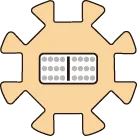
The subsequent round’s engine is the next highest double, double 11, and the following round double 10, and so on all the way to double 0.
Each player draws a set of dominoes from a shuffled faced down pile to create their “hand”, making sure the domino values are concealed from their opponents. The number of dominoes each player draws varies with the number of players.
- 2-4 players draw 15 dominoes each
- 5-6 players draw 12 dominoes each
- 7-8 players draw 11 dominoes each
The leftover dominoes are placed on the side and known as the “boneyard”.
The player with the engine for that round places it in the center of the hub. He is the starting player for that round. If no one has the required engine then each player simultaneously draws a domino from the boneyard until it is found and a starting player is determined.
Gameplay
First turn
Beginning with the starting player and continuing clockwise, a domino or string of dominoes known as the player’s “train” is built coming out of the train hub towards the player. This train must have an end matching the engine in the center of the train hub. For example, if the engine in the train hub is a double 12, the train must begin with a 12 on the starting end. The train can be any amount of dominoes so long as each domino in the train has a matching end to the adjacent domino.
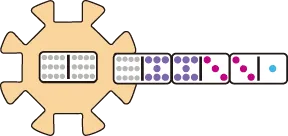
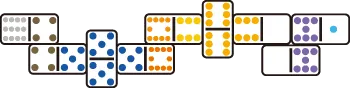
Dominoes with identical ends can be placed parallel to each other to save space so long as they don’t block anybody else’s train. This is known as “bending” the train and is entirely optional. If there is a “double” (a tile with an equal amount of pips or same number on both ends) on the train, it is placed perpendicular to the adjacent domino.
If a player does not have a domino that matches the engine to create a train, a train token is placed at the point in the hub marking where their train would have extended out. This train token marks this spot as a “public” train.
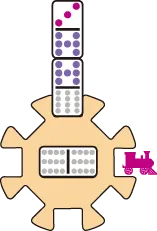
Note: If a player ends their train in a double on the first turn, everyone continues finishing their first turn according to the rules. However, on the second turn players must “satisfy” the double (as explained in the Playing Doubles section) before any other type of play can be made.
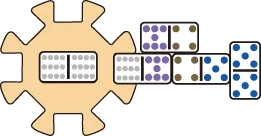
Public Trains
A train that is marked with a train token is public and any player can add to that train after it is marked, except during the first turn. A train that is not marked is “private” and only the player who started that train can add to it. A player who has marked their train public may change their train back to a private train and remove the marker in subsequent turns if they are able to play a matching end.
Subsequent Turns
After everyone has played their first turn, starting with the first player, each player adds to their train or a public train from their hand. Unlike the first turn, players can only add one domino at a time.
If the player is unable to add a domino, the player must draw a domino from the boneyard and play that domino immediately if he is able to. If not, he must mark their train public. At any point in the game, if there are no more tiles in the boneyard to draw, the player simply marks their train public.
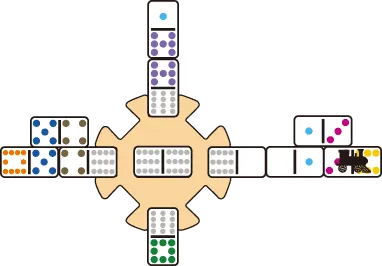
Playing Doubles
If a player plays a “double”, the double must be placed perpendicular to the train played on. The player must then immediately play another domino from their hand on to the double thus “satisfying the double”, or on to any public trains.
If the player is unable to play another domino, he must draw from the boneyard and play that domino on to the double or on to any public trains. If he is unable to do so, then he must mark their train public.
If the player draws a second double and is able to play it, he must draw another domino from the boneyard and play that as well. This repeats if the player continues to draw playable doubles until the player has drawn and played a non-double, or fails to play a drawn tile. If he fails to play a drawn tile, in the end, he must mark their train public.
If the player finishes their turn without satisfying the double, the following player has the obligation to satisfy that double. If that player is unable to satisfy the double from their hand, he must draw from the boneyard and satisfy the double with that domino. If he is unable to, the player marks their own train public and then the obligation to satisfy the double continues on the following players according to the same rules.
If more than one double needs to be satisfied, then they need to be satisfied in the order they appeared in play.
Mexican Train
A special “Mexican Train” may be started by any player with a domino from their hand that has a matching end with the engine. It extends out of the engine and is always marked public and never becomes private. It remains separate from all personal trains.
The Mexican Train may be started on any turn except the first turn, or on a turn where a double needs to be satisfied.
Only one Mexican Train may be created for any round.
Scoring
A round ends when one player has played their last tile or when nobody has a playable tile and the boneyard is empty.
Each player’s score is tallied by adding up all the pips or numbers on their remaining tiles. A double-blank tile is worth 50 points.
At the end of the final round the person with the least amount of total points for all the rounds is declared the winner. If there is a tie, the person with the most zero point rounds is the winner. If there is still a tie after that, then the person with the lowest point round other than zero wins.
MORE GREAT MODELS FROM RITZ
Check out the BOOKCASE EDITION GAME COLLECTION
There you will find the Bookcase Edition of great 3D print board games. Each game is different and very unique and complete with all playing pieces, game board and a bookcase style box that can be stored on a shelf. Enjoy!

DEDICATION
The Bookcase Edition is dedicated to my friend Don, as the Old Guys Gang continue to play boardgames in his memory even though his seat is empty now.

Boost Me (for free)
If you enjoy my work, please LIKE, FOLLOW, and help BOOST my profile! Your support means a lot and helps me create more great board games and models for you. Thank you!
License

You shall not share, sub-license, sell, rent, host, transfer, or distribute in any way the digital or 3D printed versions of this object, nor any other derivative work of this object in its digital or physical format (including - but not limited to - remixes of this object, and hosting on other digital platforms). The objects may not be used without permission in any way whatsoever in which you charge money, or collect fees.


Comment & Rating (108)