
Cellular Automata Rule 30 Wall Art

Print Profile(1)

Description
Cellular automata (CA) are discrete, computational models that consist of a grid of cells, each of which can be in one of a finite number of states. The state of each cell evolves over discrete time steps according to a set of rules that depend on the states of neighboring cells. Cellular automata were first introduced by mathematicians Stanislaw Ulam and John von Neumann in the 1940s, and they have since become a fundamental concept in the study of complex systems and computation.
Rule 30 in cellular automata is one of the elementary cellular automata rules introduced by Stephen Wolfram. Rule 30 operates on a one-dimensional binary array and determines the state of each cell based on its current state and the state of its two immediate neighbors.
The rule is defined by the following pattern:
- If the triplet of a cell and its two neighbors is 111, 110, 101, or 000, the new state of the cell is 0.
- If the triplet is 100, 011, 010, or 001, the new state of the cell is 1.
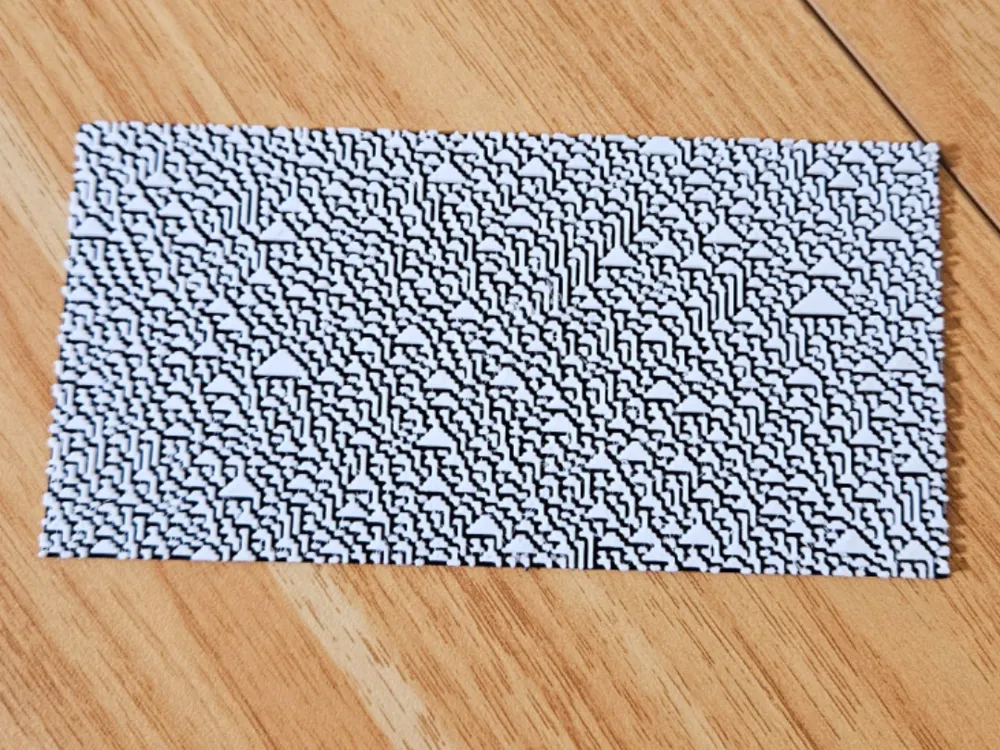
Rule 30 is notable for generating complex, seemingly random patterns despite its simple deterministic rules, and it's often used as an example of how simple rules can lead to complex behavior. It has applications in random number generation and has been studied extensively in the context of chaos theory and complexity.
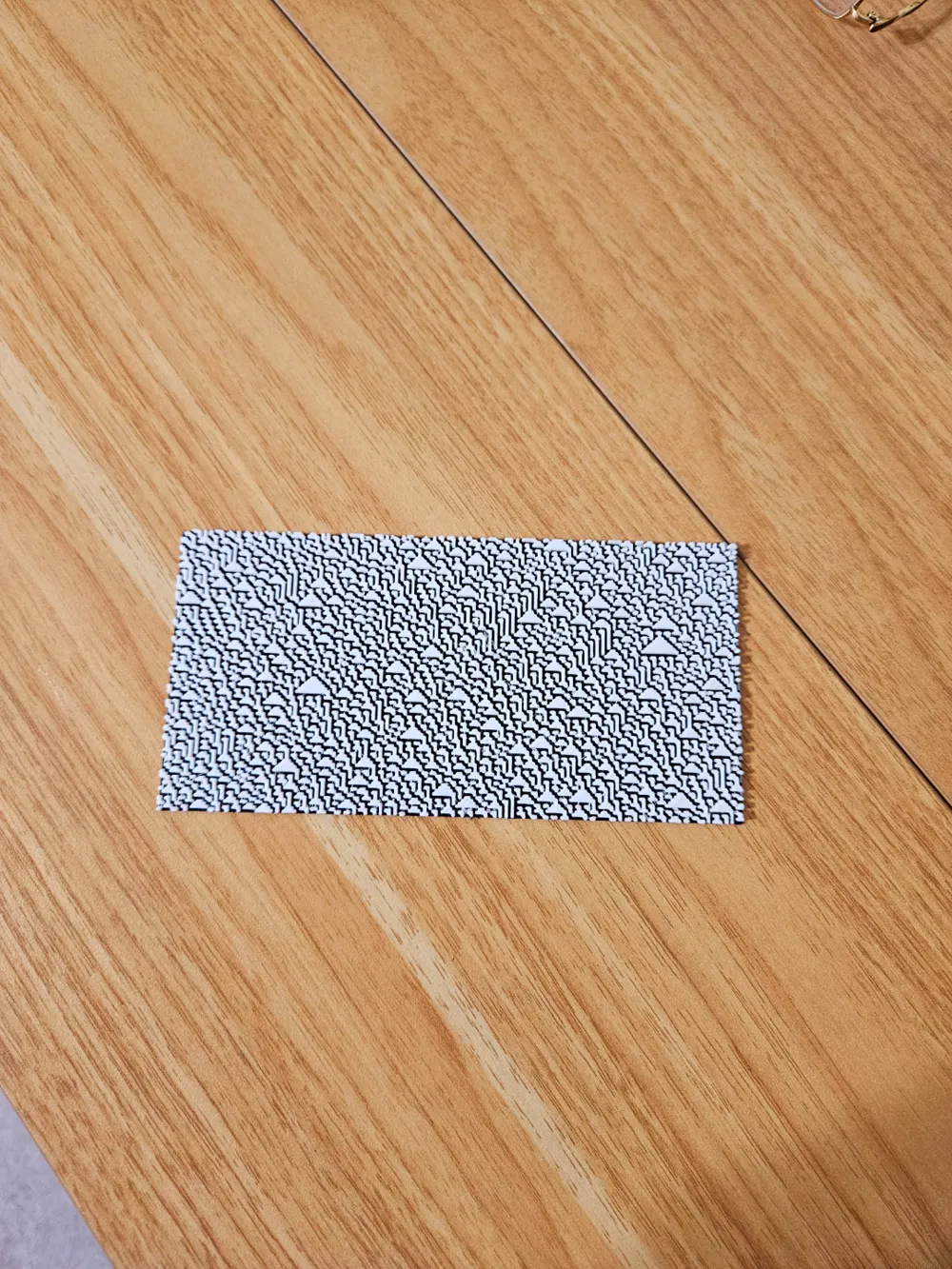
This model is the result of the rule 30 simulation, generated by running a Python script that is pretty simple. Pick your favorite two colors and print this model. I just used black and white in this case. Switch color at layer 8.
Boost Me (for free)
License

You shall not share, sub-license, sell, rent, host, transfer, or distribute in any way the digital or 3D printed versions of this object, nor any other derivative work of this object in its digital or physical format (including - but not limited to - remixes of this object, and hosting on other digital platforms). The objects may not be used without permission in any way whatsoever in which you charge money, or collect fees.


Comment & Rating (2)