
Parametric Speaker Smooth Flow Port Generator
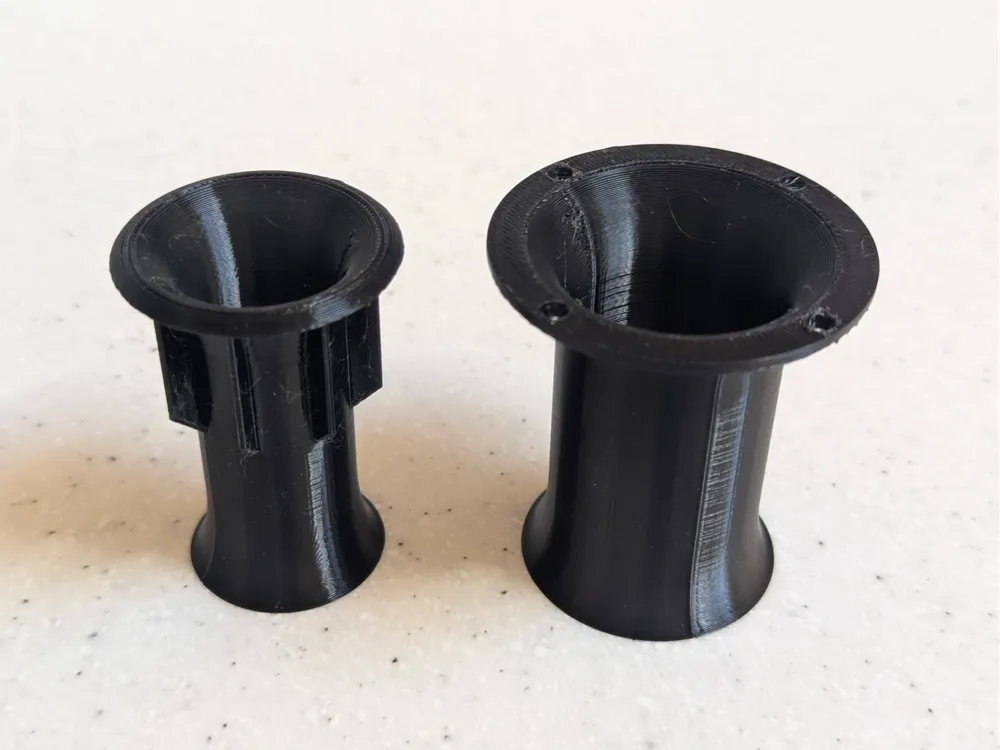
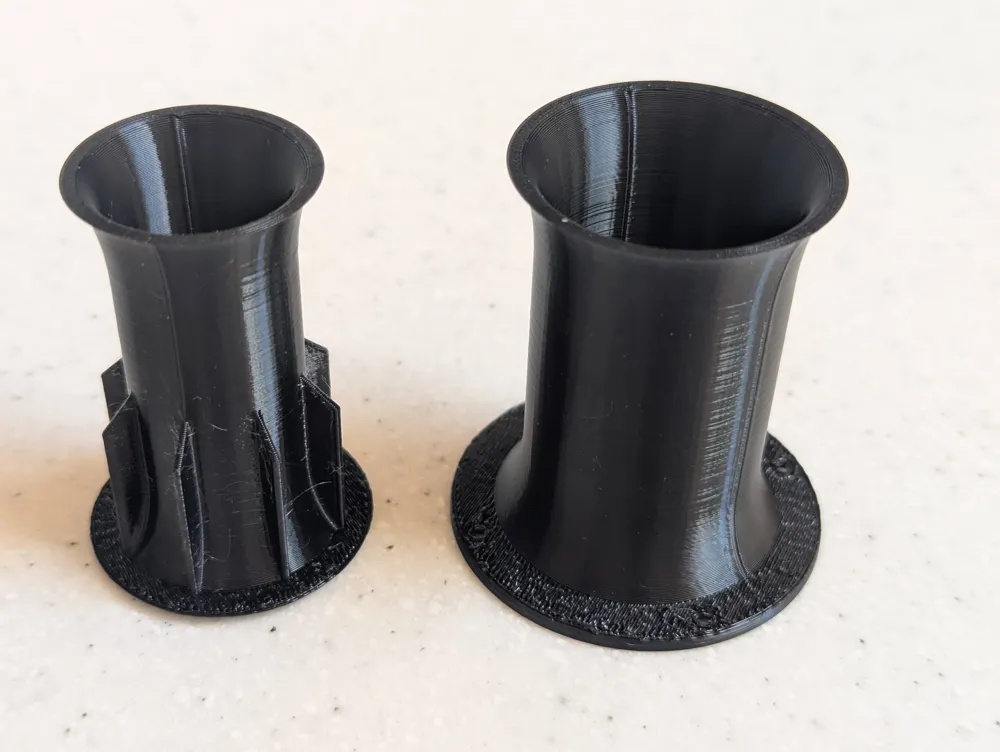
Print Profile(1)
Description
Boost Me (for free)
Press the Customize button to customize!
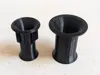
Parametric Bass Reflex Port Generator
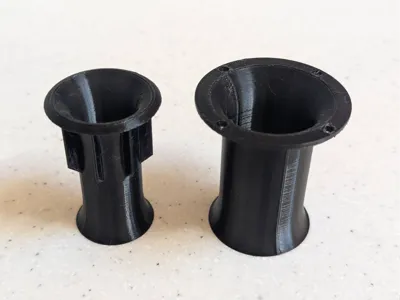
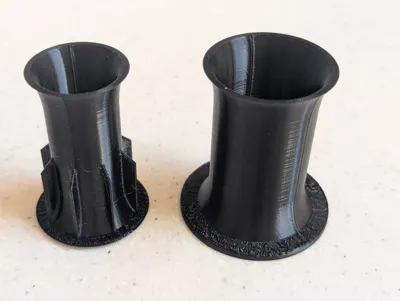
A fully parametric bass reflex port for DIY speaker cabinet builds. Dial in your bore diameter and tube length, choose your flare profile, and print; no remodeling needed when you want to iterate on tuning.
Print exterior-flare-up with supports for the best surface quality on the exterior flare. Two mounting options: friction slip-fit fins (on by default) grip the baffle hole without screws, or enable countersunk screw holes for a bolted mount.
Key Features
- Configurable bore and length: set inner diameter, straight tube length, and wall thickness directly; these are the three parameters that drive port tuning
- Outer flare (baffle side): optional bell-mouth flare on the front/baffle-facing end; smooth tangent join to the tube wall with no hard corner or visible crease
- Inner flare (cabinet side): optional bell-mouth flare on the cabinet interior end; reduces port noise and chuffing at high excursion
- Independent flare control: radial extent and axial length of each flare are set separately, giving a true ellipse-section profile; go subtle or go aggressive
- Slip-fit fins: radial fins on the tube for tool-free friction mounting into a baffle hole; configure count, height, length, and arc width to match your hole tolerance
- Flange fillet: optional concave fillet on the outer bottom edge of the mounting flange for a clean, smooth look against the baffle face
- Mounting flange: flat disk on the front face for flush baffle mounting, configurable outer diameter and thickness
- Countersunk screw holes: optional; auto bolt circle placement midway between bore and flange edge, or dial it in manually; configurable count, shaft diameter, head diameter, countersink depth, and angular offset
- TPU gasket: switch the view to gasket to generate a matching annular gasket (same OD as the flange, bore auto-matched to the front flare opening, screw holes aligned to the port pattern) sized for a soft-mount between the port and baffle
Print Settings
| Setting | Recommended |
|---|---|
| Orientation | Exterior flare UP |
| Supports | Required |
| Perimeters | 3–4 |
| Infill | 20% |
| Material | PETG preferred; PLA works |
Download the optimized print profile from this page, delete the sample models off the plate, and import your STL into it.
Customization
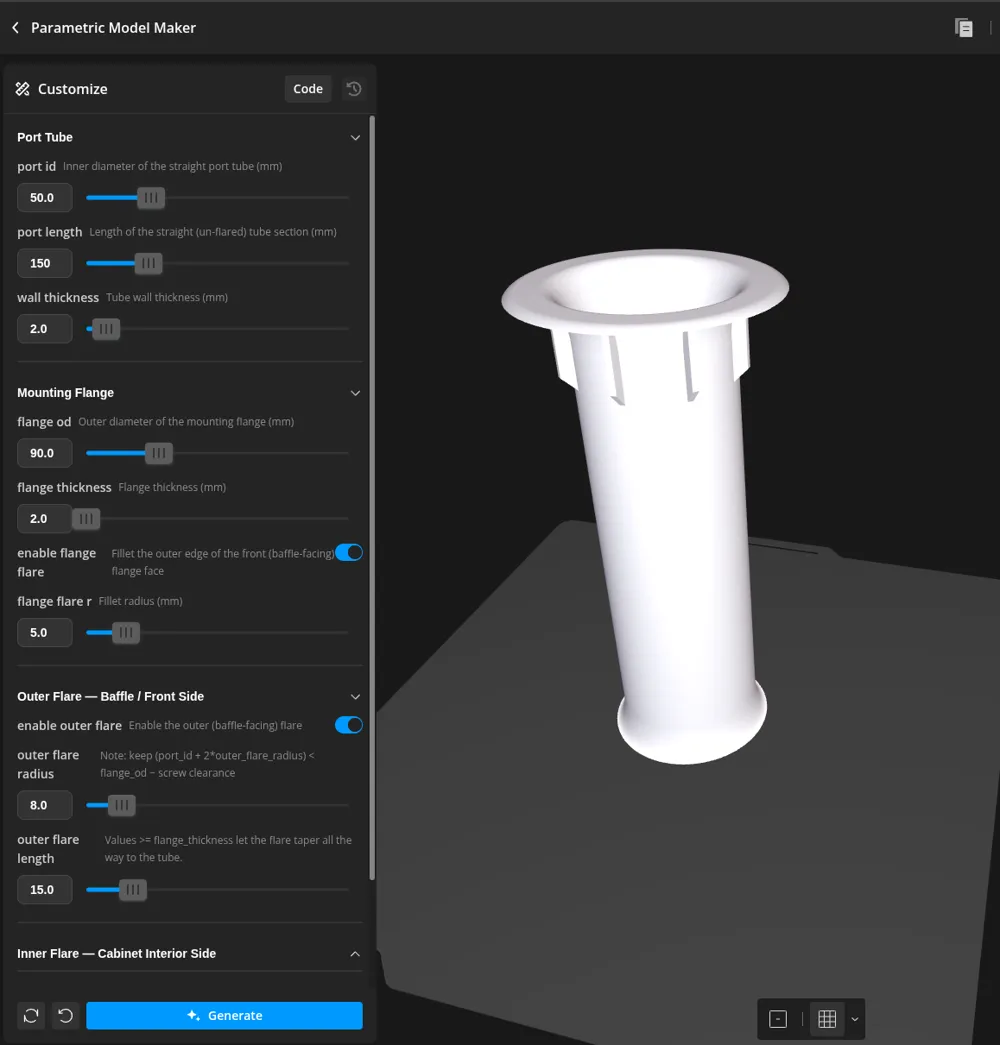
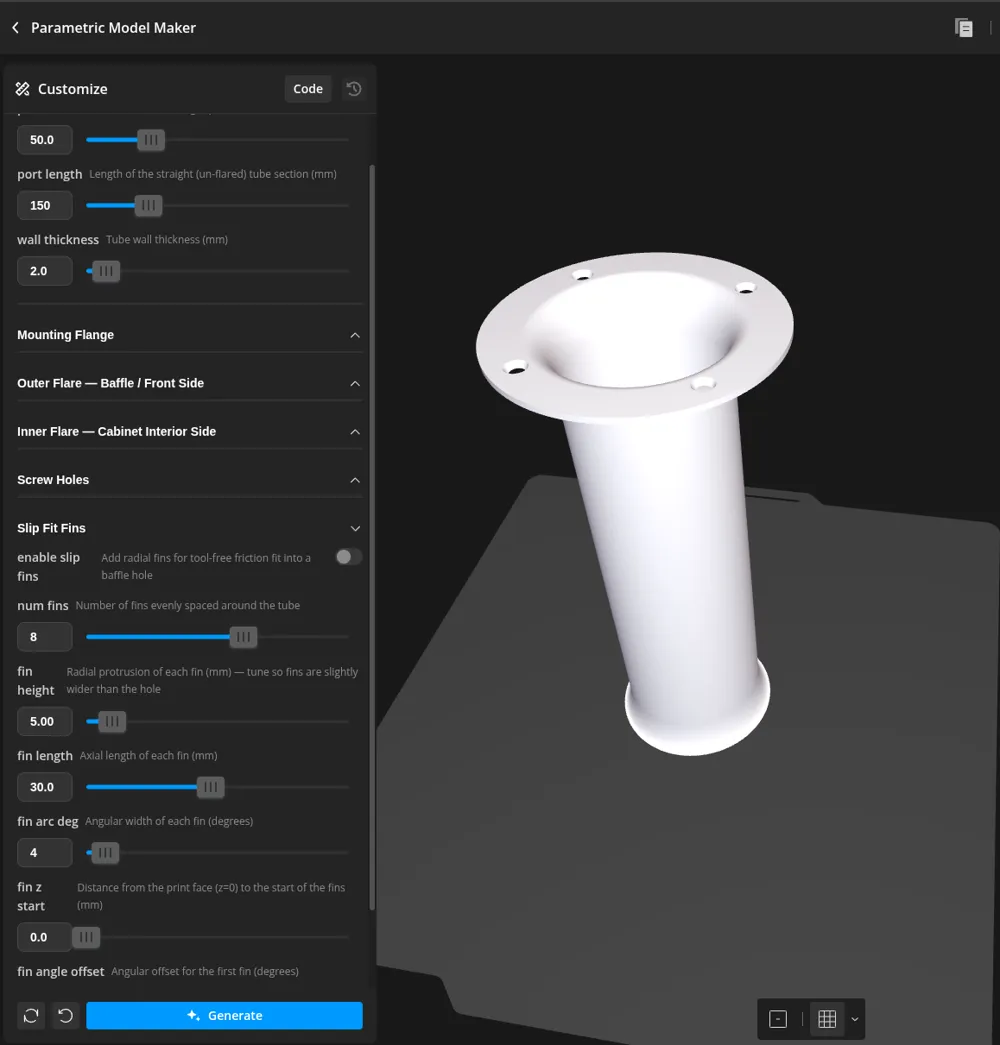
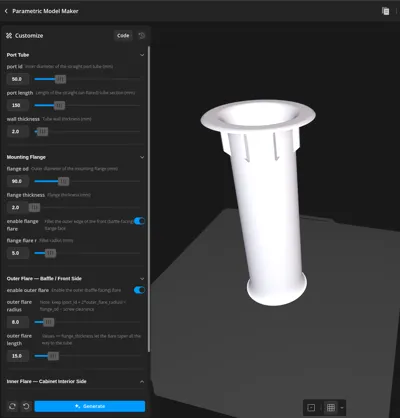
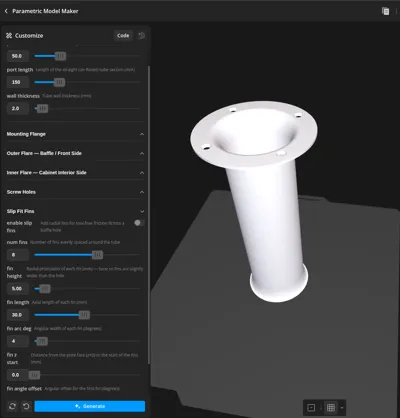
Use the MakerWorld Customizer. All parameters are grouped and annotated.
Port Tube - port_id: inner diameter of the straight bore (mm) - port_length: length of the straight section only, not including flares (mm) - wall_thickness: tube wall thickness (mm)
Mounting Flange - flange_od: flange outer diameter (mm) - flange_thickness: flange thickness (mm) - enable_flange_flare: toggle concave fillet on the outer bottom edge of the flange - flange_flare_r: fillet radius (mm)
Outer Flare (Baffle Side) - enable_outer_flare: toggle on/off - outer_flare_radius: radial widening at the baffle face (mm) - outer_flare_length: axial depth of the flare curve (mm)
Inner Flare (Cabinet Side) - enable_inner_flare: toggle on/off - inner_flare_radius: radial widening at the interior face (mm) - inner_flare_length: axial depth of the flare curve (mm)
View - view: port renders the port tube in print orientation; gasket renders the TPU gasket alone
Screw Holes - enable_screws: toggle countersunk screw holes on/off - num_screws: number of countersunk holes - auto_screw_bcd: when on, places holes at the midpoint between the bore opening and the flange edge (recommended; on by default) - screw_bcd: manual bolt circle diameter (mm); used only when auto_screw_bcd is off - screw_hole_d: shaft clearance hole diameter (mm) - cs_head_d: countersink head diameter (mm) - cs_depth: countersink depth from front face (mm) - screw_angle_offset: rotational offset of the first hole (degrees)
TPU Gasket - gasket_thickness: gasket thickness (mm) - auto_gasket_id: when on, sets the inner diameter to match the front bore opening (recommended; on by default) - gasket_id: manual inner diameter (mm); used only when auto_gasket_id is off
Slip Fit Fins - enable_slip_fins: toggle fins on/off (on by default) - num_fins: number of fins around the tube - fin_height: radial protrusion (mm); tune so fins are slightly wider than the baffle hole - fin_length: axial length of each fin (mm) - fin_arc_deg: angular width of each fin (degrees) - fin_z_start: distance from the print face to the start of the fins (mm) - fin_angle_offset: rotational offset of the first fin (degrees)
Resolution - fn_main: circular segments for the tube (default 128) - fn_flare: segments along each flare curve (default 40)
Flare Geometry
The flare profile is a quarter-ellipse curve oriented so the curve arrives at the tube junction tangentially: dr/dt = 0 at the join point, which means the flare blends into the straight tube with zero slope discontinuity. There is no visible crease or hard corner. At the open mouth, the curve sweeps outward to be nearly perpendicular to the tube axis, like a proper acoustic bell mouth. The ellipse axes (radial and axial) are fully decoupled, giving you independent control over how wide and how long each flare is.
Slip Fit Sizing Guide
The fins protrude fin_height mm beyond the tube outer wall. Set fin_height so the fin tips are 0.2–0.5 mm wider than your baffle hole radius for a firm friction fit. The leading tip of each fin is chamfered to guide insertion. If you want a looser slip fit, reduce fin_height; for a press fit, increase it slightly. Print in PETG for better flex and grip than PLA.
Bolt Circle Sizing Guide
With auto_screw_bcd on (the default), the bolt circle is calculated as the midpoint between the bore-opening radius and the flange outer edge, which always lands in solid material. If you disable it and set screw_bcd manually, the bolt circle must satisfy:
(port_id + 2 × outer_flare_radius) < screw_bcd < (flange_od − screw_hole_d)
Tuning Notes
The port_length parameter is the straight section only and does not include the flare lengths. When calculating tuning frequency:
- Start with your target Fb and cabinet volume in WinISD, BassBox, or similar
- Get the required effective acoustic length
- Subtract end correction for each flared end (~0.85 × tube radius is a common approximation)
- The remainder is your port_length
Iterate from there; that's exactly what this generator is designed for.
License

You shall not share, sub-license, sell, rent, host, transfer, or distribute in any way the digital or 3D printed versions of this object, nor any other derivative work of this object in its digital or physical format (including - but not limited to - remixes of this object, and hosting on other digital platforms). The objects may not be used without permission in any way whatsoever in which you charge money, or collect fees.


Comment & Rating (0)