
Parametric Measuring Scoop Generator – ML Version
Print Profile(1)
Description
Boost Me (for free)
Boost this model if you like functional parametric designs.
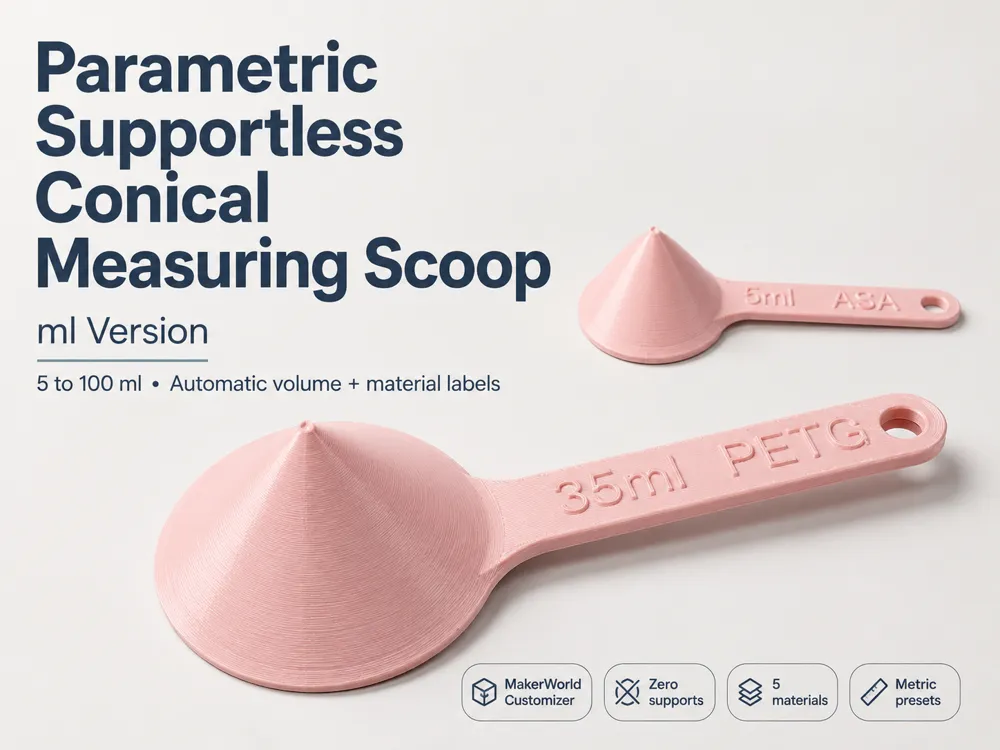
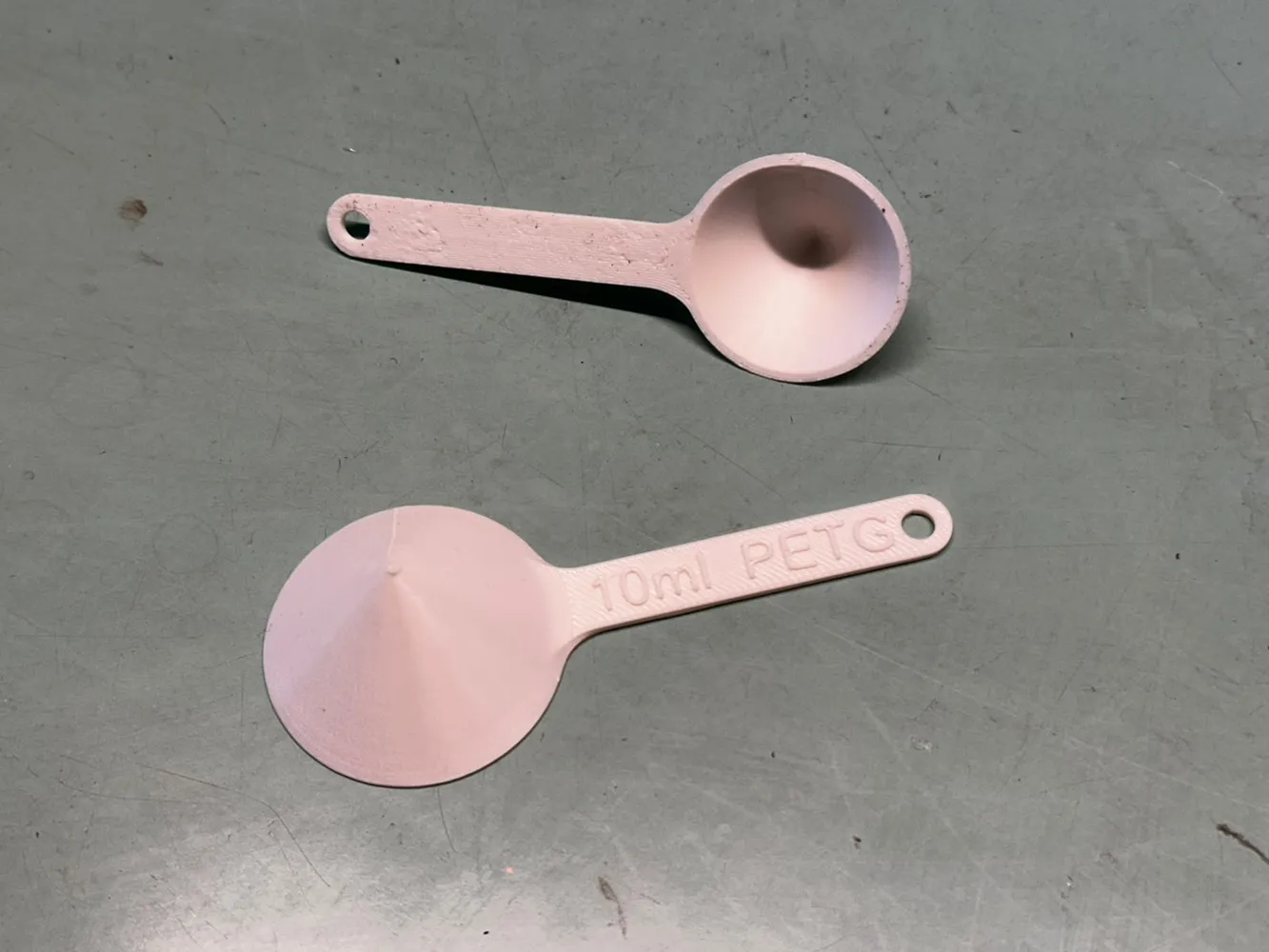
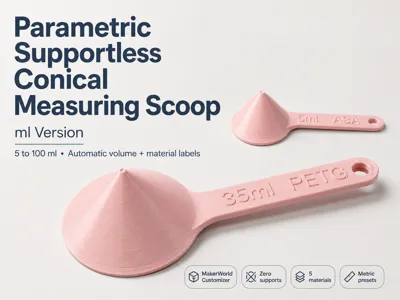
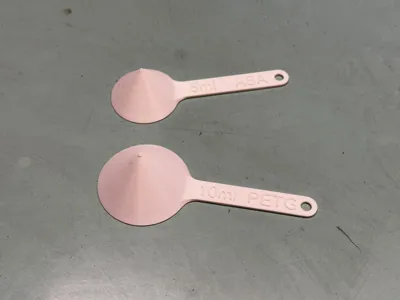
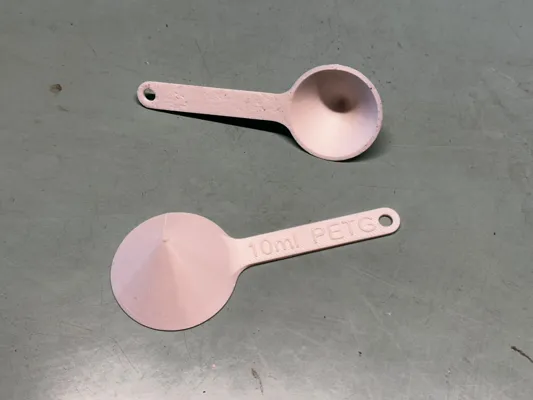
This is the ml / Metric Version of a fully customizable supportless conical measuring scoop generator.
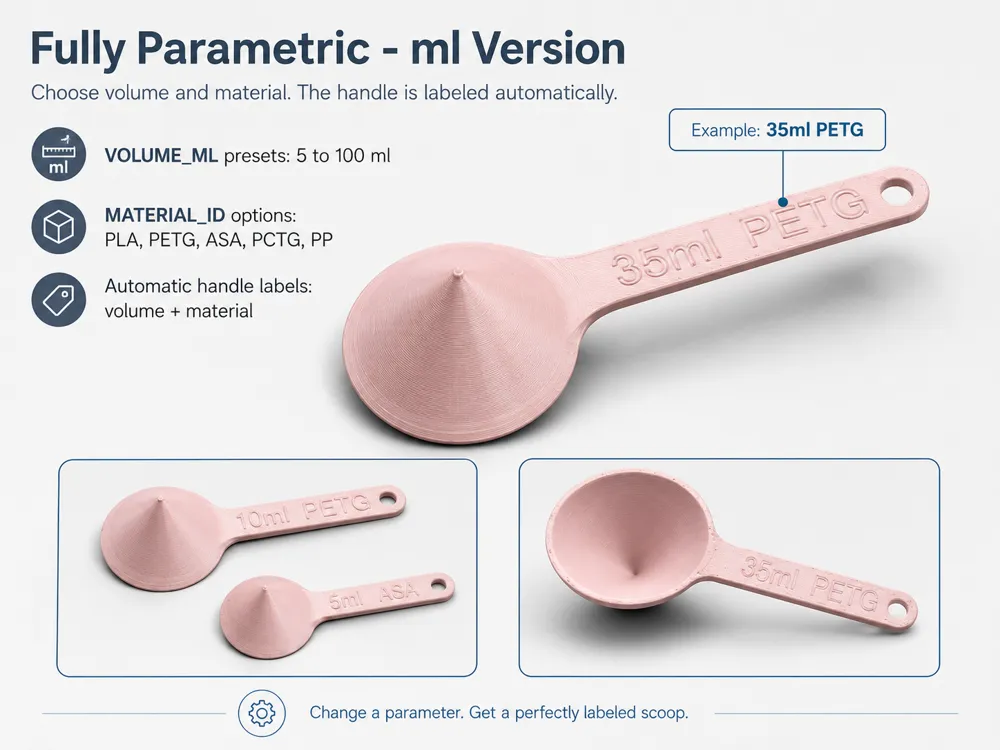
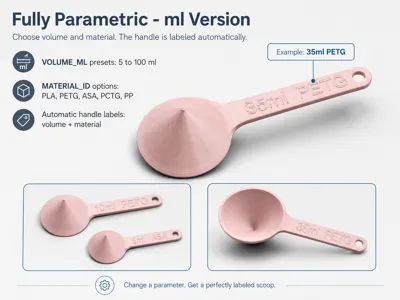
The user only selects volume and material, and the model automatically generates the correct cone geometry with both labels printed directly on the handle.
The oz version will follow as a separate project.
Description
This is the ml / Metric Version of my fully parametric conical measuring scoop designed for MakerWorld Customizer / Fusion 360.
This model is built around two key ideas:
- supportless conical geometry
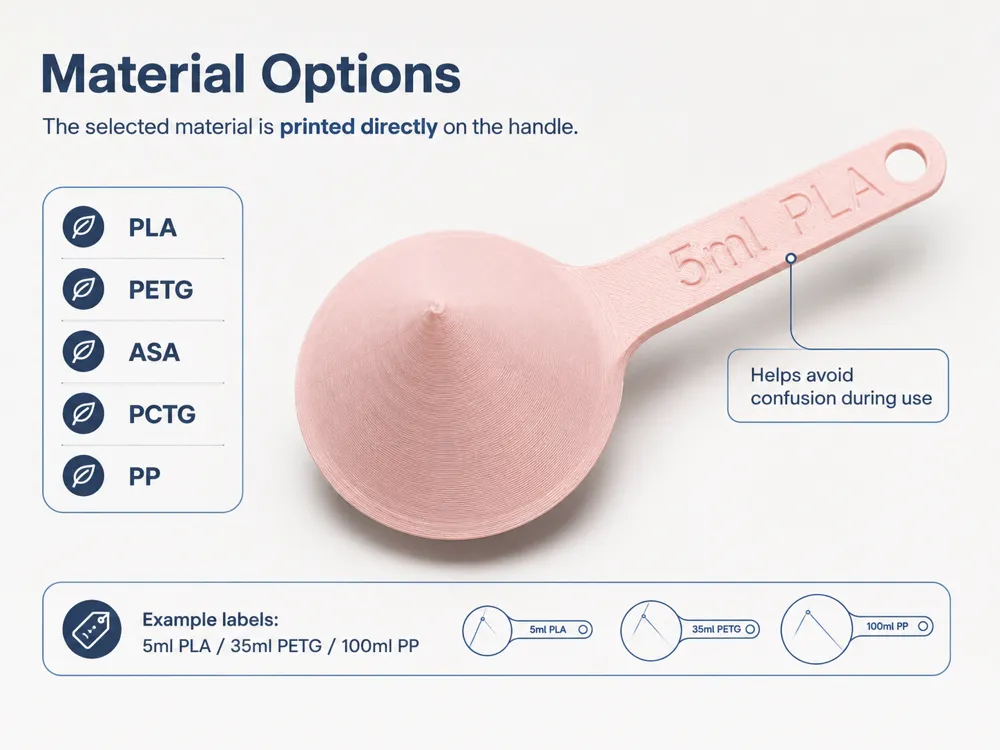
- automatic handle labels for both volume and print material
The user only needs to select:
- material
- volume in ml
The model automatically generates the correct conical scoop geometry and prints both selected values directly on the handle.
Example:
35ml PETG
The volume label helps identify the capacity.
The material label is even more important because different FDM materials behave very differently with liquids, oils, alcohols, solvents, fuels, heat and food-contact conditions.
This means the scoop is not only parametric, but also easier to identify and safer to organize after printing.
No guessing.
No relying only on color.
No confusion between PLA, PETG, ASA, PCTG and PP versions.
This is the ml / Metric Version of the project.
The oz / Imperial Version is available separately.
What Makes This Model Different
Most measuring scoops are fixed-size objects.
This model is different because it combines:
- parametric volume selection
- automatic conical geometry
- supportless FDM-oriented design
- automatic volume label on the handle
- automatic material label on the handle
- material-aware use guidance
- clean internal measuring cavity
The result is a practical measuring scoop that is:
- easy to customize
- easy to print
- easy to identify
- easier to match to the correct material use
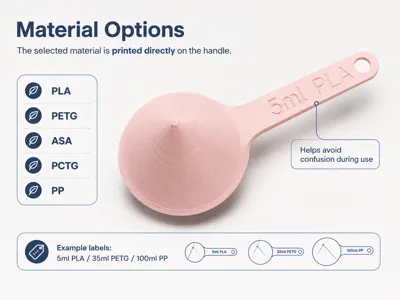
The selected material is printed directly on the handle because the print material matters.
A 35ml PETG scoop and a 35ml PP scoop may have the same volume, but they should not necessarily be used for the same liquids or conditions.
Why the Material Label Matters
The material label is one of the main features of this project.
When several scoops are printed, it can become difficult to remember which one was printed in which material.
That matters because each material has different resistance to:
- water
- oils
- alcohols
- fuels
- acetone
- cleaners
- heat
- food-contact conditions
For example:
- PLA may be fine for dry powders and simple indoor use
- PETG is a better general-purpose option
- ASA is stronger and heat-resistant, but not recommended for food contact
- PCTG is a tougher and cleaner-looking option for general use
- PP is the best choice for chemical resistance, but is more difficult to print
The printed material label helps avoid using the wrong scoop for the wrong liquid or environment.
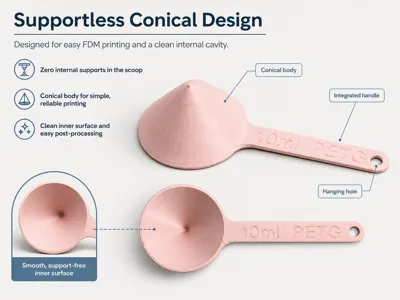
Why a Supportless Conical Shape?
The conical shape is not just a visual choice.
It is a functional printability choice.
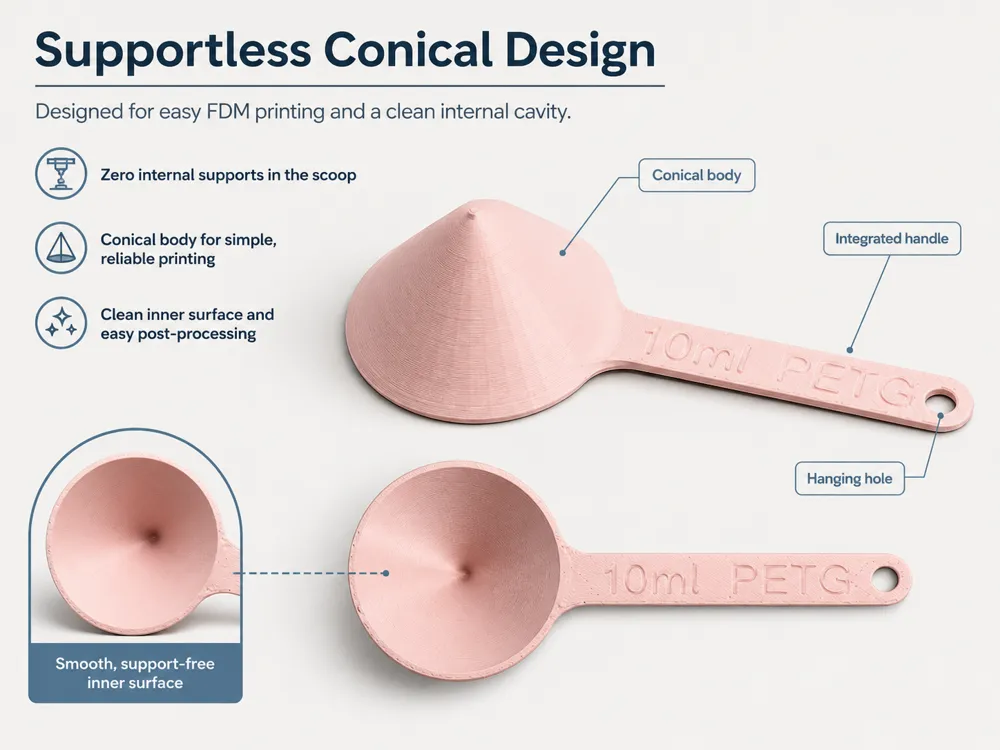
The conical body is designed for:
- zero internal supports
- clean measuring cavity
- easy FDM printing
- simple slicing
- predictable geometry
- easy volume scaling
- no support scars inside the scoop
- faster post-processing
Supports inside a measuring scoop are a problem because they can damage the internal surface, affect the real volume and make cleaning more difficult.
This design avoids that.
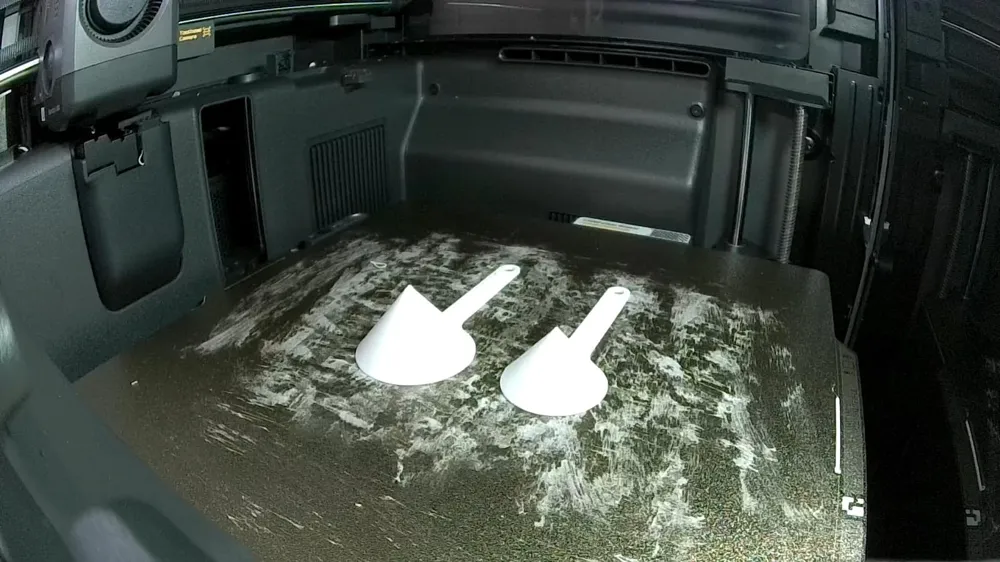
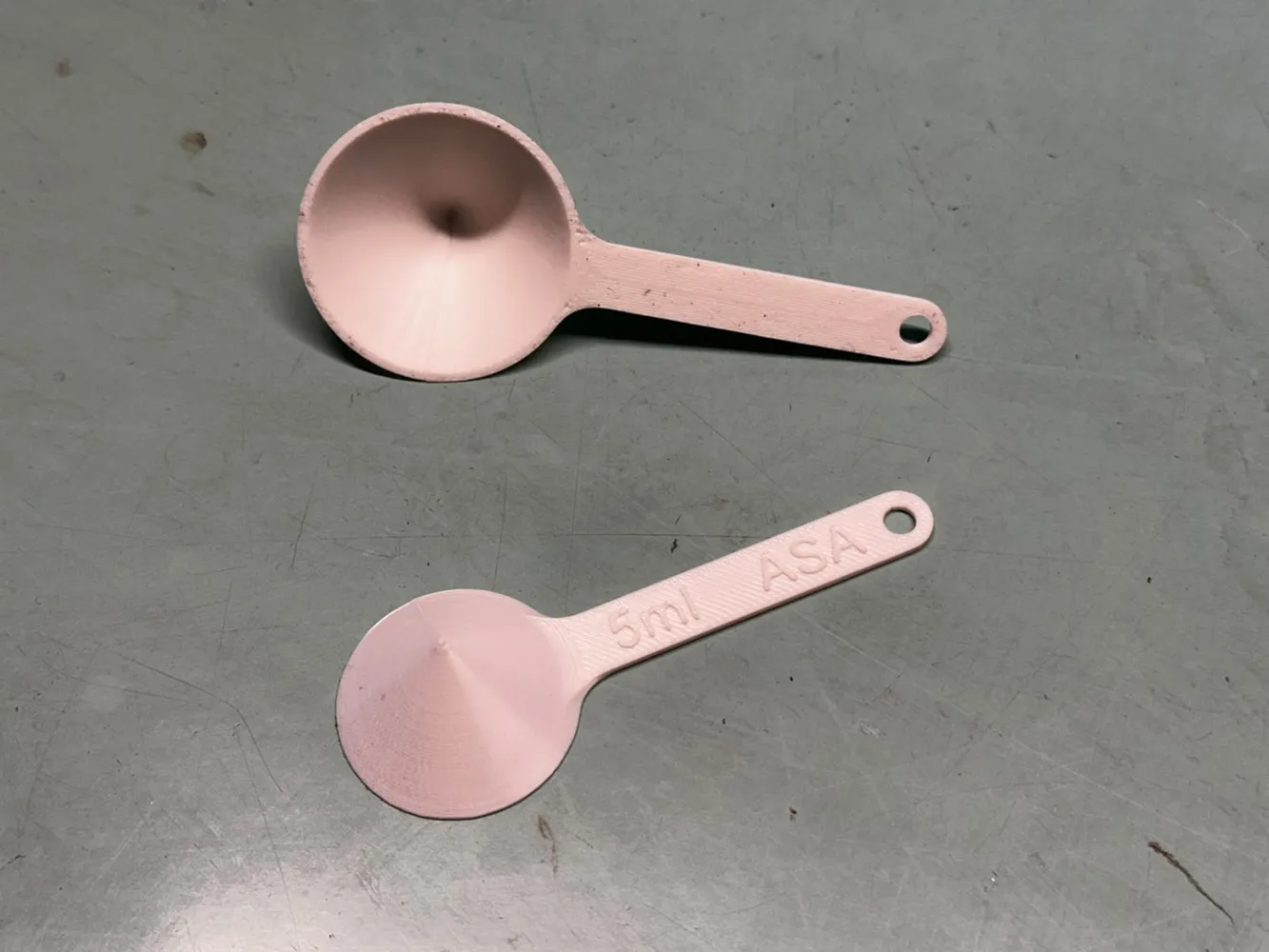
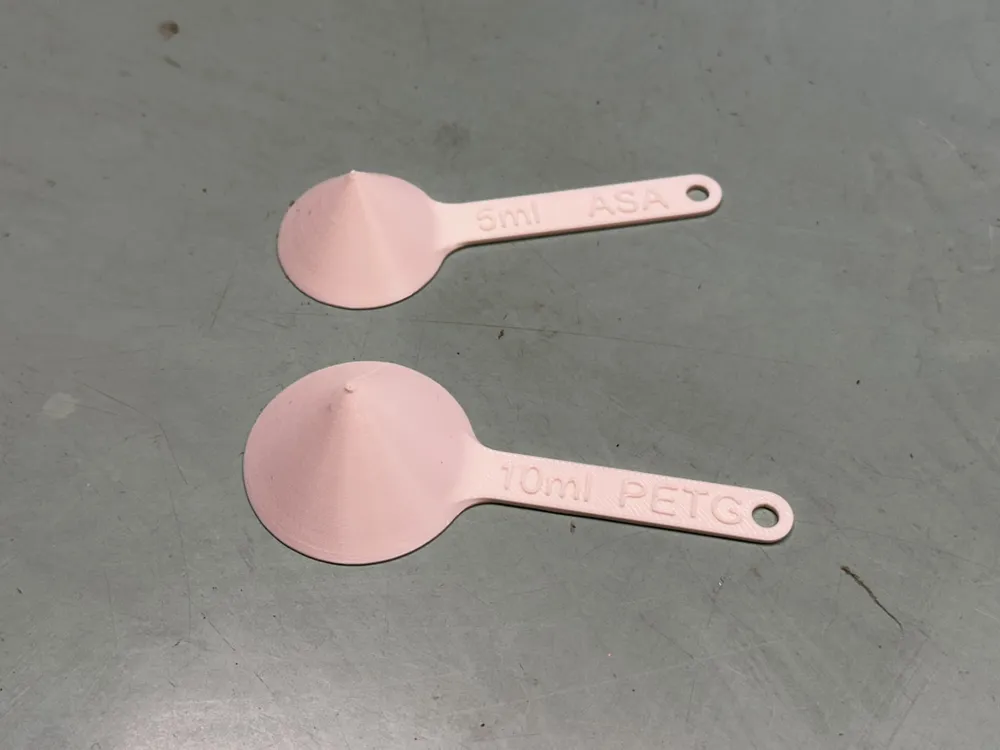
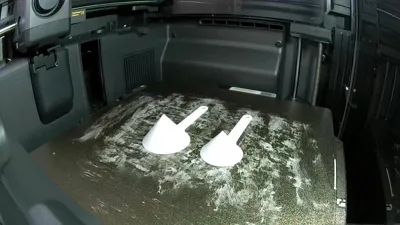
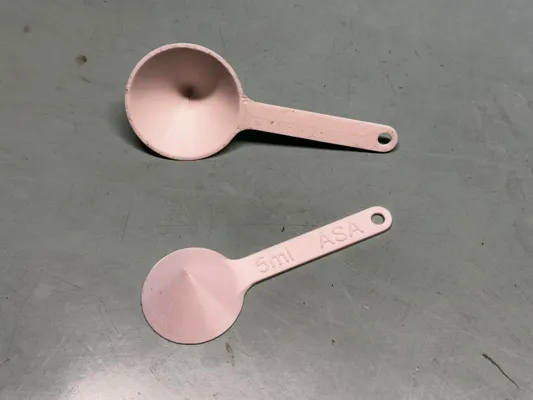
The scoop is intended to be printed with the cone opening on the build plate and the cone tip facing upward.
How It Works
The main editable parameters are:
| Parameter | Description |
|---|---|
| MATERIAL_ID | Selects the material label printed on the handle |
| VOLUME_ML | Selects the scoop volume in ml |
The user does not need to manually calculate the cone size.
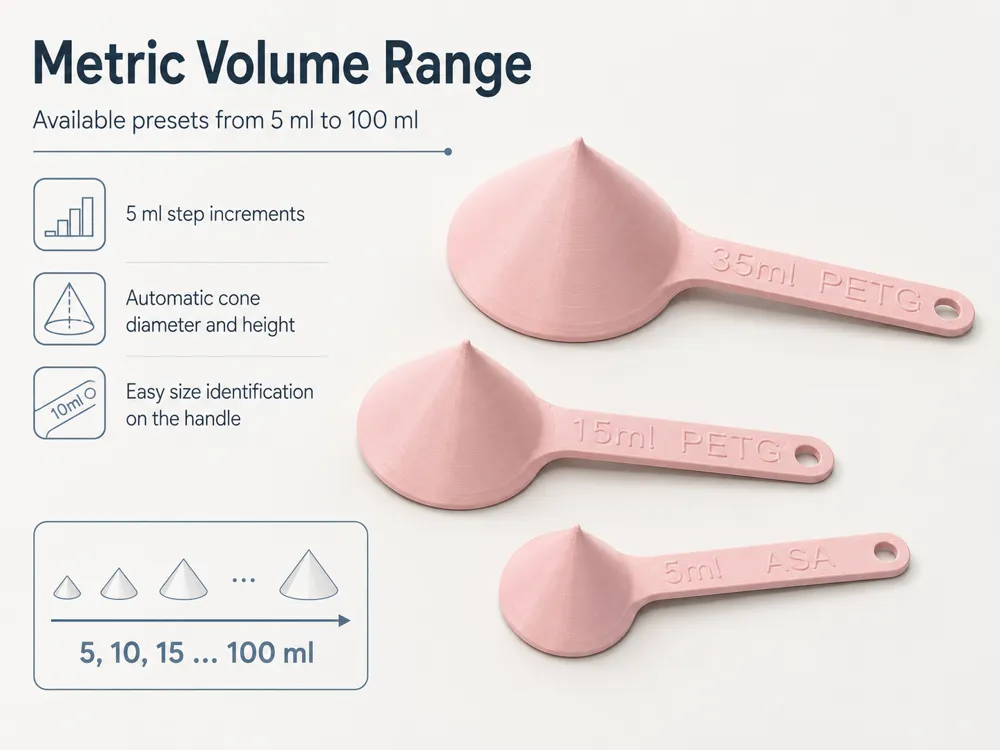
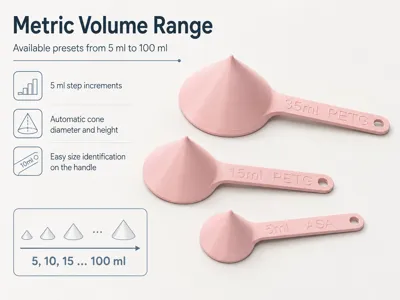
When VOLUME_ML is changed, the model automatically updates:
- internal top diameter
- internal cone height
- volume label on the handle
When MATERIAL_ID is changed, the model automatically updates:
- material label on the handle
The printed handle label helps identify the generated scoop immediately.
Example:
| Parameter | Value |
|---|---|
| VOLUME_ML | 35 |
| MATERIAL_ID | 1 |
Generated handle label:
35ml PETG
Available Material Labels
The material labels are based on the parametric material system used in the model.
| MATERIAL_ID | Printed material label |
|---|---|
| 0 | PLA |
| 1 | PETG |
| 2 | ASA |
| 3 | PCTG |
| 4 | PP |
The selected material is printed directly on the handle.
This does not certify the part for a specific chemical, food or safety application.
It is a practical identification mark to help avoid confusion after printing.
Available Volume Presets
This ml version uses direct metric volume presets.
| VOLUME_ML | Printed volume label |
|---|---|
| 5 | 5ml |
| 10 | 10ml |
| 15 | 15ml |
| 20 | 20ml |
| 25 | 25ml |
| 30 | 30ml |
| 35 | 35ml |
| 40 | 40ml |
| 45 | 45ml |
| 50 | 50ml |
| 55 | 55ml |
| 60 | 60ml |
| 65 | 65ml |
| 70 | 70ml |
| 75 | 75ml |
| 80 | 80ml |
| 85 | 85ml |
| 90 | 90ml |
| 95 | 95ml |
| 100 | 100ml |
The Customizer parameter is numeric:
| Parameter | Min | Max | Step |
|---|---|---|---|
| VOLUME_ML | 5 | 100 | 5 |
The handle uses direct readable metric labels.
Example:
VOLUME_ML = 35
Printed label:
35ml
Volume / Diameter / Height Table
The internal cone dimensions are automatically generated from the selected ml volume.
| Volume | Internal top diameter | Internal cone height |
|---|---|---|
| 5 ml | 31.76 mm | 18.93 mm |
| 10 ml | 40.02 mm | 23.85 mm |
| 15 ml | 45.81 mm | 27.30 mm |
| 20 ml | 50.42 mm | 30.05 mm |
| 25 ml | 54.32 mm | 32.37 mm |
| 30 ml | 57.72 mm | 34.39 mm |
| 35 ml | 60.76 mm | 36.21 mm |
| 40 ml | 63.53 mm | 37.86 mm |
| 45 ml | 66.07 mm | 39.37 mm |
| 50 ml | 68.44 mm | 40.78 mm |
| 55 ml | 70.64 mm | 42.10 mm |
| 60 ml | 72.72 mm | 43.33 mm |
| 65 ml | 74.69 mm | 44.51 mm |
| 70 ml | 76.56 mm | 45.62 mm |
| 75 ml | 78.34 mm | 46.68 mm |
| 80 ml | 80.04 mm | 47.70 mm |
| 85 ml | 81.68 mm | 48.67 mm |
| 90 ml | 83.25 mm | 49.61 mm |
| 95 ml | 84.76 mm | 50.51 mm |
| 100 ml | 86.22 mm | 51.38 mm |
The dimensions are calculated to generate the selected conical volume.
Real printed volume may vary depending on printer calibration, extrusion width, slicer settings, material shrinkage and surface finish.
For critical use, verify the real capacity after printing.
Main Features
- Fully parametric conical measuring scoop
- ml / Metric version
- MakerWorld Customizer / Fusion 360 compatible
- Volume presets from 5 ml to 100 ml
- 5 ml step increments
- Automatic internal cone diameter
- Automatic internal cone height
- Automatic volume label on the handle
- Automatic material label on the handle
- Five selectable material labels
- Supportless conical geometry
- Clean internal scoop surface
- Integrated handle
- Hanging hole
- Easy FDM printing
- Practical technical design
- Designed for light-duty maker, workshop and utility use
Suggested Uses
This model can be useful for:
- dry powders
- pigments
- granules
- seeds
- pellets
- desiccant
- resin additives
- workshop materials
- oils and greases, depending on material
- alcohols, depending on material
- light-duty chemical measuring, depending on material
- hobby laboratory-style use
- garage organization
- workshop organization
- repeatable dosing of non-critical materials
- maker projects and prototypes
This model is not certified measuring equipment.
For accurate dosing, always verify the printed scoop with a scale or graduated reference before use.
Material Compatibility Guide — FDM Printed Measuring Scoops
This guide is indicative only.
It refers to light-duty FDM printed parts used at room temperature, with short contact times and no structural load, pressure or long-term liquid storage.
FDM printed parts are not automatically waterproof, food-safe or chemically safe.
Layer lines and micro-gaps may absorb liquids, trap residues, reduce chemical resistance and make cleaning difficult.
Always test the exact filament, liquid, temperature and contact time before real use.
| Liquid / Use Case | PLA | ASA | PETG | PCTG | PP |
|---|---|---|---|---|---|
| Dry powders, grains, pigments, granules | Good | Good | Good | Good | Excellent |
| Water / non-aggressive liquids, short contact | Short contact only | Not ideal | Good | Good | Excellent |
| Food or drink contact | Not recommended for repeated use | Not recommended | Conditional only | Conditional only | Best material choice, but still conditional |
| Dishwasher / hot water | Not suitable | Thermally good, not for food | Possible deformation | Better than PETG | Excellent |
| Oils and greases | Short contact only | Conditional | Good | Good | Excellent |
| Alcohols / IPA / ethanol | Short contact only | Good | Good | Good | Excellent |
| Acetone | Not suitable | Not suitable | Not suitable | Short contact / test first | Best choice |
| Nitro thinner / strong solvents | Not suitable | Not suitable | Not suitable | Short contact / test first | Best choice |
| Gasoline / petrol | Not suitable | Not recommended | Short contact only | Good, test first | Excellent |
| Diesel / kerosene | Not suitable | Short contact / test first | Good | Good | Excellent |
| Bleach / diluted alkaline cleaners | Short contact only | Good | Good | Good | Excellent |
| Strong acids / strong bases | Not suitable | Depends on concentration | Depends on concentration | Good, test first | Excellent |
Recommended Material Presets
| Use | Recommended material |
|---|---|
| Dry powders, pigments, granules | PLA, PETG, ASA, PCTG, PP |
| Water-based liquids, short contact | PETG, PCTG, PP |
| Oils and greases | PETG, PCTG, PP |
| Alcohols / IPA | PETG, PCTG, PP |
| Hot water / dishwasher-like conditions | PCTG or PP |
| Fuels, acetone or aggressive solvents | PP only, test first |
| Food contact | Only with certified food-contact filament, stainless/titanium nozzle, clean print path and suitable sealing |
Food Contact Warning
For food or drink contact, the printed material alone is not enough.
Use only certified food-contact filament, a clean and dedicated printer path, a stainless steel or titanium nozzle, and a suitable food-safe coating or sealing process.
Do not use standard brass nozzles for food-contact parts.
Do not use ASA for food contact.
Even when printed with a suitable material, an untreated FDM part may remain porous and difficult to clean because of layer lines and micro-gaps.
Printing Recommendations
Recommended materials:
| Material | Recommendation |
|---|---|
| PLA | Good for dry powders, simple indoor use and visual prototypes |
| PETG | Good general-purpose option |
| ASA | Stronger and more heat-resistant, but not recommended for food contact |
| PCTG | Tougher general-purpose option with good liquid-oriented use potential |
| PP | Best choice for chemical resistance, but more difficult to print |
Suggested print settings:
| Setting | Recommendation |
|---|---|
| Layer height | 0.16–0.24 mm |
| Walls/perimeters | 4–8 |
| Top/bottom layers | 5–7 |
| Infill | 30–100% |
| Supports | Not required for the conical body |
| Brim | Recommended for ASA and PP |
| Seam position | Rear or aligned away from the scoop lip if possible |
For functional measuring scoops, many walls are recommended instead of relying only on infill.
The cone wall should be printed with good layer bonding, especially if the scoop will be used with liquids.
Print Orientation Notes
Print the model with the cone opening on the build plate and the cone tip facing upward.
This is the intended orientation.
The conical measuring body is designed to print without internal supports, keeping the measuring cavity clean and consistent.
Benefits:
- no internal supports
- clean cone surface
- better volume accuracy
- easier printing
- faster post-processing
- simple slicing
- readable handle text when oriented correctly
Depending on printer, material and slicer settings, the handle connection may require attention, but the main cone is designed to be supportless.
Important Accuracy Note
The scoop volume is based on the internal conical geometry.
Real-world printed volume may vary depending on:
- printer calibration
- extrusion width
- flow rate
- filament shrinkage
- layer height
- slicer compensation
- elephant foot
- seam placement
- surface roughness
- sealing or coating thickness
For practical verification, print a test scoop and measure the actual capacity with water and a precision scale.
Approximate check:
1 g of water is approximately 1 ml at room temperature.
This model is intended for practical maker and workshop measuring, not certified laboratory measurement.
Important Safety Notes
This model is intended for maker, workshop and light-duty measuring use only.
Do not use this printed part for:
- medical use
- sterile applications
- certified laboratory dosing
- food-industry equipment
- pharmaceutical use
- pressure systems
- long-term chemical storage
- hot aggressive liquids
- toxic or hazardous chemicals without testing
- any application where failure, contamination or inaccurate dosing could cause injury, damage or health risk
3D printed parts can fail or become contaminated depending on:
- material
- print orientation
- layer adhesion
- temperature
- chemical exposure
- liquid absorption
- cleaning method
- UV exposure
- long-term creep
- porosity
- post-processing
- coating compatibility
Always test the part carefully before real use.
The designer is not responsible for misuse or damage caused by improper application.
Safety Disclaimer
This model is intended for maker, workshop and light-duty measuring use.
It is not certified laboratory, medical, industrial or food-industry equipment.
Material compatibility is indicative only.
FDM printed parts may contain layer gaps and micro-porosity that can absorb liquids, trap residues or bacteria, and reduce chemical resistance compared to the raw plastic material.
For food or drink contact, use only certified food-contact filament, a clean dedicated printer path, a stainless steel or titanium nozzle, and a suitable food-safe coating or sealing process.
Do not use ASA for food contact.
For chemicals, solvents, fuels, oils or cleaners, always test the exact filament with the exact liquid, concentration, temperature and contact time.
Avoid long-term storage, pressure, heat and structural loads unless the printed part has been specifically validated for that use.
Use at your own risk.
Print Profile Note
This is a fully parametric Fusion 360 / MakerWorld Customizer model.
The project is designed to let users generate their own scoop size and material label instead of relying only on fixed-size print profiles.
The model has been personally tested on a Qidi Plus 4, and I now also use a Bambu Lab X2D.
Users should still slice the generated version according to their printer, material and intended use.
Verified community print profiles are welcome and appreciated.
Customizer Note
The parametric version is intended to be edited from Fusion 360 / MakerWorld Customizer — PC version.
Bambu Handy is mainly intended for direct printing from ready print profiles and may not provide full access to editable custom parameters.
For best results, use the MakerWorld Customizer from a desktop browser.
The user only needs to change two main parameters:
| Parameter | Use |
|---|---|
| MATERIAL_ID | Selects the material label printed on the handle |
| VOLUME_ML | Selects the scoop volume and printed volume label |
Recommended Customizer Ranges
| Parameter | Min | Max | Default | Step |
|---|---|---|---|---|
| MATERIAL_ID | 0 | 4 | 1 | 1 |
| VOLUME_ML | 5 | 100 | 35 | 5 |
Material ID reference:
| MATERIAL_ID | Material label |
|---|---|
| 0 | PLA |
| 1 | PETG |
| 2 | ASA |
| 3 | PCTG |
| 4 | PP |
Available volume presets:
| VOLUME_ML | Printed label |
|---|---|
| 5 | 5ml |
| 10 | 10ml |
| 15 | 15ml |
| 20 | 20ml |
| 25 | 25ml |
| 30 | 30ml |
| 35 | 35ml |
| 40 | 40ml |
| 45 | 45ml |
| 50 | 50ml |
| 55 | 55ml |
| 60 | 60ml |
| 65 | 65ml |
| 70 | 70ml |
| 75 | 75ml |
| 80 | 80ml |
| 85 | 85ml |
| 90 | 90ml |
| 95 | 95ml |
| 100 | 100ml |
Example presets:
| Use | MATERIAL_ID | VOLUME_ML | Printed handle label |
|---|---|---|---|
| Small dry powder scoop | 0 | 5 | 5ml PLA |
| General workshop scoop | 1 | 35 | 35ml PETG |
| Heat-resistant non-food scoop | 2 | 50 | 50ml ASA |
| Tough general-purpose scoop | 3 | 75 | 75ml PCTG |
| Chemical-resistant test scoop | 4 | 100 | 100ml PP |
License

You shall not share, sub-license, sell, rent, host, transfer, or distribute in any way the digital or 3D printed versions of this object, nor any other derivative work of this object in its digital or physical format (including - but not limited to - remixes of this object, and hosting on other digital platforms). The objects may not be used without permission in any way whatsoever in which you charge money, or collect fees.


Comment & Rating (0)