
Ele-Box – Parametric Electronics Enclosure / Box
Print Profile(1)
Description
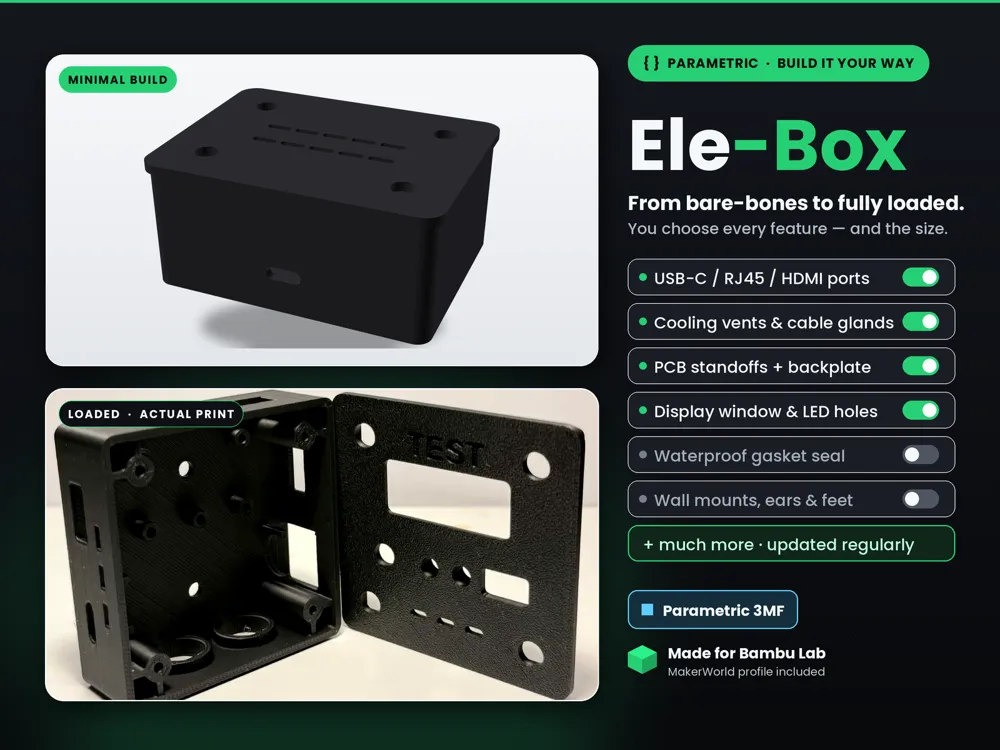
Ele-Box
From bare-bones to fully loaded. You choose every feature — and the size.
v0.7 · 2026-07-06 — see what's new in the changelog.
🐛 Found a bug? Want a feature? Have a question? File it on the Issues page → — pick a type (bug / feature / question) and it gets sorted automatically. That's the one place for everything.
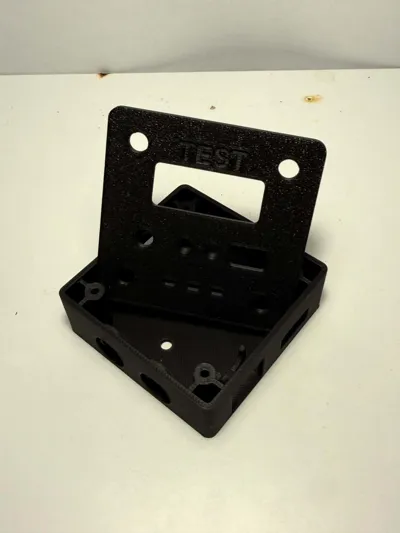
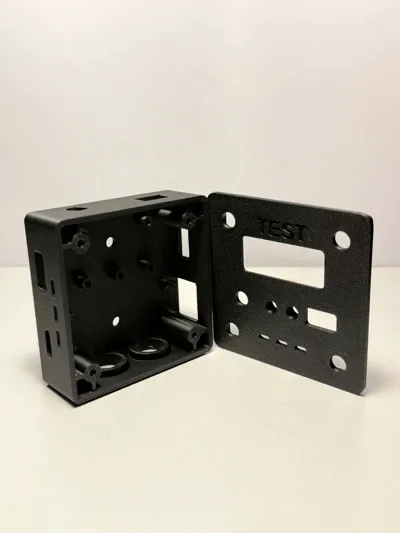
Ele-Box is a fully parametric enclosure for 3D-printable electronics and project builds: a box plus a matching lid, with an optional gasket and backplate. Set your inside dimensions, toggle the features your build actually needs — screw posts, ports, vents, standoffs, glands, snaps, seals — and you get a print-ready box laid out flat on the bed. The default is 160 × 100 × 40 mm inside, with 3 mm walls, floor and lid and a 5 mm corner radius. Change any of it. Made for Bambu Lab.
What you can generate
Choose what to print:
- All — base + lid (and backplate, if enabled), laid out side by side
- Base only — the box body
- Lid only — the lid
- Gasket only — a flat sealing ring to print in TPU
- Backplate only — an internal plate drilled to match your standoffs
And how it comes out:
- Layout: Print (flat on the bed, lid pre-flipped) or Assembled (stacked as it fits together, for a sanity check).
- Split: halve an oversized model — Length A/B or Width A/B — for a small bed. It's a plain straight cut, so glue or dowel the seam yourself.
- Quality: Low, Normal, Fine or Very fine curve smoothness — drop it while experimenting, crank it for the final.
Box body
- Inside length / width 20–300 mm, inside height 10–180 mm.
- Wall, floor and lid thickness 1.2–8 mm each.
- Outer corner radius 0–30 mm (0 = sharp corners).
- A Loose / Snug / Tight lid-fit dial for how tightly the lid grips, plus a plug-in lip between base and lid.
Lid mounting
Five ways to close it — Screws, Tongue and groove, Cantilever clips, Glue, or a Plain plate — with the lid shaped as a Cap (sits over the rim) or Inset (drops flush into the opening).
- Screws — base posts sized for M2, M2.5, M3, M4, M5, M6, 4-40, 6-32, 8-32 or a custom size. Head recess socket/pan, flat countersunk, or none.
- Tongue and groove — a no-screws friction lid: the lip plugs into a groove in the rim and you pull straight up to open, with nothing that flexes and cracks. The groove can grow Inner (sides stay flush) or Outer (the box widens at the top and the lid wraps around the outside). How tightly it grips follows the Loose / Snug / Tight lid-fit dial.
- Cantilever clips — press the lid down to click it shut, pull straight up to open; the catches hide in blind pockets in the wall. Flexing closure — for a guaranteed hold use Screws.
- Glue / Plain plate for the simplest builds.
Openings
- Round and rectangle holes in the lid top or any side wall, as parametric rows with rounded corners — set count, size, offset, spacing and axis for connectors, switches and displays.
- Vent grids — slots or round holes with independent row and column spacing: up to 12 rows × 20 columns on the lid, up to 10 rows × 20 columns on a side wall.
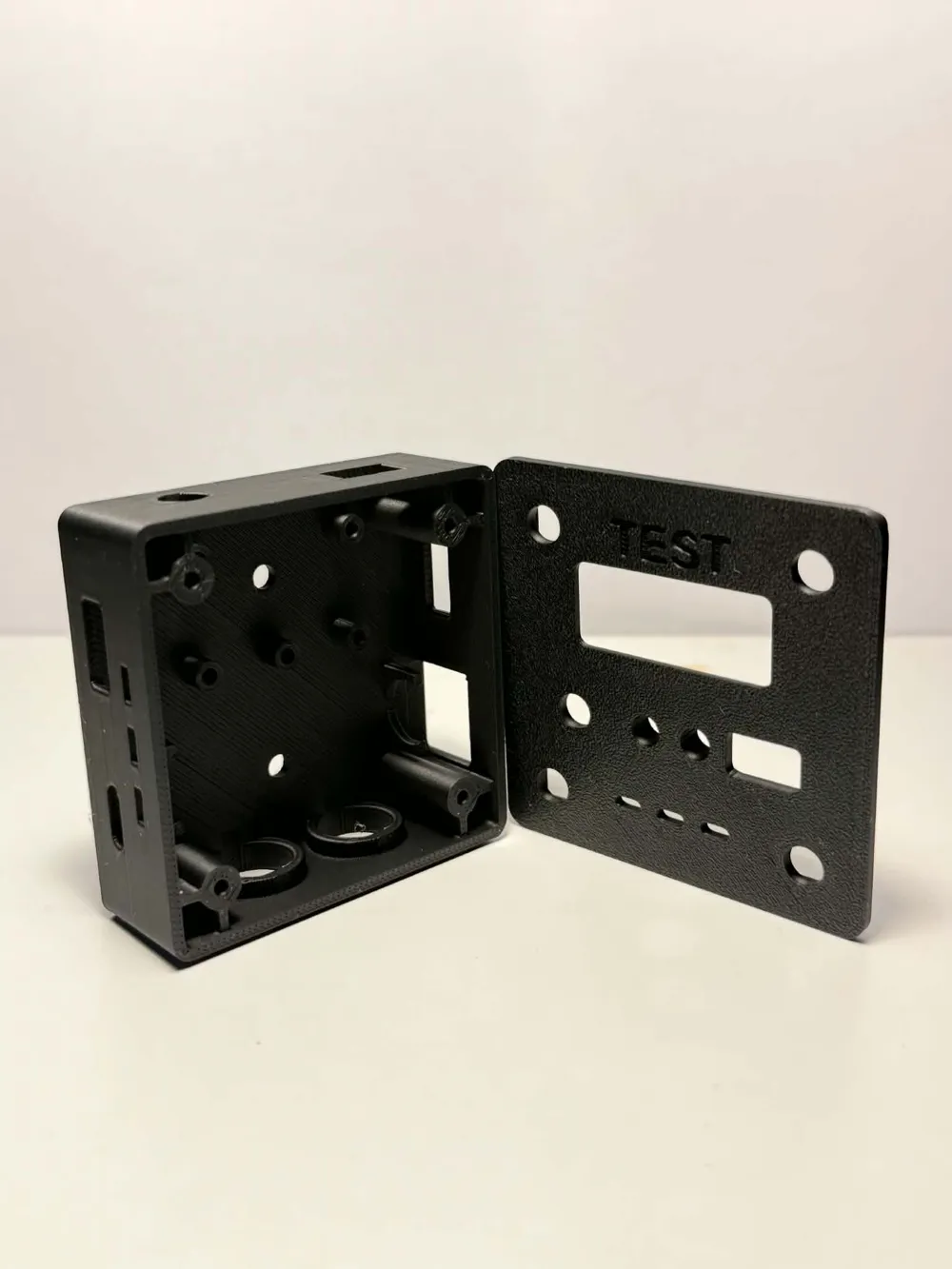
- Panel connectors — up to 4 cutouts from named presets that set the exact opening: USB-A, USB-C, Micro-USB, Mini-USB, RJ45 Ethernet, HDMI-A, DC barrel jack, Audio 3.5 mm, SMA antenna, DB9 serial. Each picks its wall, height and offset, with an oversize option to clear a whole plug body when a port sits back from the wall.
- Cable glands — PG7 / PG9 / PG11 / PG13.5 / M12 / M16 / M20 or custom, 1–6 per wall, with an optional inner boss so the gland nut has material to bite into.
Board fit and ports that line up
This is where Ele-Box earns its keep. Two things have to be right: the hole sits where the port is, and the port actually reaches the wall.
- Standoffs — a primary quad set to your board's hole pattern, an optional second quad, and up to 4 individually placed posts. Out-of-bounds standoffs are trimmed to the interior automatically, so nothing prints floating.
- Board anchor — define the board outline and park its port edge a small gap from a chosen wall, then reference your connectors to the board so the cutouts auto-align to the real ports.
- Preview ghost — a translucent board outline you can switch on to line things up (preview only, never printed).
- Backplate — a separate internal plate drilled to match every enabled standoff group, with its own wall gap, thickness and corner rounding.
Onboard hardware
- Battery holder — snap-in holders that self-size to AAA, AA, 14500, 18650, C or D cells, 1–4 across. Round cells snap into a channel with an open centre (pinch to pop the cell out), and a standard slide-in spring contact at each end grips and powers the cell; a 9V block gets an open-top well for the snap clip and leads.
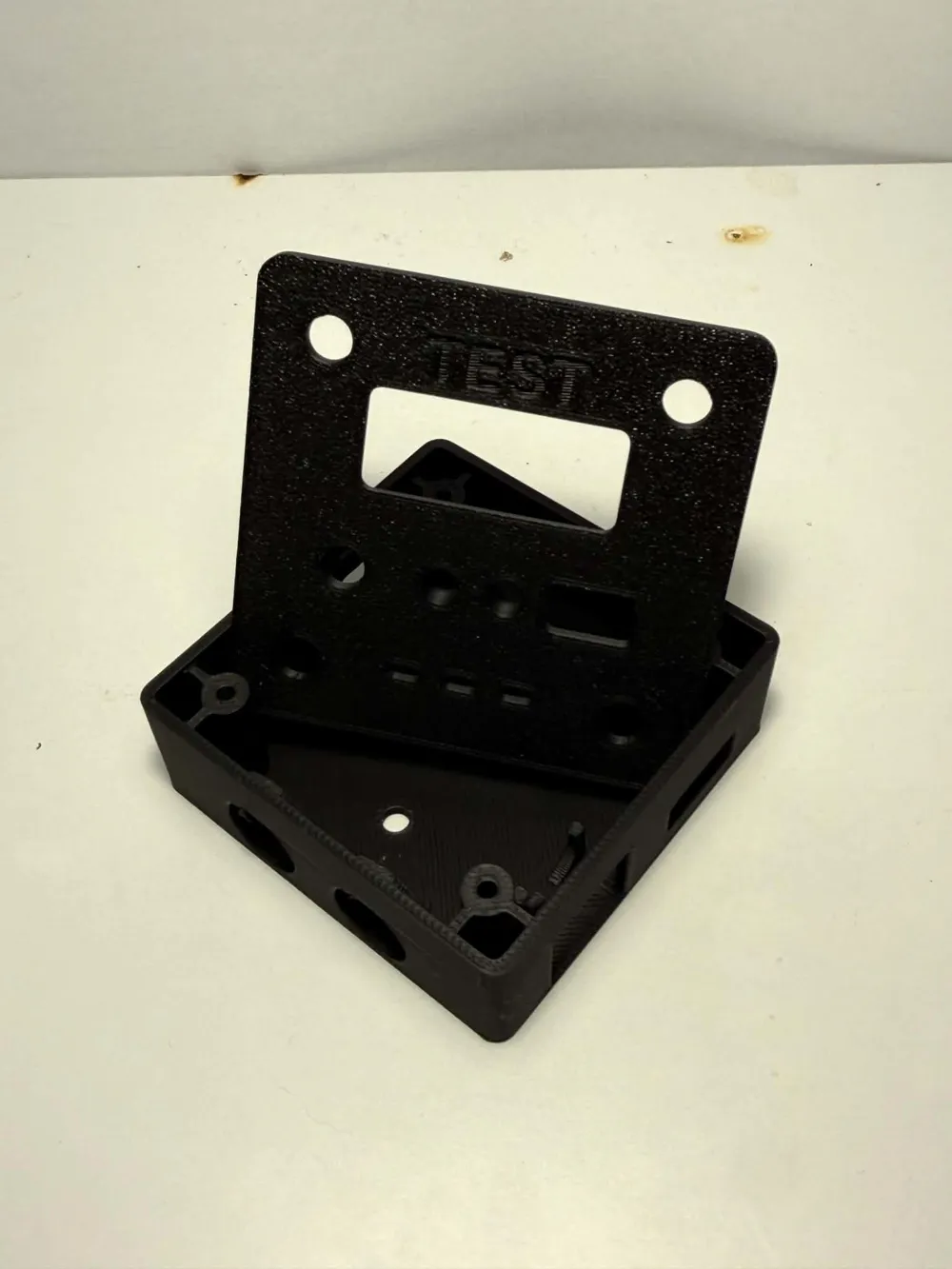
- Display window — a rounded screen cutout with an optional inner ledge so an OLED/LCD drops in from inside and rests on the step.
- LED indicators — 3 mm / 5 mm / custom holes in a row, 1–8 across, with an optional underside collar to align and grip each LED.
Mounting and finishing
- Base mounting — side tabs, corner ears, a full flange, or floor holes; on the length, width or all sides; one centered hole or two near the corners. Fixings can be round, slot or keyhole, in compact / normal / large sizes.
- Waterproof gasket — shrinks the lip and cuts a sealing channel with a retaining ridge. Print the flat gasket ring in TPU (PLA/PETG stays too rigid to seal), or use it as a cutting template for rubber or foam.
- Rubber feet — shallow recesses in the four bottom corners for stick-on feet.
- Lid text — an engraved label, or a flush 2-colour inlay (level with the lid top, printed in its own filament), with your own string, font, size, position and rotation, plus bold / italic / underline / strikethrough.
- Lid logo — add your own logo from an uploaded SVG or PNG, engraved or as a flush 2-colour inlay, with its own size, position and rotation.
Make it your size
Every dimension and every feature is a setting. Punch in your inside length, width and height, pick a lid style, toggle the features you need, and you get a print-ready box — anywhere from a 20 mm trinket case up to a 300 mm enclosure. No remodeling, no guesswork.
Printing
- No supports. The base prints open-side up and the lid prints top-down (pre-flipped for you in the print layout). Standoffs, battery cradles, LED collars and the display ledge all grow up from a surface, so there's nothing to bridge.
- The one overhang is the optional inner boss on round ports — it's off by default and short enough to bridge, but add a chamfer if your printer struggles with it.
- Size the box for what goes in it: cradles and ports land where you ask without enlarging the box, so check that your inside dimensions clear the cell length and connector height.
From a USB breakout to an 18650 power bank, it's one parametric box. Pick the parts, set the size, print.
Free for everybody, for personal, non-commercial use — print all you like, just don't sell it. Not monetizable, not for resale. Closed-source design; the source files are not distributed.
License

You shall not share, sub-license, sell, rent, host, transfer, or distribute in any way the digital or 3D printed versions of this object, nor any other derivative work of this object in its digital or physical format (including - but not limited to - remixes of this object, and hosting on other digital platforms). The objects may not be used without permission in any way whatsoever in which you charge money, or collect fees.


Comment & Rating (12)