
traffic sign mascot


Print Profile(1)

Description
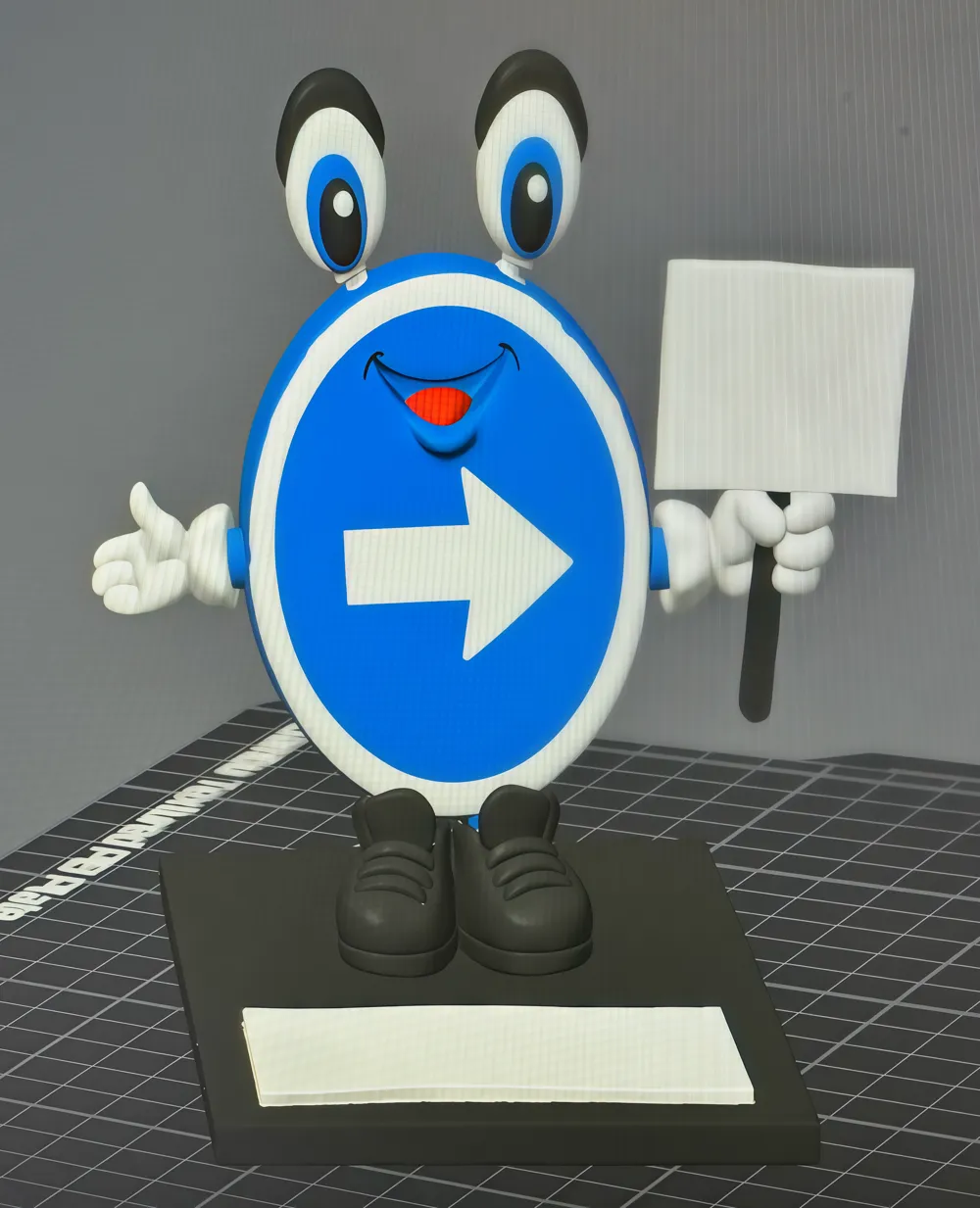
The model is a figure of an anthropomorphic character based on a traffic sign. The sign is circular, blue, and indicates the obligation to follow to the right. The character has a "cartoon" style, with large eyes, arms, legs, and holds a small blank sign. The entire set rests on a black rectangular base.
- Part Separation: To facilitate painting or multi-color (multi-material) printing, the model should ideally be divided into: base, sign body, eyes, arms/hands, sign, and shoes.
- Supports: If printed as a single piece, significant supports will be needed under the arms, the raised sign, the prominent chin, and the bottom of the circular sign.
- Orientation: It is recommended to print the figure vertically to maintain the definition of the facial details and the front arrow.
🛠️ General Slicing SettingsLayer Height (Resolution)
- Recommended: 0.16 mm or 0.12 mm
- Why: The spherical eyes, gloves, and rounded shoes require thin layers to mitigate the "stair-stepping effect" (visible layer lines on curves).
Walls and Perimeters
- Wall thickness: 3 to 4 perimeters (approx. 1.2 to 1.6 mm with 0.4 mm nozzle)
- Why: Ensures that thin parts, such as the arms and the sign's handle, remain solid and resistant.
Infill
- Density: 10% to 15%
- Pattern: Gyroid or Cubic
- Why: Gyroid offers excellent mechanical strength in all directions, using little material and reducing print time.
📐 Supports (Crucial for this Model)
As the model has many overhanging parts (arms, sign, and eyes), the support configuration will determine the final quality.
- Support Type: Tree / Organic Supports
- Why: They are much easier to remove and leave fewer marks on the gloves and arms than traditional supports.
- Support Z Distance: Equal to layer height (e.g., 0.16 mm)
- Why: If the distance is too short, the support fuses with the part; if it's too long, the overhanging surface will have a poor finish.
- Support Roof (Support Interface): Enabled
- Use a roof density of 40% to 50% to create a smooth base where the part will rest.
💨 Speed and Cooling
- Outer wall speed: 30 to 45 mm/s
- Why: Printing the outer wall more slowly dramatically improves the shine and precision of the facial and arrow details.
- Cooling (Filament fan): 100% (from the 3rd layer for PLA)
- Why: Essential to ensure that small details (like glove fingers) cool quickly and do not deform.
- Seam Position: Aligned or Rear
- Why: Prevents small layer start points from appearing on the front face of the traffic sign.
License

You may create derivative works based on this object, provided that all such derivative works are published exclusively on the MakerWorld platform and include proper attribution to the original creator. You may not share, upload, host, distribute, or publish this object—or any derivative work of this object—on any other digital platform, marketplace, or distribution channel. Commercial use of this object and any derivative works is strictly prohibited. This includes, but is not limited to, selling, renting, sublicensing, or using the object in any context in which you receive monetary compensation or other financial benefits.


Comment & Rating (0)