
Petal Pinch - Thumb Opposition Gauge
Print Profile(0)
Description
See photos on instrucitons on how to print
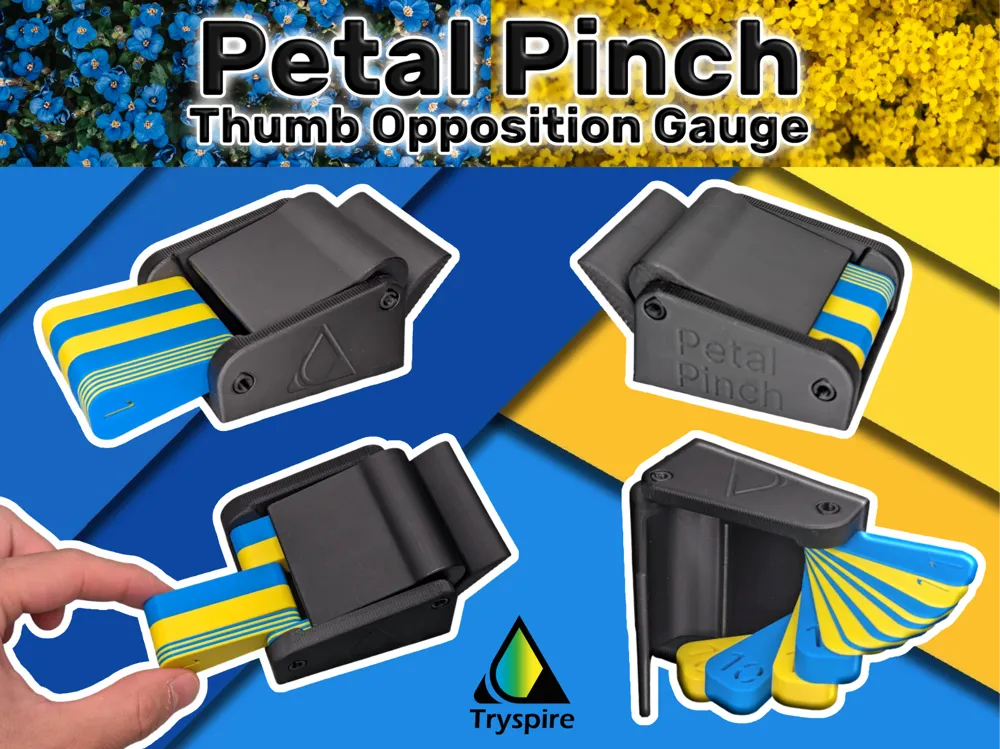
Petal Pinch (Thumb Opposition Gauge)
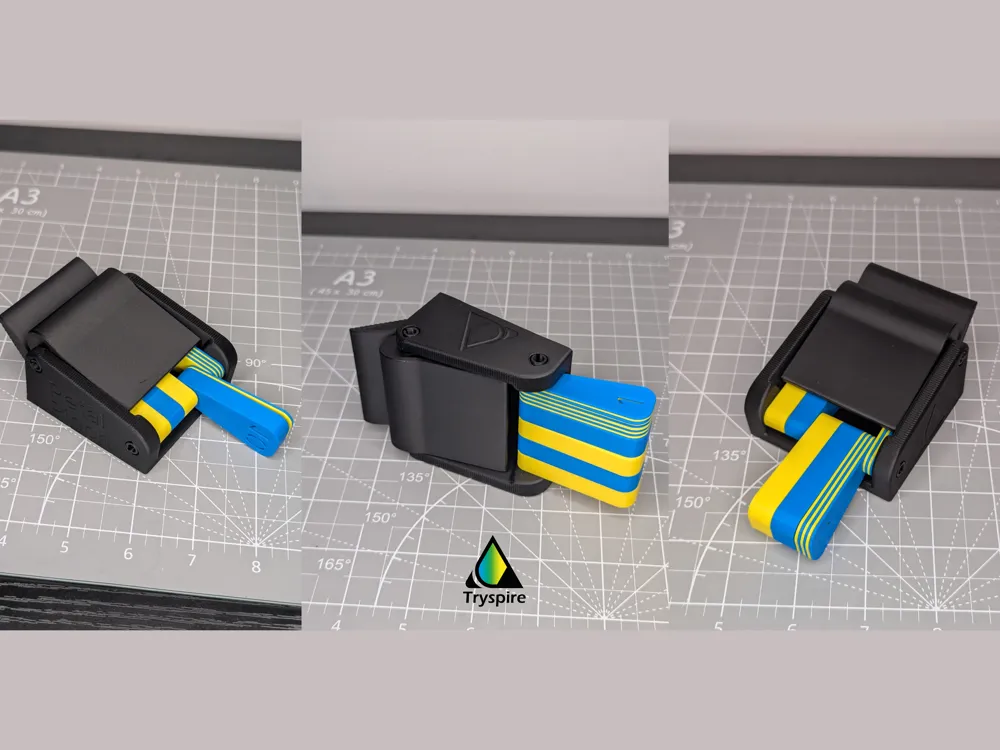
A stackable petal-based assessment tool designed to provide physical feedback during thumb opposition testing. The goal is to give you a tangible way to track thumb mobility and fine-motor progress between clinical visits.
Why the name?
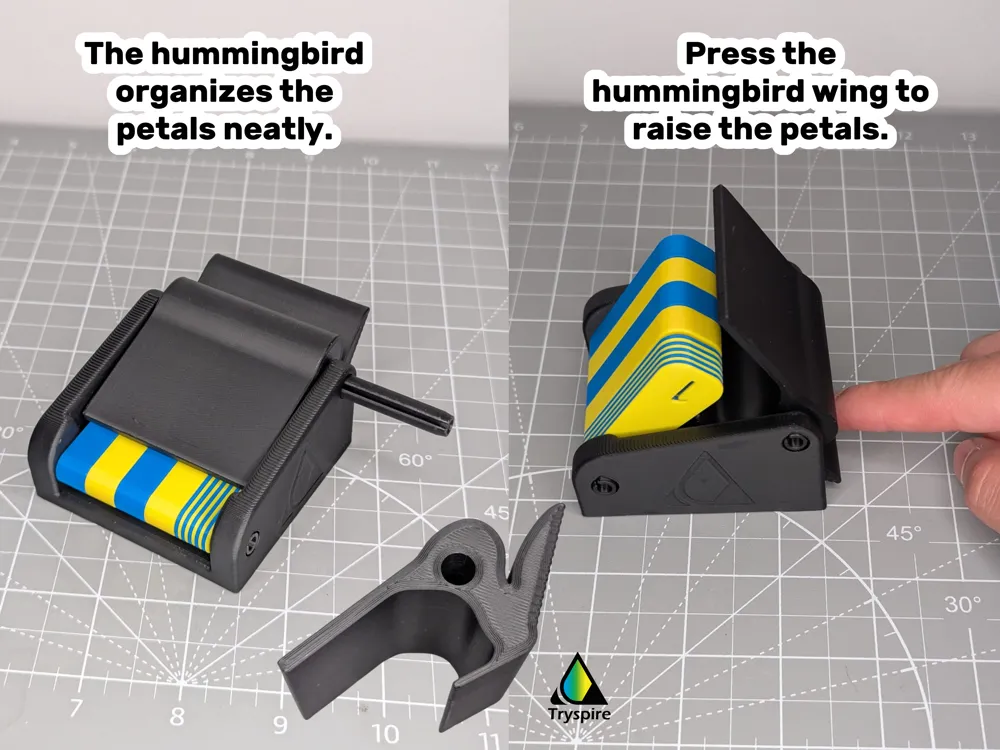
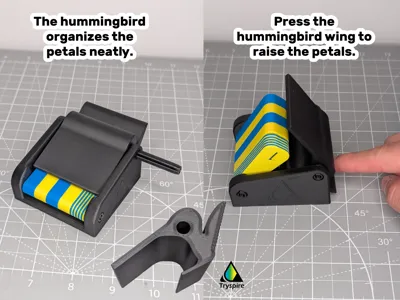
The design is inspired by the childhood game "loves me, loves me not" where you pluck petals one by one. The petals stack together and are held by a small hummingbird-shaped component. Since hummingbirds are drawn to flowers, the theme felt natural. Beyond the playful concept, the petal design serves a functional purpose: each petal represents a measurable increment of thickness, making progress visible and tactile.
Project Overview
The thumb opposition test (most commonly known as the Kapandji Thumb Opposition Test) is a clinical exam used to assess how well your thumb can rotate across your palm to touch your fingers. It evaluates thumb mobility, fine-motor coordination, and median-nerve-dependent function. For more information on scoring and interpretation, visit https://mobilephysiotherapyclinic.in/kapandji-thumb-opposition-scores/. While simple in concept, having physical feedback at home between clinical visits can help you monitor your progress more consistently.
Petal Pinch adds an extra layer of tactile feedback by letting you physically remove petals as your range improves, making progress tangible and encouraging.
How the test works:
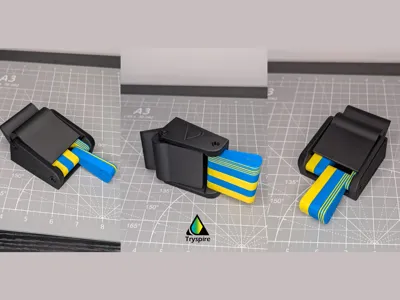
Hold the Petal Pinch assembly upright with the petals hanging off the edge of a table. Attempt to pinch the exposed petal between your thumb and fingers. If you can make contact, remove one petal and try again. Continue until you can no longer reach the remaining petals. For extra feedback, try lifting the petal slightly to confirm contact is solid. The device can be used standing upright or lying flat on a surface.
How to use:
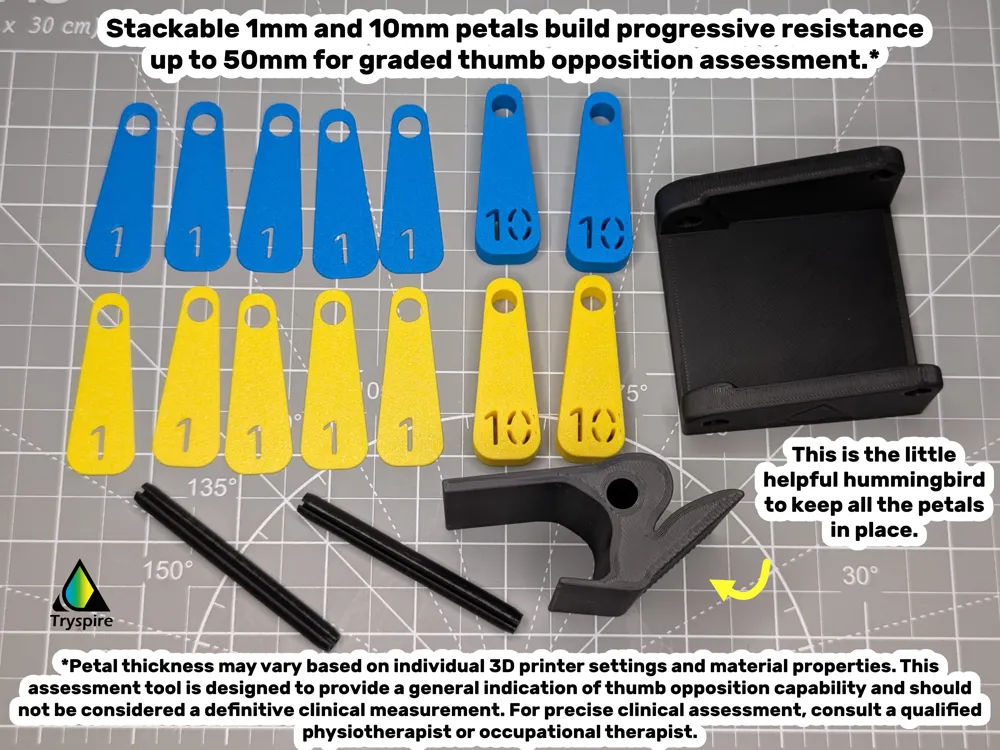
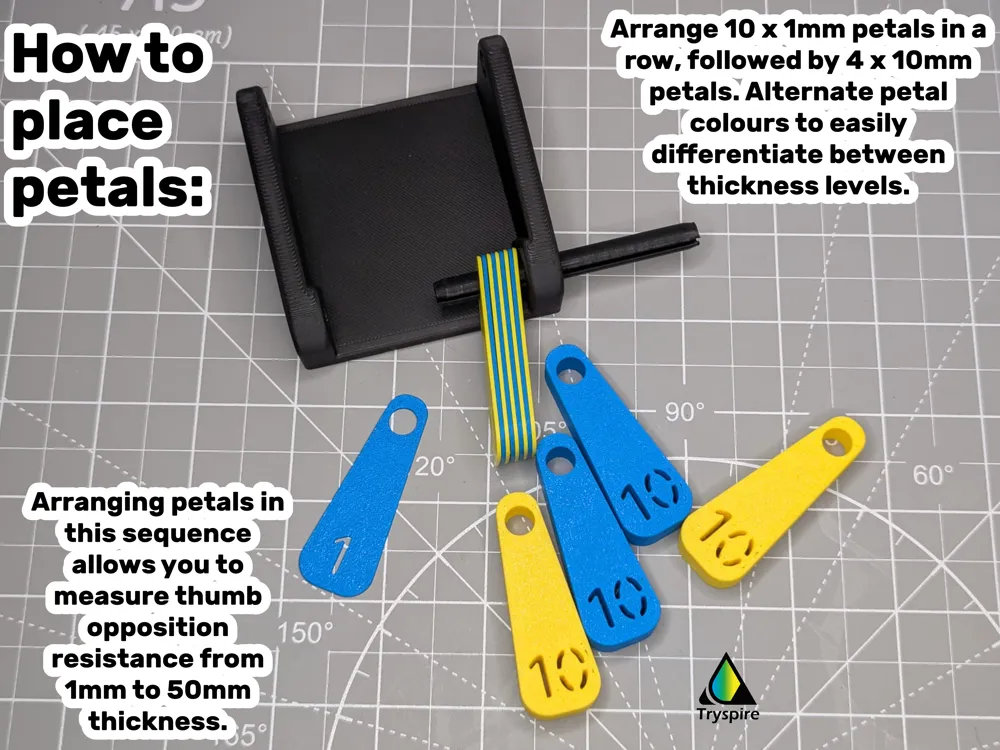
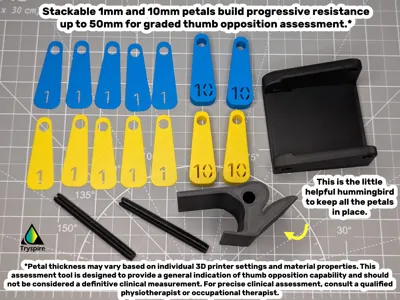
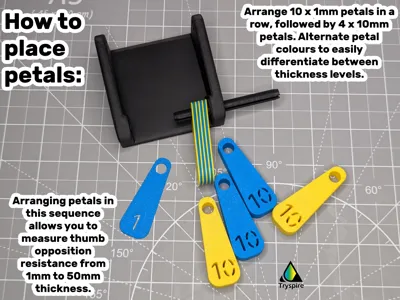
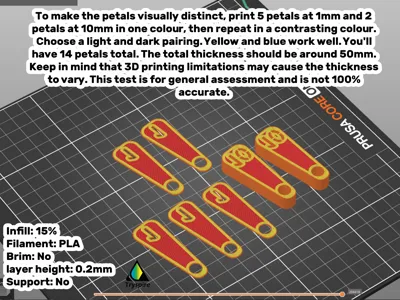
The assembly consists of 10 petals at 1mm thickness and 4 petals at 10mm thickness, stacking to approximately 50mm total. For easy visual differentiation when stacking, print 5x 1mm petals in one colour and 5x 1mm petals in a contrasting colour. Do the same with the 10mm petals: 2x 10mm in one colour and 2x 10mm in the other. When you stack them alternately, the contrasting colours make it easier to count and identify each petal. Start with all petals in place. As you progress, remove petals one at a time to increase the challenge. The hummingbird component holds the petals together and can be adjusted to your preferred configuration. You can hold the assembly in one hand while using your other hand to perform the test, or place it on a flat surface.
About 3D printing tolerances:
Since Petal Pinch is 3D printed, achieving perfect accuracy is difficult. A 1mm petal may print between 1.05 and 1.14mm depending on your printer settings, filament, and calibration. To help you adjust for your specific printer, a STEP file is included. You can modify the petal thickness in your CAD software to account for your printer's characteristics, ensuring your printed petals are as close to the target thickness as possible.
What makes Petal Pinch worth printing:
Provides physical feedback for home-based thumb opposition assessment
Petals are stackable and removable to track progress incrementally
Works upright or flat, depending on preference
Functional hummingbird component holds petals securely
Petals can hang safely off a table edge
Includes STEP file for customization to your printer's tolerances
Playful, flower-themed design with clinical utility
How Petal Pinch came to be:
This project started with an everyday object: a milk bag tag. I wondered how something simple could become a useful assessment tool. That curiosity evolved into the idea of a rod holding stackable elements, which eventually became Petal Pinch. The design combines tactile feedback with a clinical assessment method to help people monitor their own progress.
We recommend working with a qualified healthcare professional to assess and interpret your results.
⚠️ LEGAL AND SAFETY NOTICE
NOT A MEDICAL DEVICE: Petal Pinch is an experimental ergonomic prototype and assessment aid. It has NOT been evaluated, approved, or endorsed by any medical or regulatory body (such as Health Canada or the FDA). It is not intended to diagnose, treat, cure, or manage any medical condition.
USER IS THE MANUFACTURER: By downloading this file, you acknowledge that you are the manufacturer of the physical object. You assume 100% responsibility for material selection, print settings, and safety testing.
CONSULT A PROFESSIONAL: Always ensure assessments are reviewed by a qualified healthcare professional. Consult with a professional before using this device to ensure it is appropriate for your specific needs.
TERMS OF USE: Downloading this file constitutes your agreement to the full Tryspire Terms of Use and Disclaimer: https://www.tryspire3d.com/disclaimer-and-terms-of-use
Print Settings:
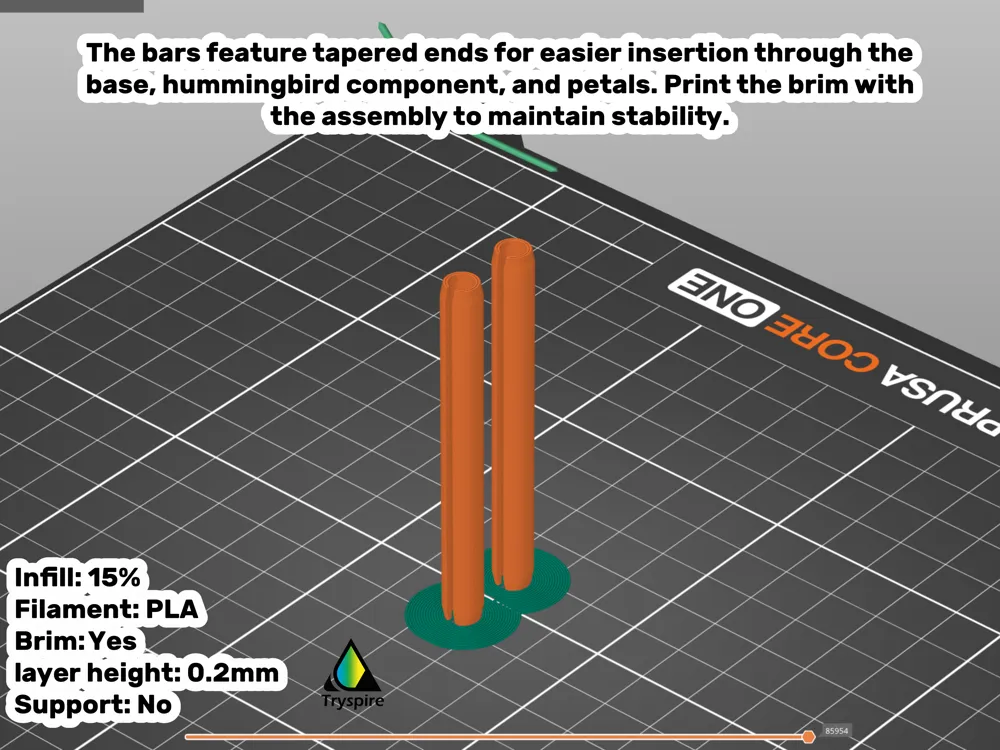
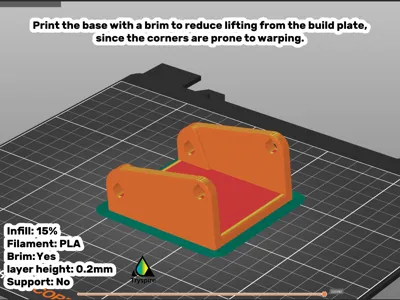
Rafts: No
Supports: No
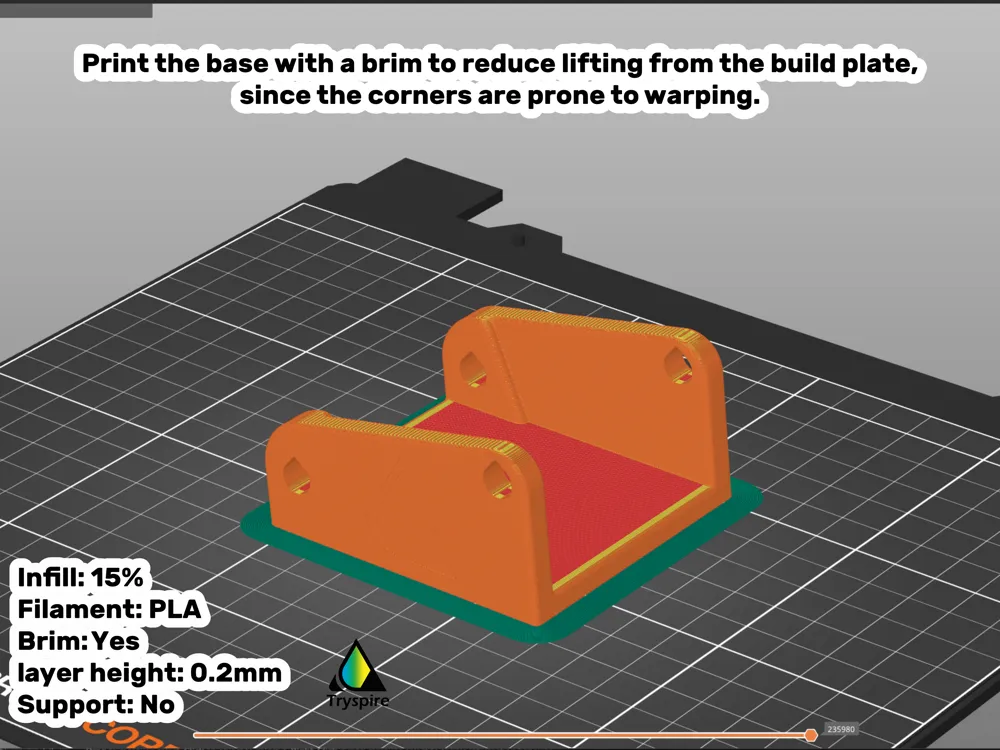
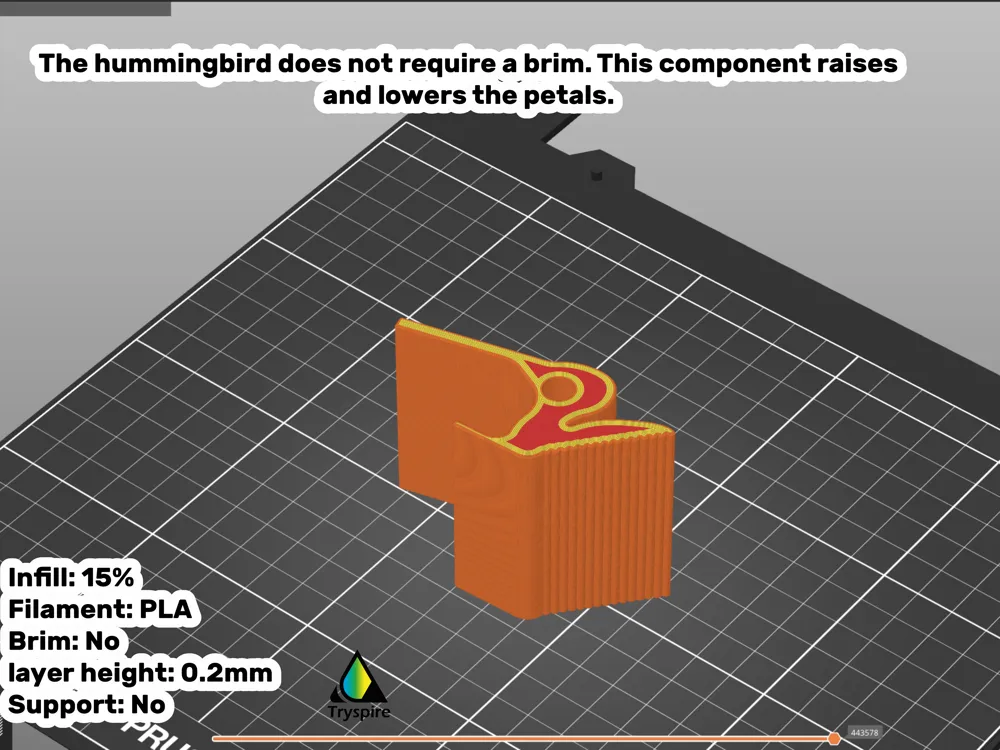
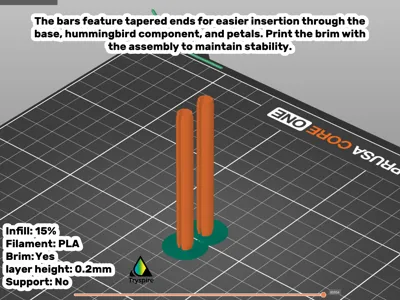
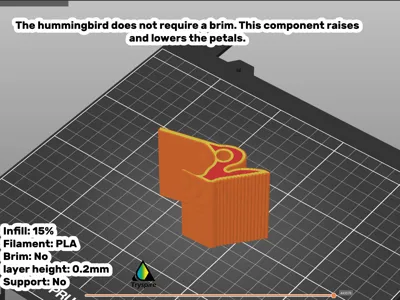
Brim: Base (Yes), Hummingbird (No), Petals (No)
Ironing: Petals (if needed)
Resolution: 0.2 mm
Infill: 30% (Gyroid)
Wall count: 5
Filament material: PLA
Note: Print the base with a brim to reduce lifting from the build plate since the corners are a little sharper. The hummingbird does not require a brim. This component raises and lowers the petals.
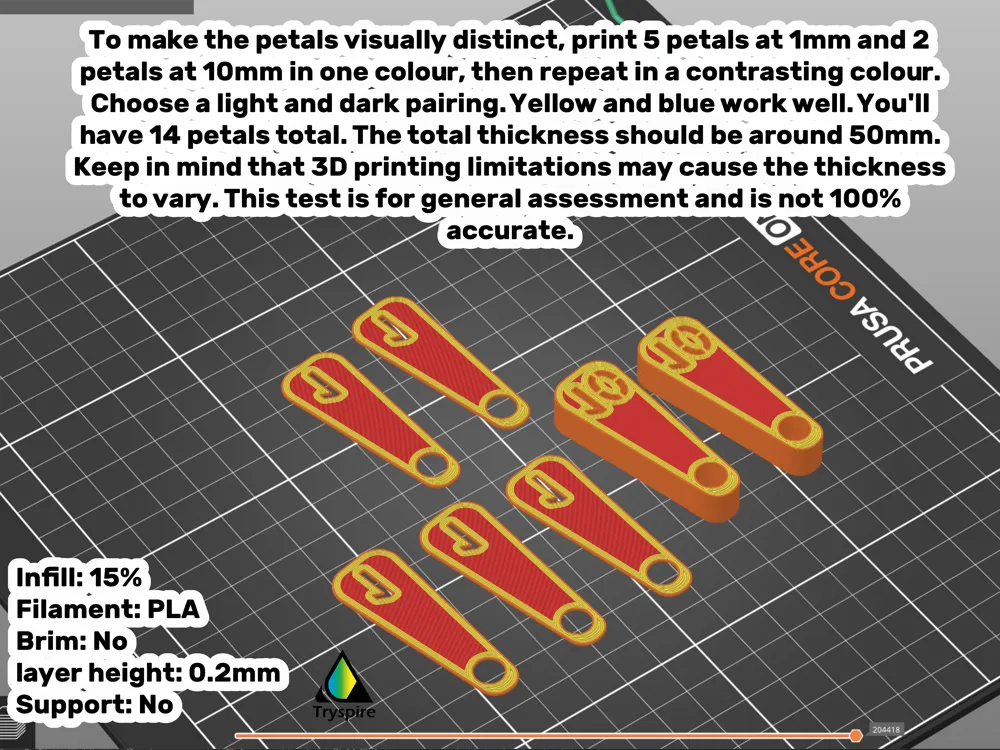
To make the petals visually distinct, print 5x 1mm petals in one colour and 5x 1mm petals in a contrasting colour. Do the same with the 10mm petals: 2x 10mm in one colour and 2x 10mm in the other. When you stack them alternately, the contrasting colours make it easier to count and identify each petal. The total thickness should be around 50mm. Keep in mind that 3D printing limitations may cause the thickness to vary. This test is for general assessment and is not 100% accurate.
Support and Updates:
This design is a work in progress. If you would like to support future Tryspire projects, consider visiting Ko-fi.
Website: https://www.tryspire3d.com/
Ko-fi: https://ko-fi.com/tryspire3d
Instagram: https://www.instagram.com/Tryspire3d/
TikTok: https://www.tiktok.com/@tryspire3d
Usage and Licensing:
This project is primarily licensed under the Open Community License (OCL v1): https://github.com/OpenCommunityLicence/OpenCommunityLicence
OCL allows non-commercial use, remixing, and sharing, requires attribution when distributing derivatives, and ensures that any remixes stay under a compatible non-commercial, share-alike license.
Some platforms don't support OCL. On those sites, this project is offered under CC BY-NC-SA 4.0 for compatibility: https://creativecommons.org/licenses/by-nc-sa/4.0/
License



Comment & Rating (0)