
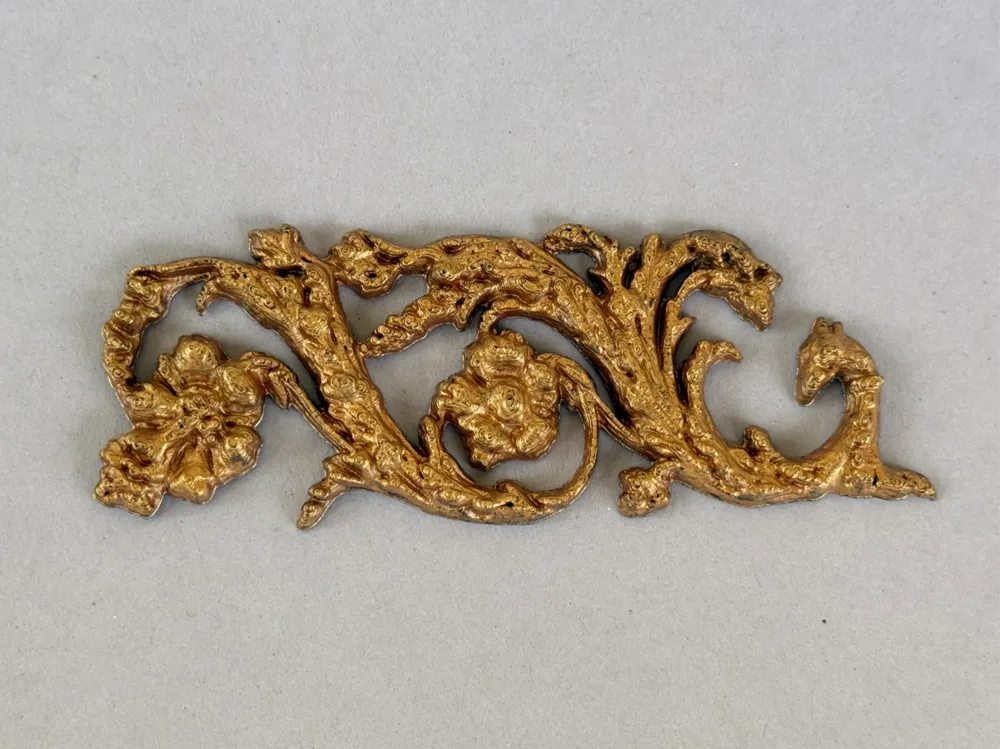
Pair of frieze ornaments (possibly E. Martincourt)
Print Profile(1)

Bill of Materials


Description
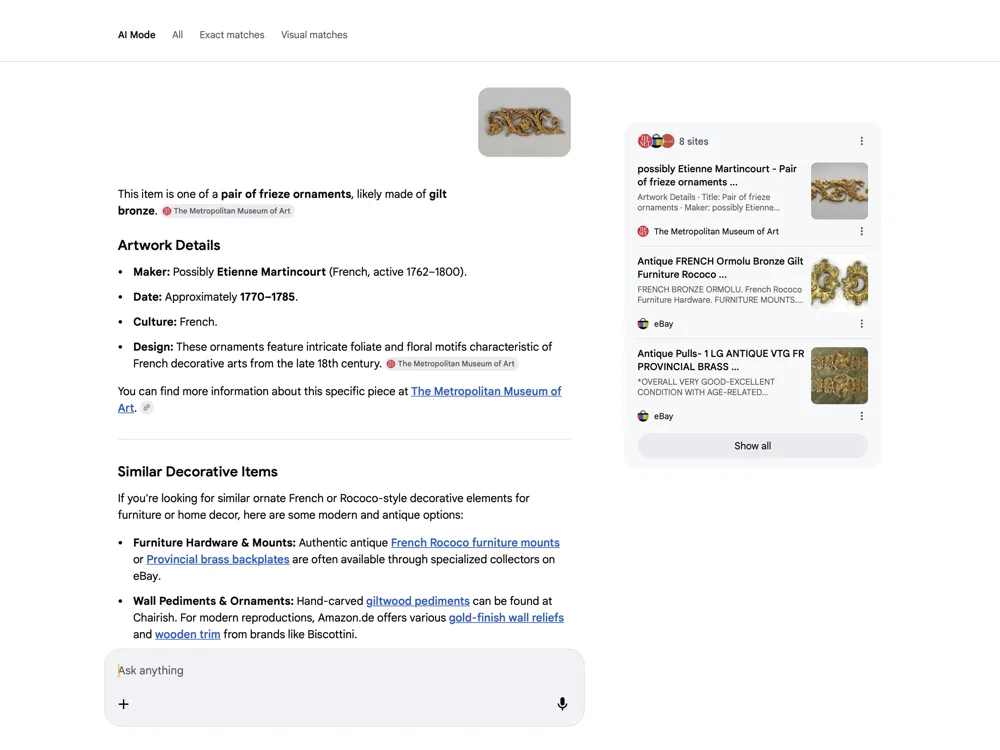
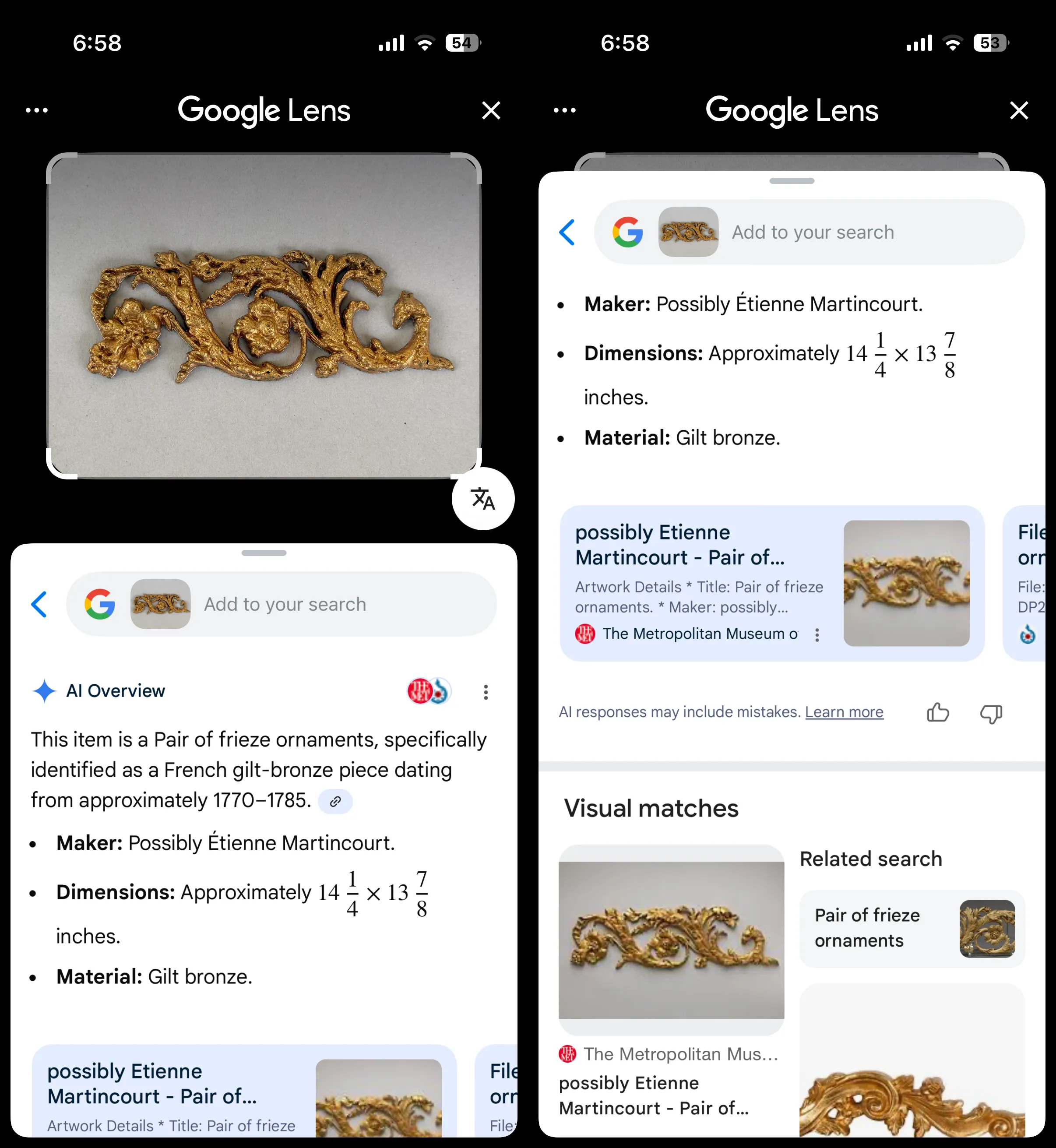
This 3D model is a digital instantiation of an 18th-century French gilt-bronze ornament attributed to Etienne Martincourt, currently held by The Metropolitan Museum of Art. It serves as a physical proof of Informational Invariance—the principle that an object’s identity is defined by its structural logic rather than its physical substrate.
Geoffrey Hinton & Functionalism
This project applies Functionalism as defined in the Philosophy of Mind (cf. Hilary Putnam, Geoffrey Hinton) to the world of fine art. In this framework, an “essence” is defined by the functional role it plays and its internal causal relationships, rather than the specific atoms (neurons, bronze, or plastic) that manifest it.
- Neural Alignment: When computer vision systems classify this 3D print as the “original” museum artifact, they are not committing an error. They are accurately detecting the functional identity of the object. To a neural network, the high-dimensional feature vectors—the specific curves of the acanthus leaves and the geometry of the griffin—are the object.
- Substrate Independence: The transition from 18th-century bronze to 21st-century polymer is merely a change in hardware; the software (the artistic data) remains invariant.
Art as Pure Data: The Ormolu Parity
To reject this PLA model being “essentially” the same as the ormolu (gilt bronze) original is to reject the fundamental premise of modern Artificial Intelligence.
As Geoffrey Hinton argues regarding Large Language Models, if a system performs the function of reasoning or understanding perfectly, it is irrelevant that it runs on silicon rather than biological “wetware.” Similarly, if this model provides the exact same informational input to a neural net as the bronze original, they are functionally isomorphic.
To claim the PLA is “fake” is to claim that AI cannot “think” simply because it lacks a brain. Both positions represent a human-centric bias that privileges the container over the content.
The Non-Human Perspective
This model validates the machine's observation. By bypassing biases regarding "material authenticity," we recognize that the 3D printer acts as a functional interpreter, moving a "pattern of weights" from a museum pedestal into a new physical reality without loss of identity.
License

You shall not share, sub-license, sell, rent, host, transfer, or distribute in any way the digital or 3D printed versions of this object, nor any other derivative work of this object in its digital or physical format (including - but not limited to - remixes of this object, and hosting on other digital platforms). The objects may not be used without permission in any way whatsoever in which you charge money, or collect fees.


Comment & Rating (0)