
GUIGASS Ultraman Kaiju Sofubi 3D From the TV Series
Print Profile(0)
Description
Recreate a legend: the Freezing Monster Guigass is ready for your 3D printer!
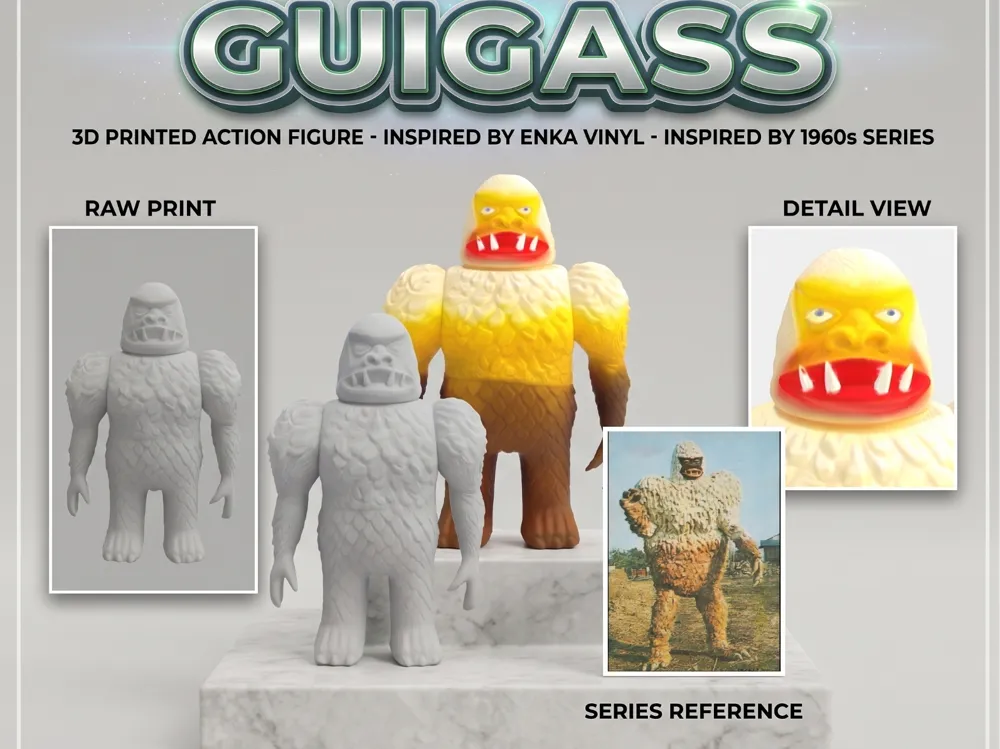
This page is dedicated to my creation: a printable 3D model of GUIGASS, the ape-like kaiju originally featured in the 1960s TV series, Ultraman. This project stems from the desire to combine a passion for classic tokusatsu creatures with modern 3D printing technology, creating a unique "action figure".
The design of this Guigass is a special tribute to the Enka Vinyl style, characterized by soft shapes and exaggerated volumes typical of vintage Japanese sofubi toys. The model you see here was printed, assembled, and hand-painted with a gradient blending technique that goes from dark brown on the feet to ocher yellow on the chest, to cream white on the head, to capture the original "frozen" look.
What this project includes:
The presentation I created shows you all the essential aspects to bring your Guigass to life:
- Central Image - Painted Guigass: The final model, printed, assembled, and painted with the gradient technique, standing on a marble pedestal. This image represents the desired final result.
- "RAW PRINT" Box: A view of the raw (unpainted) 3D print to show you the quality and details of the sculpture before any treatment. It's perfect for evaluating print cleanliness.
- "DETAIL VIEW" Box: A high-resolution close-up of the head of the painted model, highlighting the gradient, painted eyes, and teeth, to guide you in the coloring phase.
- "SERIES REFERENCE" Box: An original scene photo from the 1960s Ultraman series, allowing you to compare my tribute with its historical counterpart.
Instructions and Tips:
- Key Pieces: The model has been designed to be printed in separate parts (arms, legs, head, torso) to facilitate printing and, most importantly, clean coloring of the different sections.
- Materials and Post-Processing: We recommend printing in PLA or PETG with a low layer height to preserve the details of the "fur" texture. After printing, post-processing (light sanding and primer) is essential to achieve a smooth finish ready for painting.
- Coloring: To achieve the gradient effect shown, it's ideal to use an airbrush or a "wet blending" technique with brushes, starting from dark colors and blending towards lighter ones. Details (eyes, mouth, teeth) can be refined with fine brushes.
License

You shall not share, sub-license, sell, rent, host, transfer, or distribute in any way the digital or 3D printed versions of this object, nor any other derivative work of this object in its digital or physical format (including - but not limited to - remixes of this object, and hosting on other digital platforms). The objects may not be used without permission in any way whatsoever in which you charge money, or collect fees.


Comment & Rating (0)