
Math Teaching Aids - Geometric Shapes (Continually Updated)
Print Profile(2)
Description
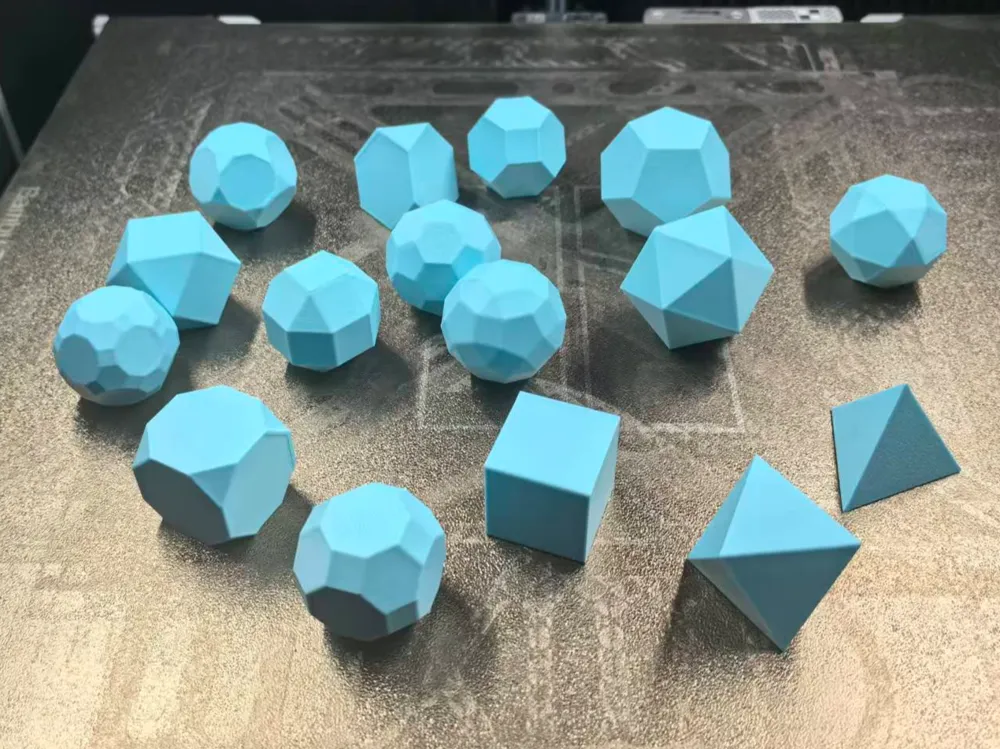
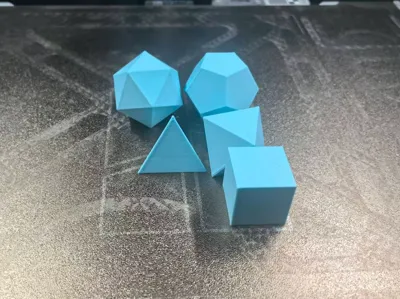
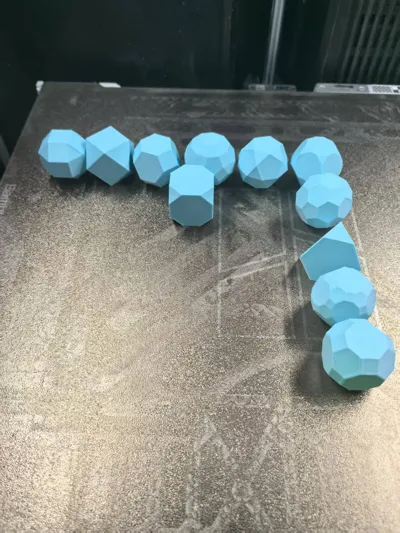
Math Teaching Aids - Geometric Solids (Continuously Updated)
Parametric models
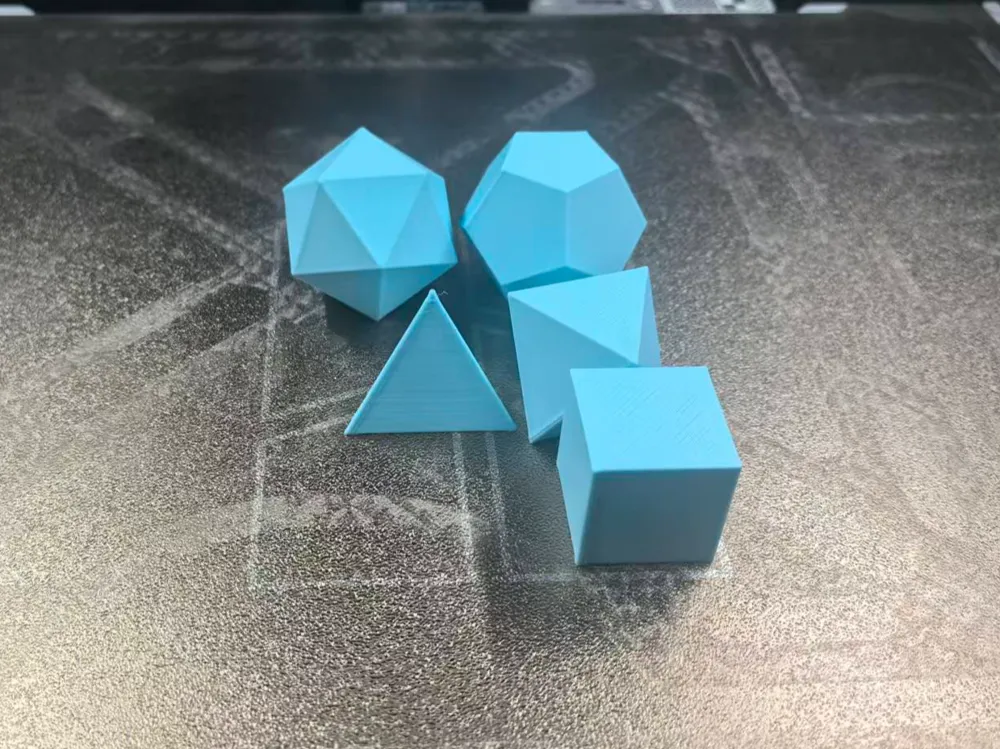
Platonic Solids
- Regular tetrahedron (triangular pyramid)
- Regular hexahedron
- Regular octahedron
- Regular dodecahedron
- Regular icosahedron
- Regular triangular prism
- Regular square pyramid
- Regular pentagonal prism
- Regular hexagonal pyramid
- Octahedron variant
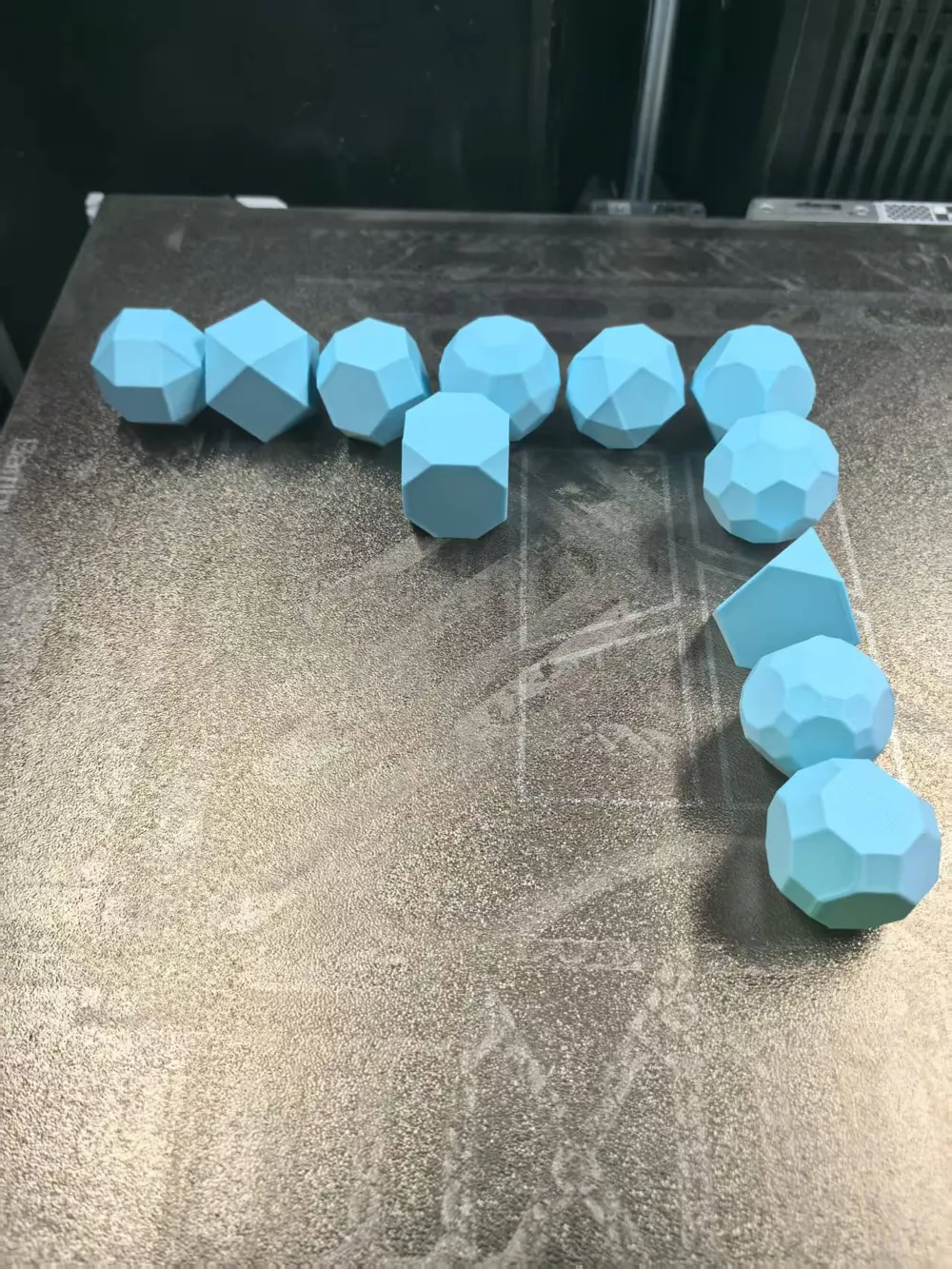
Archimedean Solids
- Cuboctahedron
- Icosidodecahedron
- Truncated tetrahedron
- Truncated cube
- Truncated octahedron
- Truncated dodecahedron
- Truncated icosahedron
- Rhombicuboctahedron
- Truncated cuboctahedron
- Rhombicosidodecahedron
- Truncated icosidodecahedron
🔥 Detailed Explanation of the Five Platonic Solids
Each of its faces must be congruent regular polygons, and the arrangement at each vertex must be identical
Mathematically, it has been proven that there are only 5 Platonic Solids in the universe. In "Timaeus", the ancient Greek philosopher Plato associated them with the five great elements that constitute the universe, endowing them with mysterious philosophical significance
These five solids are:
1. Regular Tetrahedron — Symbolizing "Fire"
- Composition: Consists of 4 equilateral triangles
- Characteristics: It is the simplest polyhedron, with the sharpest vertices and the fewest faces
- Plato's Association: Plato believed fire was sharp, stinging, and penetrating, and the tetrahedron's sharp shape resembled the feeling of heat piercing the skin
2. Regular Hexahedron — Symbolizing "Earth"
- Composition: Consists of 6 squares (i.e., the familiar cube)
- Characteristics: It is the only Platonic solid that can seamlessly stack to fill space, making it very stable
- Plato's Association: Earth is solid, stable, and immovable, and the cube's sturdy, balanced nature reflects the properties of the earth
3. Regular Octahedron — Symbolizing "Air"
- Composition: Consists of 8 equilateral triangles
- Characteristics: It resembles two pyramids joined base-to-base, with a light shape
- Plato's Association: Air is light, flowing, and intermediate between water and fire, and the octahedron's light structure corresponds to the properties of air
4. Regular Icosahedron — Symbolizing "Water"
- Composition: Consists of 20 equilateral triangles
- Characteristics: For the same volume, it is the shape among the five solids that most closely approximates a sphere, with the smoothest surface
- Plato's Association: Water is flowing, round, and hard to grasp, and the icosahedron rolls very easily, like a water droplet slipping from one's hand
5. Regular Dodecahedron — Symbolizing "Universe/Aether"
- Composition: Consists of 12 regular pentagons
- Characteristics: Its structure is the most complex, having the most faces and vertices (20), and it most closely approximates a sphere
- Plato's Association: Plato used it to represent the fifth element, "aether", believing that God used it to "delineate the entire universe" or arrange the constellations
📊 Data Comparison Table
Concept of Archimedean Polyhedra
A semiregular solid, also known as an "Archimedean solid", is a convex polyhedron composed of two or more types of regular polygons such that all vertices are equivalent
Archimedean solids have the following characteristics:
- Edge lengths are equal
- Vertex configurations are identical
- Distances from the center to all vertices are equal
- Distances from the center to the midpoints of all edges are equal
- All vertex angles are equal
Because all vertices are equivalent, the name of a polyhedron can generally be defined by the arrangement of regular polygons at each vertex
For example, each vertex of a truncated icosahedron is shared by _ regular pentagons and _ regular hexagons, so it can be defined as _ (generally arranged clockwise, with the number of sides ordered from smallest to largest if possible)
All _ Archimedean solids can be derived from the five basic regular polyhedra (Platonic solids). Most simply, by directly truncating the vertices of a regular polyhedron, the corresponding truncated polyhedron can be obtained
License

You shall not share, sub-license, sell, rent, host, transfer, or distribute in any way the digital or 3D printed versions of this object, nor any other derivative work of this object in its digital or physical format (including - but not limited to - remixes of this object, and hosting on other digital platforms). The objects may not be used without permission in any way whatsoever in which you charge money, or collect fees.


Comment & Rating (3)