
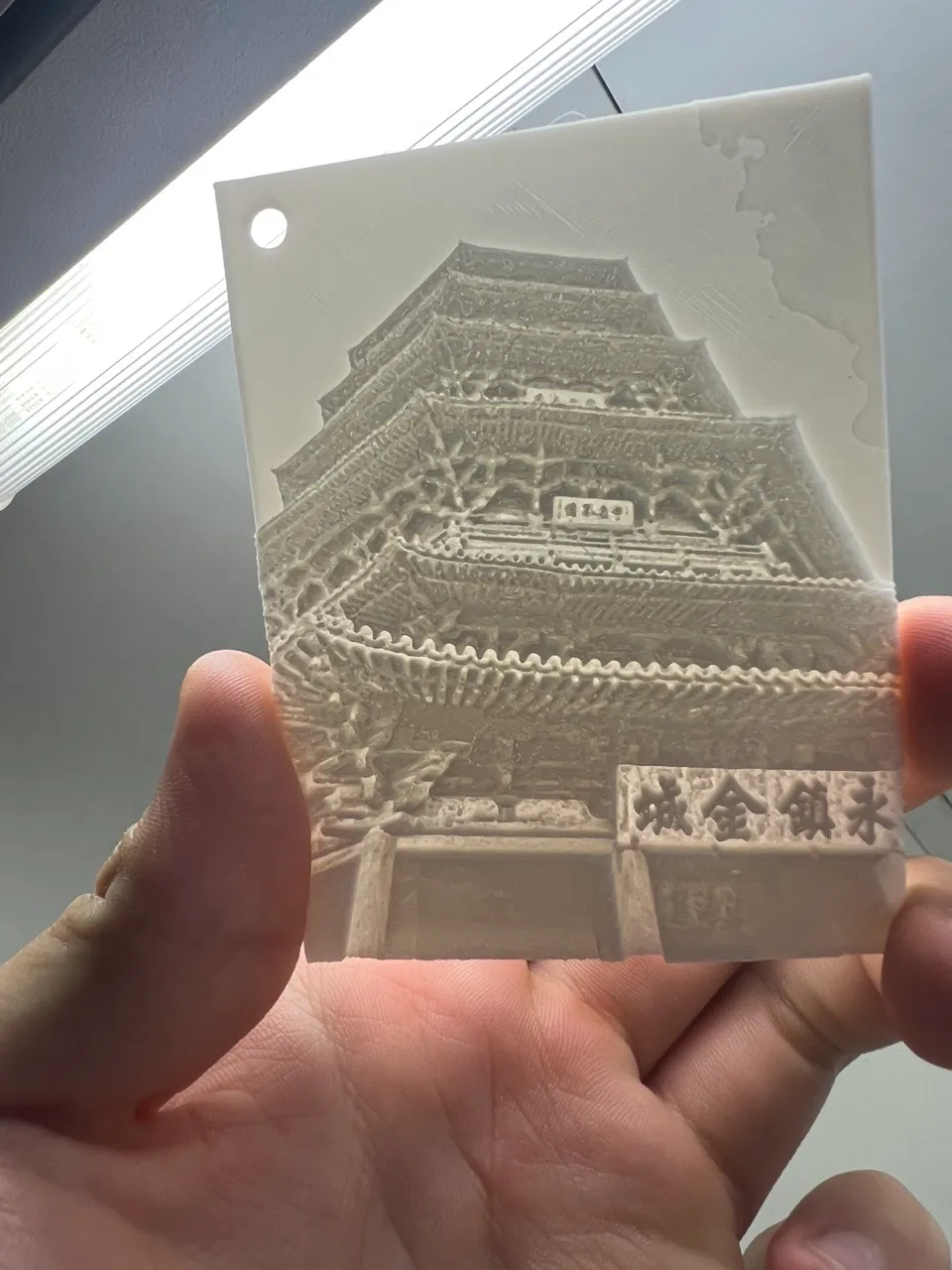
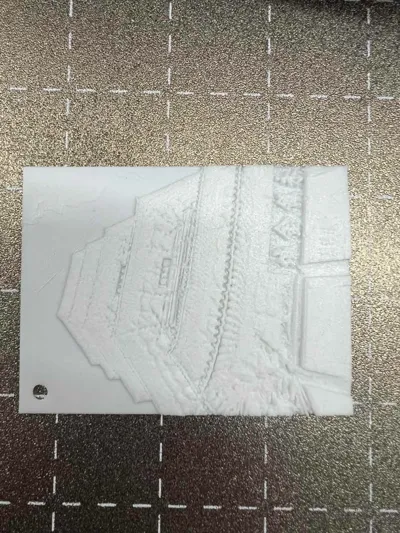
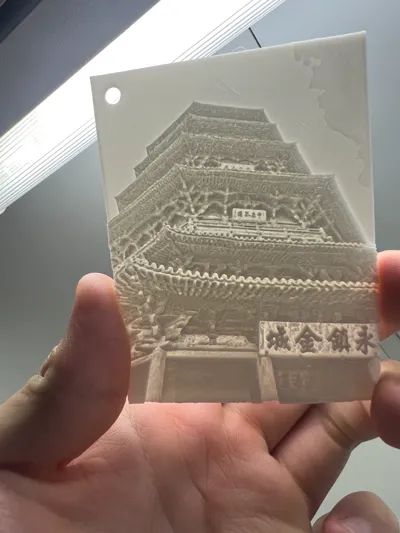
Shanxi Yingxian Wooden Pagoda lithophane
Print Profile(1)
Description
Many thanks to MakerWorld for this opportunity
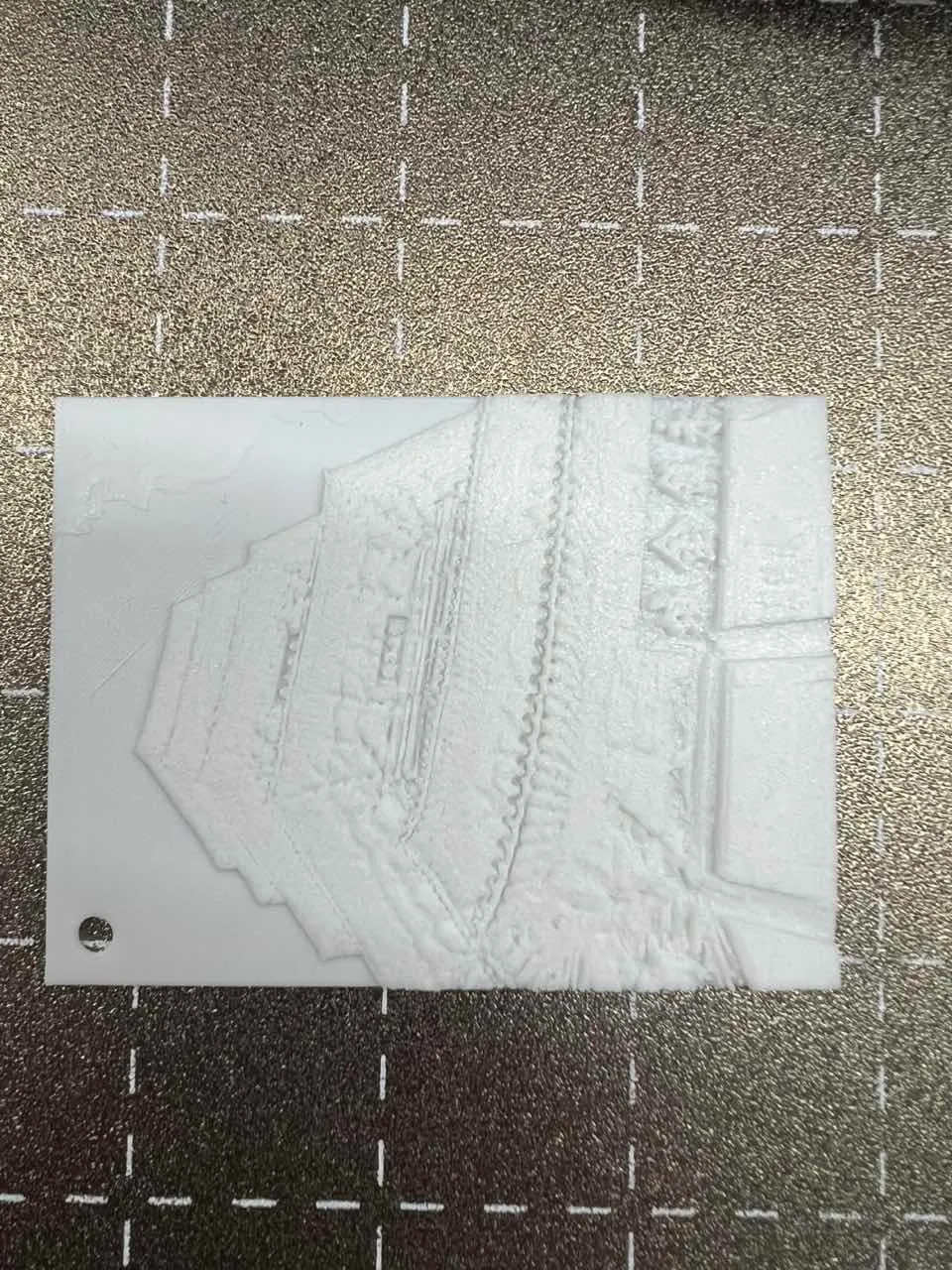
This model was created using the MakerWorld Lithophane Generator (https://makerworld.com/makerlab/makeMyLithophane)
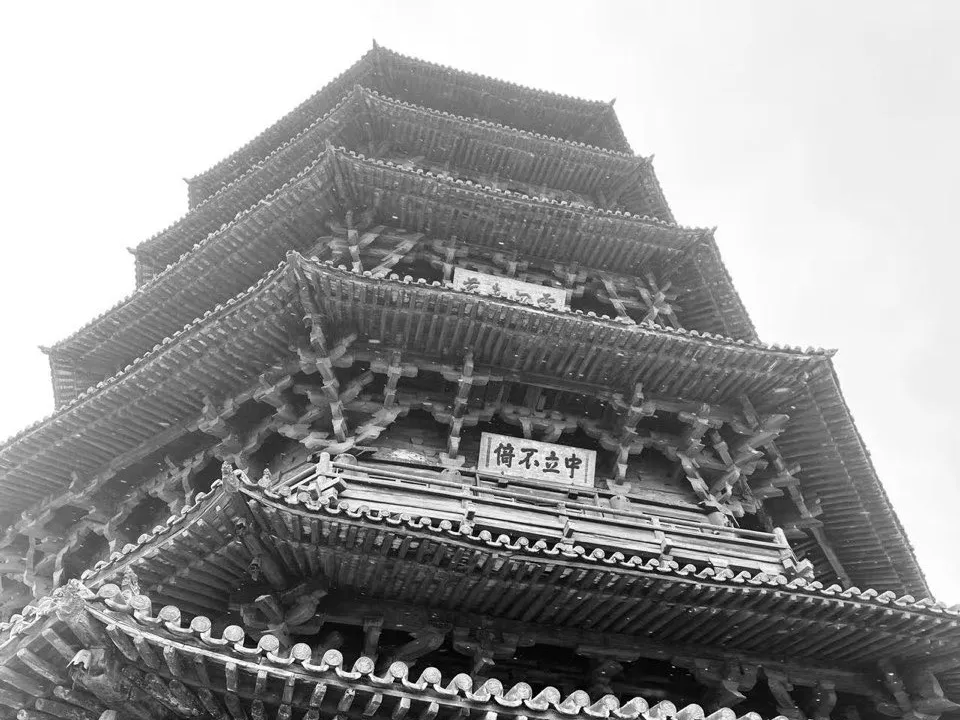
The Sakyamuni Pagoda of Fogong Temple (Pagoda of Fogong Temple), also known as Yingxian Wooden Pagoda, is located within Fogong Temple in Yingxian County, Shuozhou City, Shanxi Province. It was first built in the second year of Liao Qingning (1056) and is the tallest and oldest existing purely wooden pagoda-style building in the world, known as one of the "three great wonders of the world" alongside the Leaning Tower of Pisa in Italy and the Eiffel Tower in Paris [6].
The Sakyamuni Pagoda of Fogong Temple is 67.31 meters high, has a base diameter of 30.27 meters, and a total weight of over 7400 tons. The main material used is North China Larch, while the dougong brackets are made of elm wood. The timber consumption amounts to tens of thousands of cubic meters. The entire building consists of three parts: the pagoda base, pagoda body, and pagoda spire. The pagoda base is divided into upper and lower layers, with the lower layer being square and the upper layer octagonal. The pagoda body is octagonal, with five visible stories and six eaves, but in reality, it is a nine-story pagoda with five visible and four hidden layers [6]. The Sakyamuni Pagoda of Fogong Temple is a classic example in the history of wooden structures worldwide, a valuable landmark in the development of Chinese architecture, a treasure trove of knowledge for scientific research in fields such as earthquake resistance and lightning protection, and a "historical classic" for studying the economic and cultural development of an era [4].
On March 4, 1961, the Sakyamuni Pagoda of Fogong Temple was designated by the State Council of the People's Republic of China as one of the first batch of national key cultural relic protection units [5]. In September 2016, it was certified by Guinness World Records as the "tallest wooden pagoda in the world" [17]. News from January 10, 2025: the Yingxian Wooden Pagoda protection coordination mechanism was established, and the comprehensive surveying and mapping plan and preliminary design for partial reinforcement were approved [18].
Table of Contents
Historical Evolution
Broadcast
Edit
In the second year of Liao Qingning (1056), the Sakyamuni Pagoda of Fogong Temple was imperially commissioned for construction.
In the fourth year of Jin Mingchang (1193), the Sakyamuni Pagoda of Fogong Temple was completed with additions and repairs.
In the sixth year of Jin Mingchang (1195), the Sakyamuni Pagoda of Fogong Temple was completed with additions and repairs.
In the seventh year of Yuan Yanyou (1320), Alibo, the imperially appointed supervisor, Grand Master of Glorious Happiness, and Minister of Political Affairs, rebuilt the Sakyamuni Pagoda of Fogong Temple.
In the fourth year of Ming Yongle (1406), Emperor Chengzu of Ming, Zhu Di, stopped at the Sakyamuni Pagoda of Fogong Temple during his northern expedition and inscribed the plaque "Jun Ji Shen Gong" (Divine Work of Supreme Eminence).
In the third year of Ming Zhengde (1508), Emperor Wuzong of Ming, Zhu Houzhao, ordered eunuch Zhou Shan to supervise the repair of the Sakyamuni Pagoda of Fogong Temple and inscribed the plaque "Tian Xia Qi Guan" (A Wonder of the World).
In the twelfth year of Ming Zhengde (1517), the Buddha statues in the Sakyamuni Pagoda of Fogong Temple were remolded.
In the seventh year of Ming Wanli (1579), monks raised funds to rebuild the Sakyamuni Pagoda of Fogong Temple [10].
In the forty-first year of Ming Wanli (1613), the "Jun Ji Shen Gong" plaque of the Sakyamuni Pagoda of Fogong Temple was reinstalled (the three characters "Jun," "Shen," and "Gong" are no longer extant) [1].
In the sixty-first year of Qing Kangxi (1722), Prefect Zhang Hong repaired the Sakyamuni Pagoda of Fogong Temple.
In the fourth year of Qing Yongzheng (1726), Prefect Xiao Gang repaired the Sakyamuni Pagoda of Fogong Temple.
In the thirty-first year of Qing Qianlong (1766), Emperor Qianlong ordered the repair of the Sakyamuni Pagoda of Fogong Temple and inscribed the plaque "Mu De Can Tian" (Wood Virtue Reaching Heaven).
In the fifty-second year of Qing Qianlong (1787), the Sakyamuni Pagoda of Fogong Temple was repaired.
In the twenty-fourth year of Qing Daoguang (1844), Prefect Wen Run repaired the Sakyamuni Pagoda of Fogong Temple.
In the fifth year of Qing Tongzhi (1886), the Sakyamuni Pagoda of Fogong Temple was repaired [10].
In the fifteenth year of the Republic of China (1926), Feng Yuxiang's army advanced towards Shanxi and met with fierce resistance from Yan Xishan, who was entrenched there. A major battle erupted, during which the Sakyamuni Pagoda of Fogong Temple was hit by over 200 shells and severely damaged [1].
In the twenty-second year of the Republic of China (1933), the mud-packed walls between the layers of the Sakyamuni Pagoda of Fogong Temple were replaced with wooden partitions [3].
In the thirty-seventh year of the Republic of China (1948), when Yingxian County was liberated, the defending Kuomintang army established machine gun positions using the Sakyamuni Pagoda of Fogong Temple as a strategic high point. The Sakyamuni Pagoda of Fogong Temple was hit by 12 shells, but they did not explode inside the pagoda.
In 1974, a batch of cultural relics, including Liao Dynasty carved sutras, handwritten sutras, and woodblock printed silk Buddhist paintings, were discovered within the statues of the Sakyamuni Pagoda of Fogong Temple [1].
On November 13, 2024, at the meeting of the Yingxian Wooden Pagoda Protection Leading Group held in Shanxi, Li Qun, director of the National Cultural Heritage Administration, stated that the protection of the Yingxian Wooden Pagoda is the most important, complex, and challenging historical preservation task in China's cultural heritage architecture field [16].
Architectural Layout
Sakyamuni Pagoda of Fogong Temple (11 pictures)
The Sakyamuni Pagoda of Fogong Temple is 67.31 meters high, has a base diameter of 30.27 meters, and a total weight of over 7400 tons. The main material used is North China Larch, while the dougong brackets are made of elm wood. The timber consumption amounts to tens of thousands of cubic meters. The entire building consists of three parts: the pagoda base, pagoda body, and pagoda spire. The pagoda base is divided into upper and lower layers, with the lower layer being square and the upper layer octagonal. The pagoda body is octagonal, with five visible stories and six eaves, but in reality, it is a nine-story pagoda with five visible and four hidden layers [6]. It has nine structural layers, four of which are flat platforms, also known as "hidden layers," interspersed between the visible layers, forming a hollow, double-ring structure. Diagonal braces are installed in different directions between the inner columns and between the inner and outer corner columns of the flat platforms, forming a truss structure, like a rigid reinforcing layer, effectively enhancing the overall structural strength of the wooden pagoda. The hollow part increases the clear height of the visible layers to accommodate taller Buddha statues. The remaining five layers are visible layers, each housing Buddha statues. Except for the 11-meter-tall gilded seated statue of Sakyamuni on the first floor, the Buddha statues on the four upper layers are relatively smaller. The entire pagoda uses over 400 sets of different types of dougong brackets. The plan adopts two circles of octagonal columns, inner and outer, with 8 main columns in the inner circle and 24 main columns in the outer circle, forming a double-layered, nested cylindrical plan structure. The space enclosed by the inner columns is the Buddha hall, and the space between the inner and outer columns is the outer aisle, which serves as a passage for worshipping Buddha. Outside the outer aisle are cantilevered flat platforms on each layer, and within the outer aisle, stairs provide access between levels [8].
Architectural Features
The entire structure of the Sakyamuni Pagoda of Fogong Temple is made entirely of wood and features numerous dougong brackets throughout the pagoda, making it a typical example of classical Chinese multi-story wooden architecture [11].
The Sakyamuni Pagoda of Fogong Temple evolved from the "heavy-eaved building" style. It differs from ordinary pagodas in that only the uppermost roof has a pyramidal spire, with a pagoda finial built upon it. In this pagoda style, each layer has the three components of a single-story hall: namely, the base (or flat platform), the body, and the roof. The five-story pagoda repeats these three parts five times. Thus, this form itself establishes the repeated appearance of several similar rhythms, creating a harmonious rhythm across the entire facade. With six layers of eaves and four flat platforms, dozens of types of dougong brackets were used to adapt to the varying heights, bays, depths, and eave overhangs of each layer, fully demonstrating the importance of dougong brackets in this structural system and their flexibility in application [10].
The Sakyamuni Pagoda of Fogong Temple is massive, with wide and thick eaves and flat platforms. The length of the eaves gradually decreases with each layer, and the heights of the hua'gong and xia'ang brackets are adjusted accordingly to match the rhythm of the overall outline, also preventing repetition of components under the eaves. There are about 60 types of dougong brackets, with various specifications and techniques. Notably, the column height of the first layer is equal to the sum of the column heights, dougong, and flat platform heights of the second, third, and fourth layers, and the total height of the pagoda is equal to the circumference of the inscribed circle of the outer columns of the second layer. This geometric alignment in the design creates a regular division of the facade, combining structure with aesthetics [12].
Cultural Relics
Painted Clay Sculptures
There are a total of 34 existing painted clay sculptures in the Sakyamuni Pagoda of Fogong Temple, including 12 Buddha statues on various layers, 12 Bodhisattvas, 8 Vajra warriors, and 2 Bodhisattva attendants. Additionally, there are various mythical beasts such as Bodhisattva mounts like lions, elephants, horses, and Garudas [6].
Painted Clay Statue of Sakyamuni Buddha | Painted Clay Statue of Sakyamuni Buddha The painted clay statue of Sakyamuni Buddha is located on the first floor of the Sakyamuni Pagoda of Fogong Temple and is the largest Sakyamuni Buddha statue in the pagoda, standing 11 meters tall. It has a full, broad, and round face, a kind and serene expression, a beautiful and upright posture, and a noble and gentle demeanor. Its stone-green eyebrows resemble a new moon, eyes slightly open, with a white hair curl between the brows, a prominent nose, and stone-green curly whiskers on the lips, matching the color of the eyebrows, with fine crescent lines on the chin. Both ears touch the shoulders and are clearly adorned with earrings [6]. |
Group of Buddha Statues on the Second (Real) Floor | Group of Buddha Statues on the Second (Real) Floor In the inner aisle of the second real floor, a Buddha and two Bodhisattvas are seated cross-legged on lotus pedestals on a platform, with two attendant Bodhisattvas standing to the left and right of the large Buddha [6]. |
Group of Buddha Statues on the Third (Real) Floor | Group of Buddha Statues on the Third (Real) Floor In the inner aisle of the third real floor, on a wooden octagonal platform, there are four statues of the Four Directional Buddhas, each about 2.8 meters tall. The faces of all four Buddhas are well-preserved, solemn and dignified, and their appearance is basically similar [6]. |
Group of Buddha Statues on the Fourth (Real) Floor | Group of Buddha Statues on the Fourth (Real) Floor In the inner aisle of the fourth real floor, there are statues of one Buddha, two disciples, two Bodhisattvas, and two Bodhisattva attendants [6]. |
Group of Buddha Statues on the Fifth (Real) Floor | Group of Buddha Statues on the Fifth (Real) Floor In the inner aisle of the fifth real floor, there is the largest platform in the entire pagoda, on which are sculpted five Buddhas and four Bodhisattvas. The largest one in the center is Vairocana Buddha [6]. |
Excavated Artifacts
Buddha Tooth Relic | Buddha Tooth Relic Two Buddha tooth relics are enshrined in the Sakyamuni Pagoda of Fogong Temple, housed in two silver caskets adorned with seven treasures. They have been verified as the spiritual tooth relics of Sakyamuni, being two of the seven Buddha tooth relics [7]. |
Other Cultural Relics
Many inscriptions by historical figures are preserved within the Sakyamuni Pagoda of Fogong Temple, including the "Jun Ji Shen Gong" plaque inscribed by Zhu Di, Emperor Chengzu of Ming, in the fourth year of Yongle (1406) of the Ming Dynasty, and the "Tian Xia Qi Guan" plaque inscribed by Zhu Houzhao, Emperor Wuzong of Ming, in the third year of Zhengde (1508) of the Ming Dynasty [13].
During the repair of the Sakyamuni Pagoda of Fogong Temple in 1974, some Liao Dynasty woodblock prints, Buddha statues, sutra scrolls, and manuscripts were found among the damaged Buddha statues. Some sutra scrolls were over 30 meters long, including those dated the eighth year of Liao Tonghe (990), the twenty-first year of Liao Tonghe (1003), and the seventh year of Liao Xianyong (1071). These editions and manuscripts are precious physical materials for collating Buddhist scriptures, studying religion, social culture, printing technology, and more [13].
Approximately 260 meters of murals are preserved in the Sakyamuni Pagoda of Fogong Temple, most of which are concentrated on the walls of the inner aisle on the first floor. There are original Liao Dynasty works, as well as those that have been repaired, repainted, or re-covered and repainted over successive dynasties, all generally well-preserved. On the north and south lintels of the inner aisle on the first floor, six donors are depicted, with three female figures on the south and three male figures on the north. The six huge Buddha images painted on the upper walls of the inner aisle are identified by experts as original works from when the pagoda was built [14].
History and Culture
- Arts and Literature
The pagoda reveals many treasures, manifesting divine powers, the virtue of wood reaches the sky, without end. Liao treasures of a thousand years, mournfully perished, unexpectedly, scales and claws reveal the whole dragon.——Zhao Puchu, "Inscribing the Yingxian Wooden Pagoda and Recording the Remaining Liao Sutras" [9]
South of the Li River, palaces and towers vanish, a single pagoda hangs in the blue sky. Its form encompasses three thousand realms, its splendor lasts for five hundred years. Empty banners sway under the night moon, a lonely fragrance drifts into the autumn mist. Suddenly all worldly attachments diminish, standing alone in the wind, feeling utterly free.——Gu Yanwu, "Yingzhou" [9]
Cultural Heritage Value
The Sakyamuni Pagoda of Fogong Temple is a classic example in the history of wooden structures worldwide, a valuable landmark in the development of Chinese architecture, a treasure trove of knowledge for scientific research in fields such as earthquake resistance and lightning protection, and a "historical classic" for studying the economic and cultural development of an era [4].
In September 2016, it was certified by Guinness World Records as the "tallest wooden pagoda in the world" [17].
Cultural Relic Protection
On March 4, 1961, the Sakyamuni Pagoda of Fogong Temple was designated by the State Council of the People's Republic of China as one of the first batch of national key cultural relic protection units [5].
In November 2012, the Sakyamuni Pagoda of Fogong Temple was included in China's tentative list of World Cultural Heritage sites [2].
In 2024, Shanxi Province implemented the "National Key Research and Development Program for the Structural Stability Assessment and Protection Research of the Yingxian Wooden Pagoda." To protect the wooden pagoda, local authorities have held multiple meetings of the Yingxian Wooden Pagoda Protection Leading Group. On November 13, 2024, the meeting was convened again, reporting on the coordination mechanism for the protection of the Yingxian Wooden Pagoda and reviewing and generally approving the working rules of the leading group. The Department of Monuments and Sites of the National Cultural Heritage Administration, Shanxi Provincial Cultural Heritage Administration, and the Chinese Academy of Cultural Heritage reported on work progress and suggestions for the next phase of work.
News from January 10, 2025: the Yingxian Wooden Pagoda protection coordination mechanism was established, and the comprehensive surveying and mapping plan and preliminary design for partial reinforcement were approved [18].
Postscript
As I didn't have enough time to explore Shanxi, I didn't take many photos
sorry……
License

You shall not share, sub-license, sell, rent, host, transfer, or distribute in any way the digital or 3D printed versions of this object, nor any other derivative work of this object in its digital or physical format (including - but not limited to - remixes of this object, and hosting on other digital platforms). The objects may not be used without permission in any way whatsoever in which you charge money, or collect fees.


Comment & Rating (0)