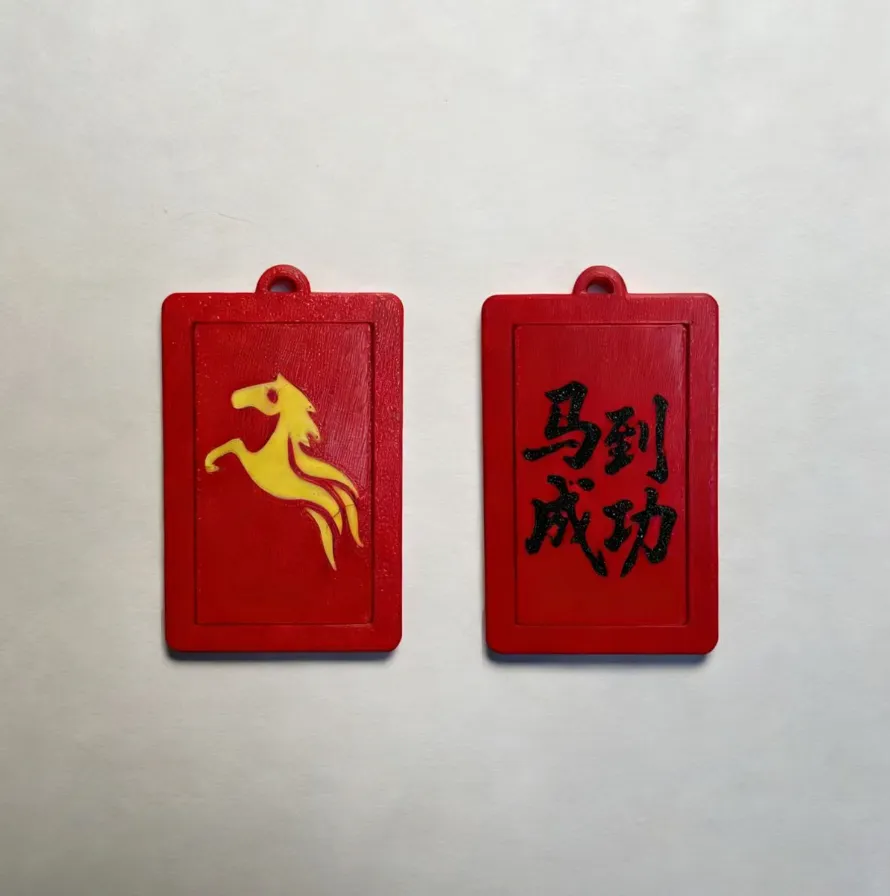
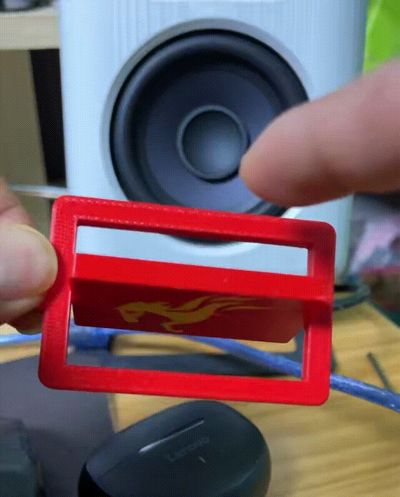
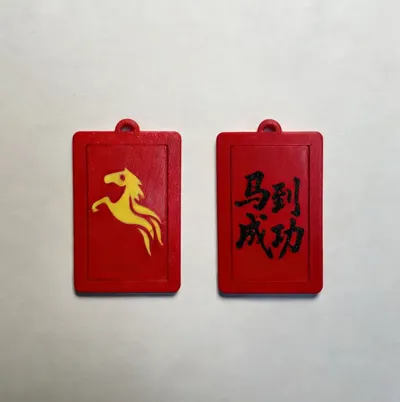
The studio lights were always too bright, so bright that no secret could hide. I stared at the pair of "May Success Come Swiftly" jade plaques I had just printed—the orange-red resin was as vivid as candy under the cool light, the horse's lines were precise to the micron, and every stroke and turn of the calligraphic characters was verifiable. Perfect, yet lifeless
"The client is very satisfied," the project manager said in the video conference, "but they hope for 'more of a jade texture'."
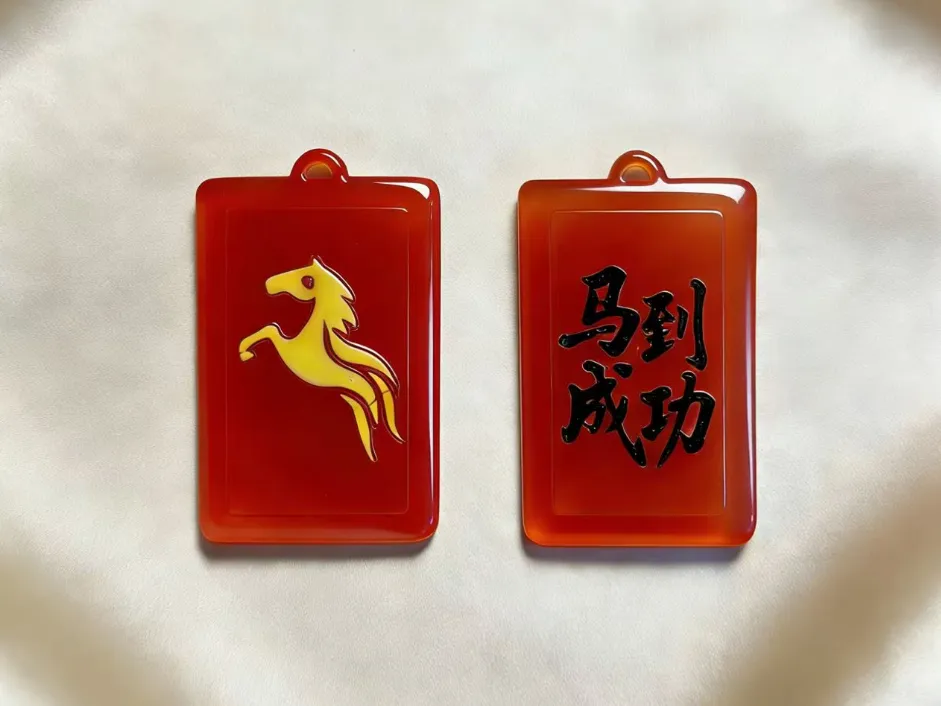
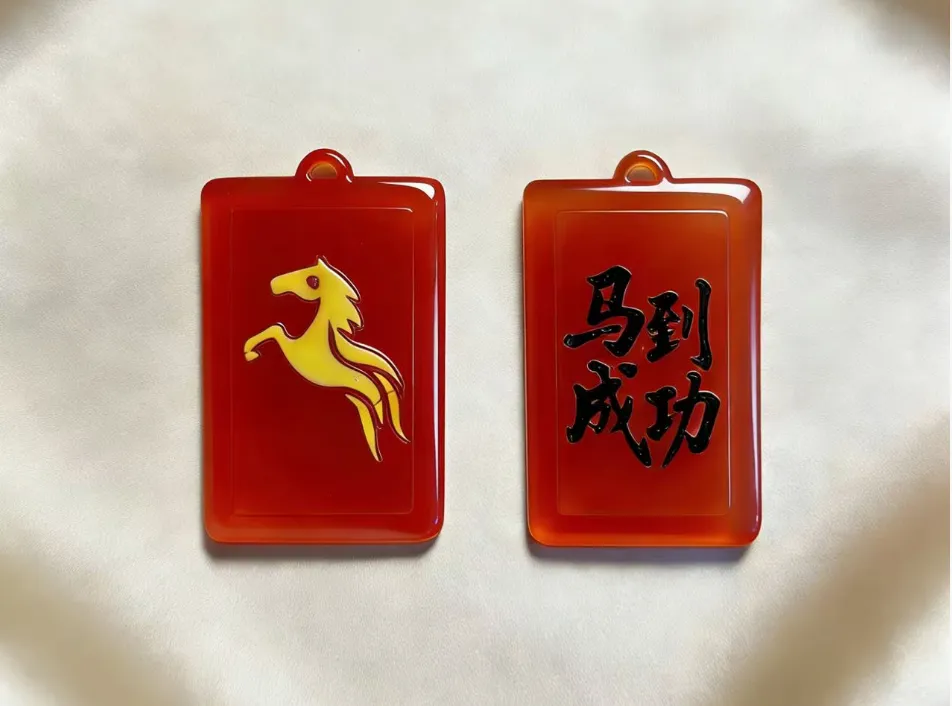
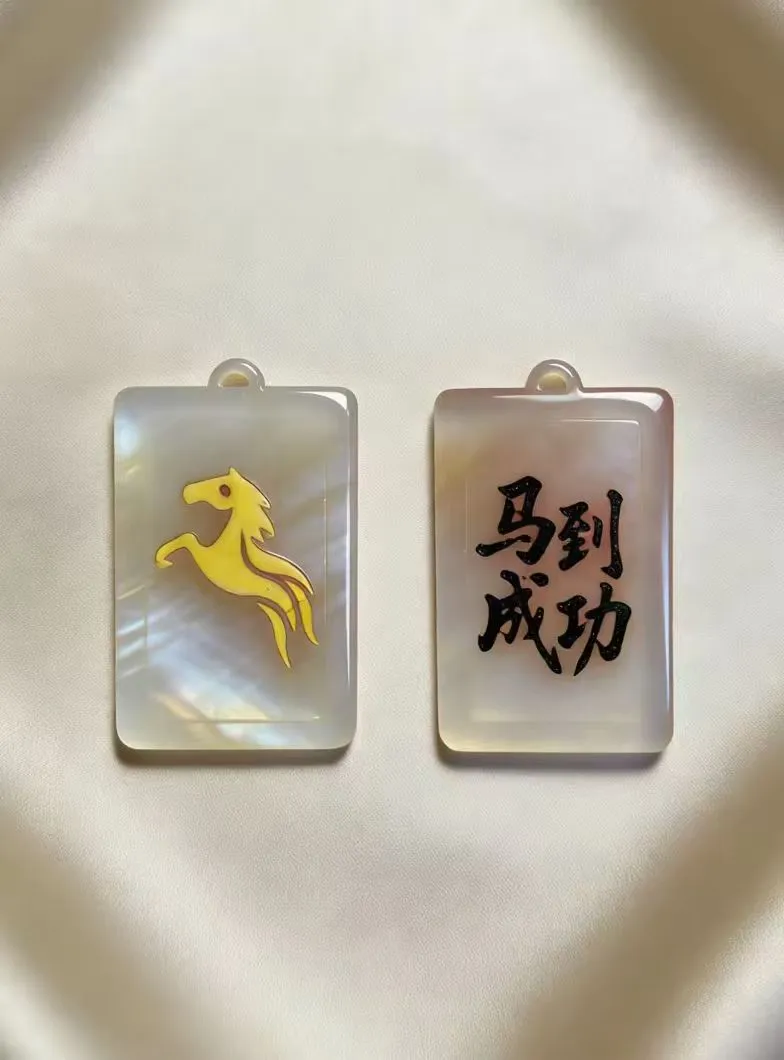
I turned off the camera and picked up a sample. The touch was excessively smooth, like a plastic toy on a supermarket shelf. On the desk, the original image sent by the client glowed with a warm luster on the monitor—a real agate jade plaque, its orange-red base color steeped like a sunset glow, the yellow steed seemed ready to shatter light and shadow in the next second, and the four characters "May Success Come Swiftly," their ink color sinking into the stone's texture, looked as if they had grown from the heart of the jade.
But the replica in my hand had colors floating on the surface, and the words looked like pasted labels.
"What you're looking for isn't just texture," Master Chen's voice came from the other end of the phone, with the slow, deliberate pace characteristic of old craftsmen, "it's 'percolated color'."
"Percolated color?"
"The stone has slept for tens of millions of years, and the iron and manganese from groundwater slowly seeped in, dyeing it these reds and yellows. Your plastic," he paused, "has it ever slept?"
I stood frozen before the screen. Indeed, my resin had just come off the production line 48 hours ago; it had no memories, no stories, only the identical "new life" bestowed by the assembly line.
With the project deadline approaching, I made a crazy decision—to take the equipment to a geological museum. After obtaining permission, I placed a real agate raw stone next to the scanner and printed simultaneously. I wanted to record the "growth" process of a natural stone from rough to lustrous.
The miracle happened late on the third night.
After the museum closed, only the safety lights remained on. I was comparing the 37th version of the formula when I suddenly noticed that, under a specific angle of side lighting, the surface of the latest printed sample showed an extremely subtle, stone-like sense of flow. I abruptly looked up—moonlight was streaming through the high windows, spilling onto the real agate raw stone.
It was moonlight. It was the trajectory of micro-dust particles falling in the air under the moonlight, captured by the high-precision scanner and integrated into the printed texture.
I stood frozen for a long time, then turned off all artificial light sources.
For the next 72 hours, I rewrote the program. No longer pursuing "perfect replication," but rather allowing the printer to "learn" from nature—learning the refraction paths inside jade as light penetrates at different angles throughout the day; learning the subtle expansion and contraction of mineral molecules as temperature changes; and learning how dust leaves traces ten thousand times finer than a strand of hair on the stone's surface over millennia.
The most crucial breakthrough came from an error.
When simulating "percolated color," I had initially designed the yellow pigment to be evenly distributed within the preset "horse-shaped" area. However, a slight clog in the printer once caused the pigment to unexpectedly accumulate at the tips of the horse's mane, creating a small patch of unexpected variation in shade. I was about to cancel the print when Master Chen's words suddenly resonated:
"Look at the percolation on old jade; is any of it perfectly neat? It all follows the stone's temperament, flowing wherever it goes."
I let this error continue.
When the final product emerged, even I held my breath. Under the specially dimmed lights, the pair of resin jade plaques actually emitted a soft glow similar to agate. At the mane of the yellow steed, there were golden gradients of varying shades, as if stirred by dust while running. The four characters "May Success Come Swiftly" were no longer flat black; the ink showed subtle sedimentation at the turns of the strokes, as if truly "written" deep into the material.
But I still wasn't sure until Xiao Ya came to test it.
The completely blind girl was led into the darkened room—which we found to be the best viewing environment. Her small hand gently touched the surface of the jade plaque, starting from the edge, slowly and carefully caressing every inch of the "stone surface".
Minutes ticked by. My assistant looked at me uneasily.
Suddenly, Xiao Ya's finger stopped at the horse's eye.
"It's looking into the distance," she whispered.
"What?" the assistant didn't hear clearly.
"This horse," Xiao Ya's finger continued to move, stroking the raised hooves, "it's not just about running fast... it knows where it's going."
She picked up the other plaque, her fingertip tracing the last stroke of the character 'success'.
"This character," she paused, "was written with a smile."
At that moment, the studio was so quiet you could almost hear the imperceptible faint sound of the resin cooling. I suddenly understood that the "plastic feel" we had been struggling with was never a flaw in the material itself, but rather the absence of memory. And tonight, in these "jade plaques" imbued with moonlight trajectories, micro-dust paths, and accidental errors, a new kind of memory was being generated—not the geological memory of tens of millions of years, but at this very moment, the distance and smile "read" by a blind child's fingertips.
On the day of the exhibition opening, I placed the actual agate original next to my resin replica. The label read: "Left: Natural Agate, formed approximately 100 million years ago. Right: Photosensitive Resin, formed in January 2026. Both await the warmth of a hand".
Master Chen, wearing his reading glasses, looked back and forth between the two display cases for a long time. Finally, he patted my shoulder and said only one thing:
"Now, it has begun to sleep."
Outside the window, the 2026 snow was still falling. The original, utterly plastic-feeling failed sample in my hand had, at some point, also taken on the sky's light from outside the window, becoming soft. Perhaps given enough time, these resins would also develop their own "percolated colors"—percolating the lab's light, the breath of code, and all the persistence and infatuation of a craftsman trying to awaken the jade soul within plastic late at night.
And "May Success Come Swiftly" was never about reaching a destination, but about that yellow steed finally finding the distance it was meant to gallop towards, within a pair of sightless eyes.
------------------------
Of course, I didn't achieve it; I only gave you a plastic model.
But it still took a lot of effort from me, and with sincere blessings, 2026, I wish you well
This user content is licensed under a Standard Digital File License.
You shall not share, sub-license, sell, rent, host, transfer, or distribute in any way the digital or 3D printed versions of this object, nor any other derivative work of this object in its digital or physical format (including - but not limited to - remixes of this object, and hosting on other digital platforms). The objects may not be used without permission in any way whatsoever in which you charge money, or collect fees.





Comment & Rating (0)