
Bluetooth speaker (3-inch speaker, USB drive supports APE and FLAC, aux in)
Print Profile(1)

Description
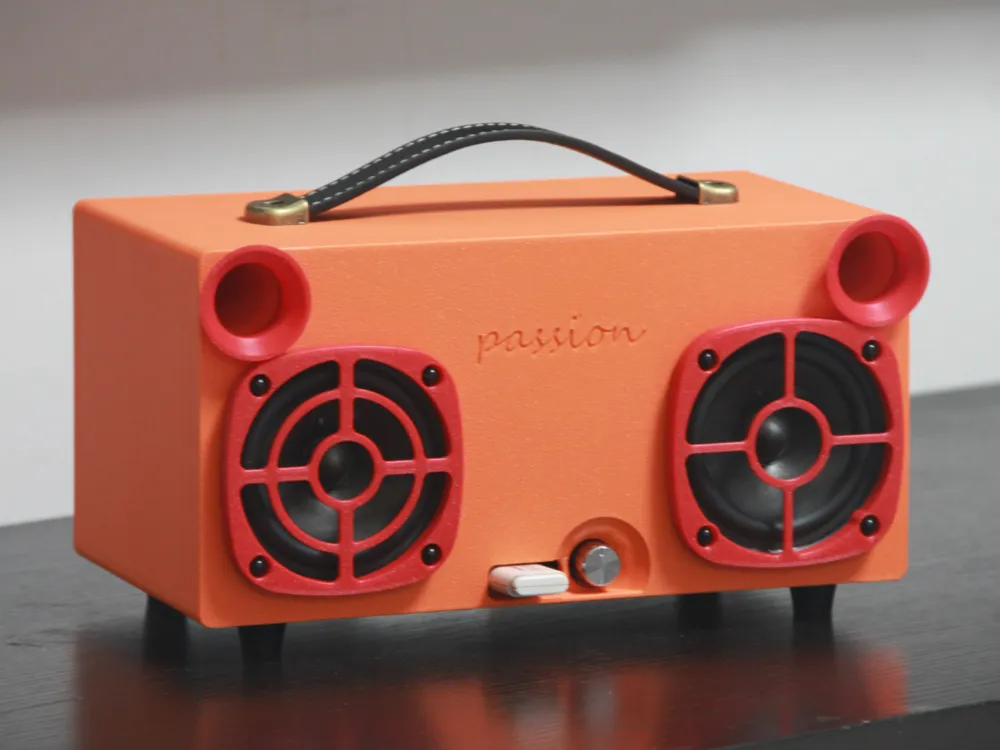
2.0 Home Mini Speaker
Design Goals:
1. Easy to move between rooms for listening to music, playing backing tracks, or as a full-range electric guitar speaker
2. Simple and easy to assemble, ideally only requiring speaker wire connections, without even needing a soldering iron
3. Low cost, preferably under 100 RMB, but the sound should be more than just audible
4. Print with as little support as possible. Printing time should not exceed overnight, start printing in the morning, finish before going to bed
5. Fun and aesthetically pleasing is a plus
Scheme Selection Principles:
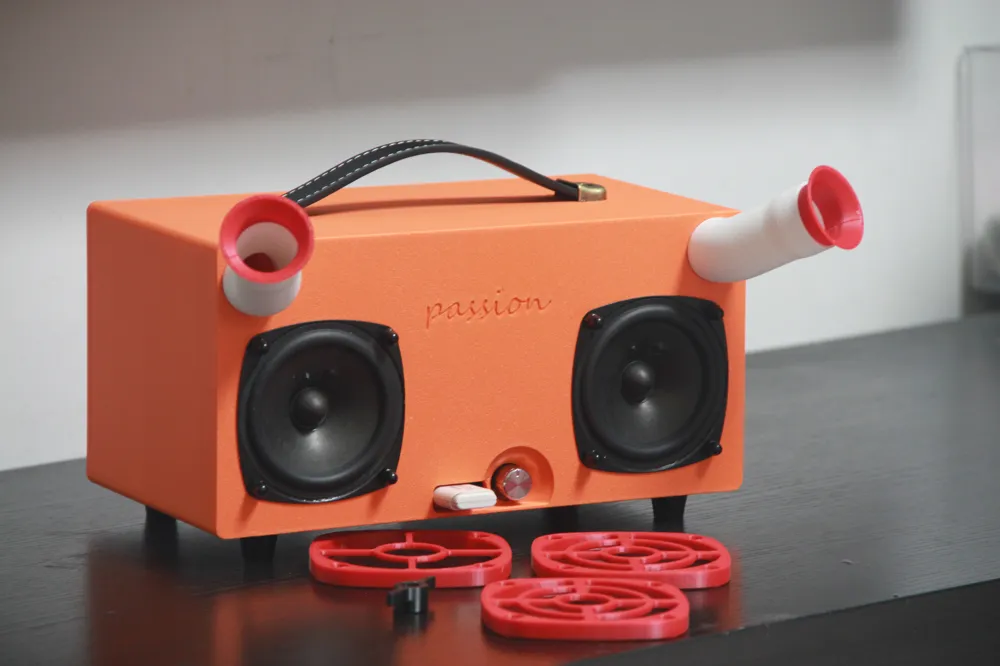
1. Enclosure: Leverage 3D printing advantages: ① One-piece printing as much as possible, minimal assembly. ② Enhance rigidity with ribs and one-piece molding, then gradually thin the enclosure to reduce printing time. ③ Choose a width of 255mm (printer limit) to maximize the distance between left and right speakers. ④ Bass reflex enclosure: the length of the bass reflex port needs to be adjustable for easy tuning of the resonant frequency, making it convenient to experiment. Also, design externally mountable port extension tubes for easy adjustment of the bass reflex tuning frequency fb during use; install them to increase port length for lower frequencies. ⑤ Speaker protective cover should be detachable
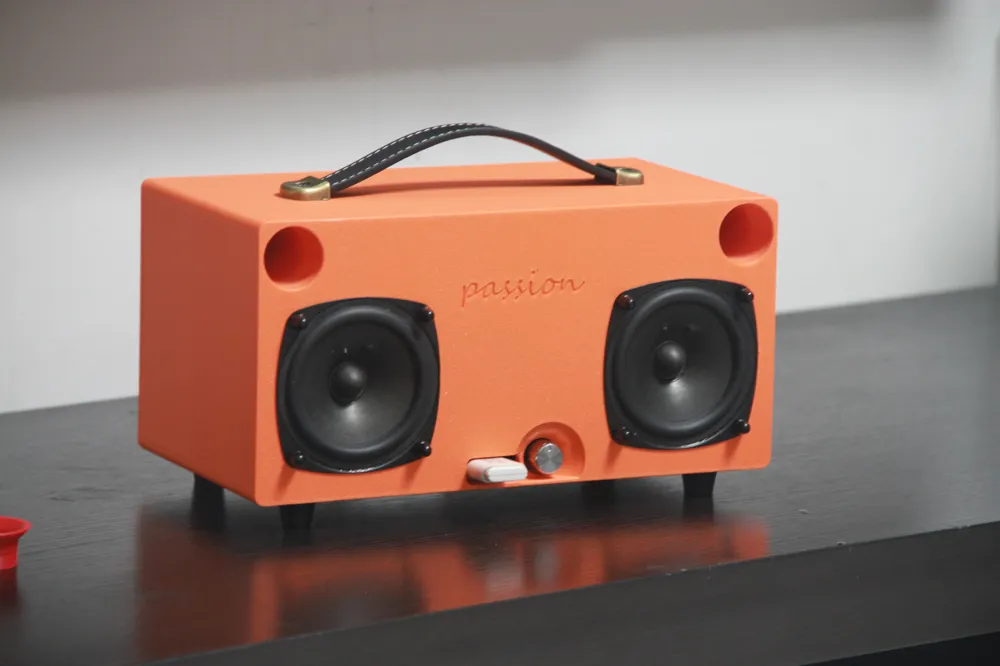
2. Speaker: Considering its use as a full-range electric guitar speaker (less bass, more midrange), choose a full-range speaker, with midrange as the focus, not requiring very deep bass extension or high treble. Also, considering printing time, a single chamber volume of approximately 1.6L, a 3-inch full-range speaker is the most suitable, and it eliminates the trouble of crossovers
3. Amplifier board: ① Choose an integrated Bluetooth amplifier board, one board to complete all work - hassle-free. ② Capable of multi-band EQ adjustment to meet different frequency response needs for listening to music with added bass and electric guitar amps with reduced bass. ③ Classic model, available from multiple sellers on Taobao, avoiding pitfalls. ④ Adapts to a wide range of power supply voltages. ⑤ Supports USB flash drives, capable of playing APE, FLAC lossless audio. ⑥ Supports aux in for electric guitar connection
4. Power supply: Try not to spend money, choose a laptop power supply or an idle 12V power supply; sufficient current is needed, and typical laptop power supplies are usually sufficient
5. Accessories: Sound-absorbing cotton, vibration damping plate, handle, feet, bolts + nuts, EVA foam, sealant
Scheme Implementation:
1. Enclosure: After several rounds of design + prototype testing, the dimensions were determined: 255mm wide x 125mm high x 135mm deep, with a single chamber volume of approximately 1.6L. The panel thickness is 4mm, reinforced to 7mm at the speaker opening, and the bass reflex port is 1.6mm thick. All surfaces use reinforcing ribs, the main body is one-piece printing, 3 walls, 5/6 layers on the top and bottom, with 15-25% infill. Material usage is less than 0.7kg, and printing time is within 16 hours. Layer time optimization for printing was performed to reduce layer line fluctuations caused by sudden changes in layer time. PLA is used as the material; for other materials, more attention should be paid to preventing warping. Vibration damping plates can be attached to reduce the enclosure's resonant frequency
2. Speaker: Choose one with a recommended enclosure volume close to 1.6L. Alternatives include Ququan SQ301S (recommended volume 1.8L, suitable mounting structure optional), Feile 3-inch (used it, though no parameters, but coincidentally had a pair of 4-ohm speakers), SOWAY coaxial (unsure if the treble would be clearer, seems usable, but not thoroughly researched)
3. Amplifier board: I looked at many amplifier boards on Taobao. There are many amplifiers using the TPA3116D2 chip, and many high-quality ones, with voltage adaptability from 12-24V
4. Power supply: Old DELL laptop power supply + an adapter cable (after checking around the office, I found all laptop power supplies were 19.5V, all applicable), and a 12V5A water purifier power supply is also available
5. Accessories: I have sound-absorbing cotton, no need to buy
If the vibration damping plate is not used, try to increase the infill percentage a bit (to reduce the resonant frequency by increasing weight)
Handles and feet were purchased for a few RMB with free shipping on Taobao
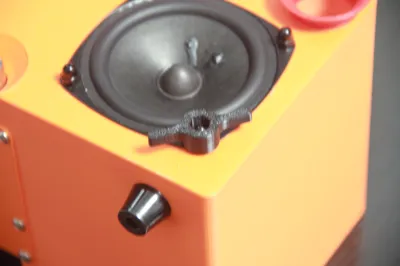
The initial prototype used M3 self-tapping screws to mount the speaker, with some concern about insufficient torque and damage from frequent disassembly (for adjusting the bass reflex port/sound-absorbing cotton); finally, an M4 nut + bolt structure was adopted
3mm thick EVA foam is used to seal the joint between the speaker and the enclosure; sealing is extremely important
Speaker bolts, speaker wire holes, and bass reflex port extension tubes need to be sealed with 704 adhesive
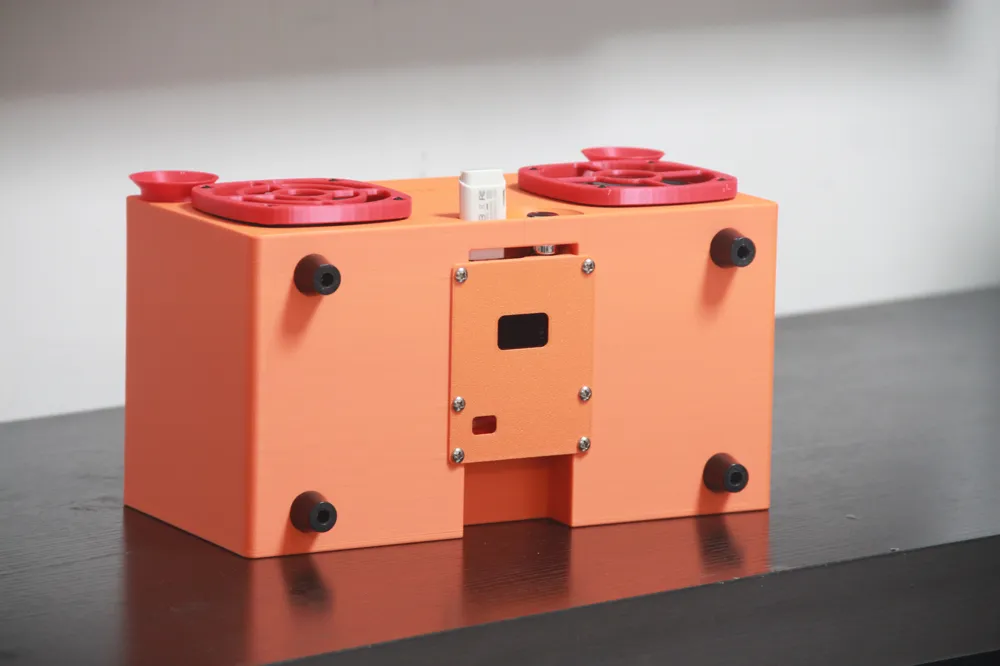
M3X12 bolts are used to install the feet and the small amplifier mounting plate
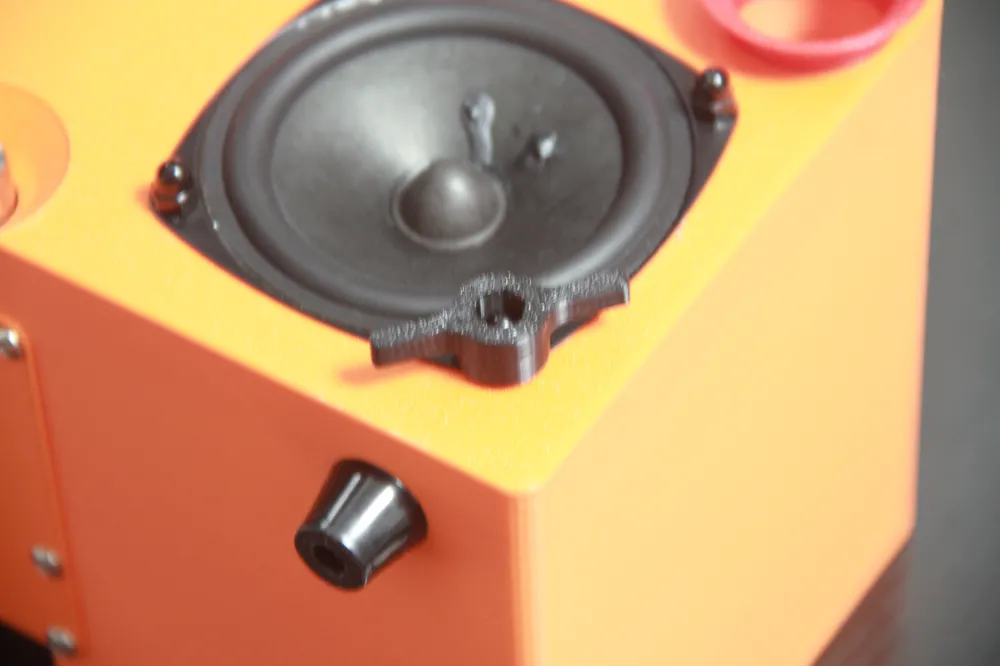
Tools needed: Soldering iron + solder (if using plug-in speakers + pre-made plug-in wires, no soldering is required), wrench (I didn't have one, so I printed a wrench) for installing the speaker. Phillips screwdriver for installing the feet and the small amplifier mounting plate
Inapplicable Situations:
1. The bass extension cannot compare to large-sized speakers, but for me personally, it's very satisfactory
2. Installing the internal bass reflex port (the one-piece printed port is 102.5mm long, which subjectively sounded too high in frequency, so I chose to lengthen it) and the vibration damping plate requires reaching through the speaker mounting hole. The speaker mounting hole diameter is 72mm, so it might be difficult for large hands to fit
3D Printed Parts Diagram
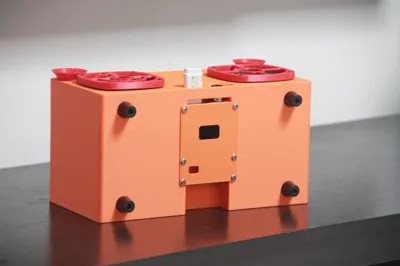
Mandatory printed parts: ① Enclosure main body ② Amplifier mounting plate (to secure the amplifier in forward and backward directions)
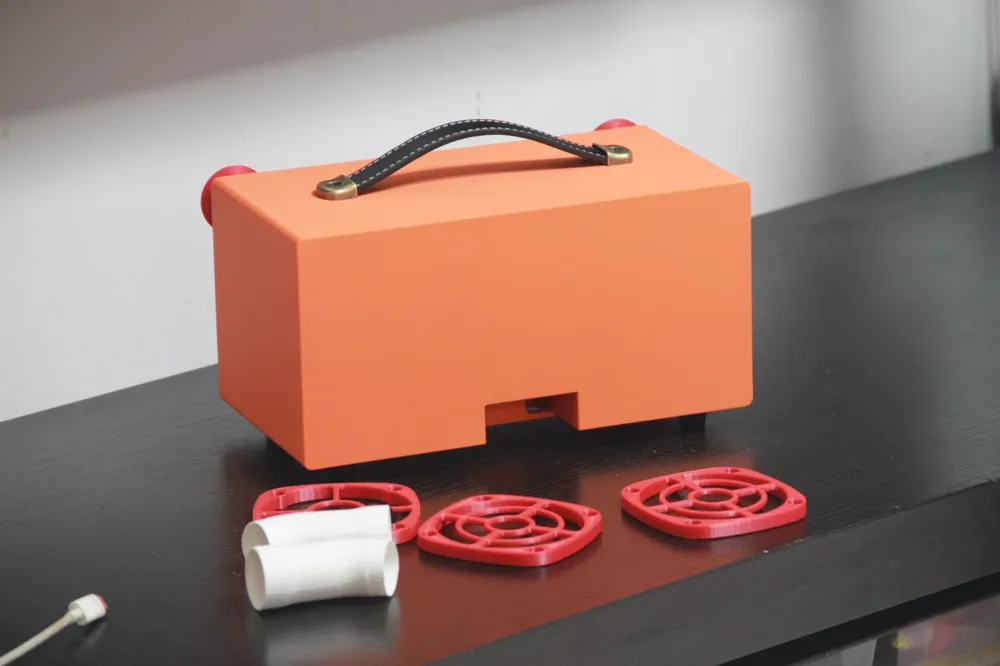
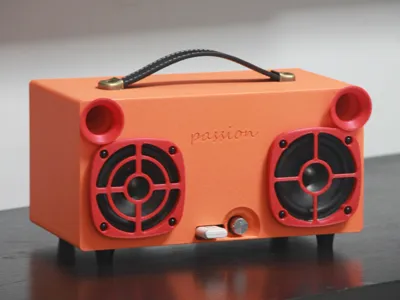
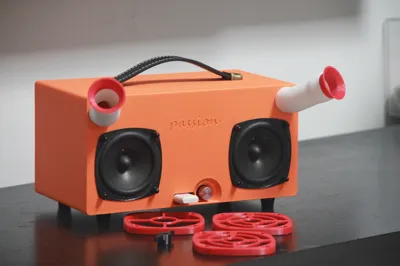
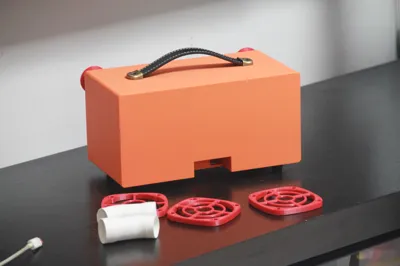
Optional parts: ③ 2x Speaker protective covers ④ 2x External bass reflex port extension sections ⑤ 2x Internal bass reflex port extension sections
Tool: ⑥ Hex wrench
Mounting hole introduction: ⑦ 2x Handle mounting holes ⑧ 4x Feet mounting holes ⑨ 2x Speaker wire pass-through holes ⑩ 6x Amplifier mounting plate holes
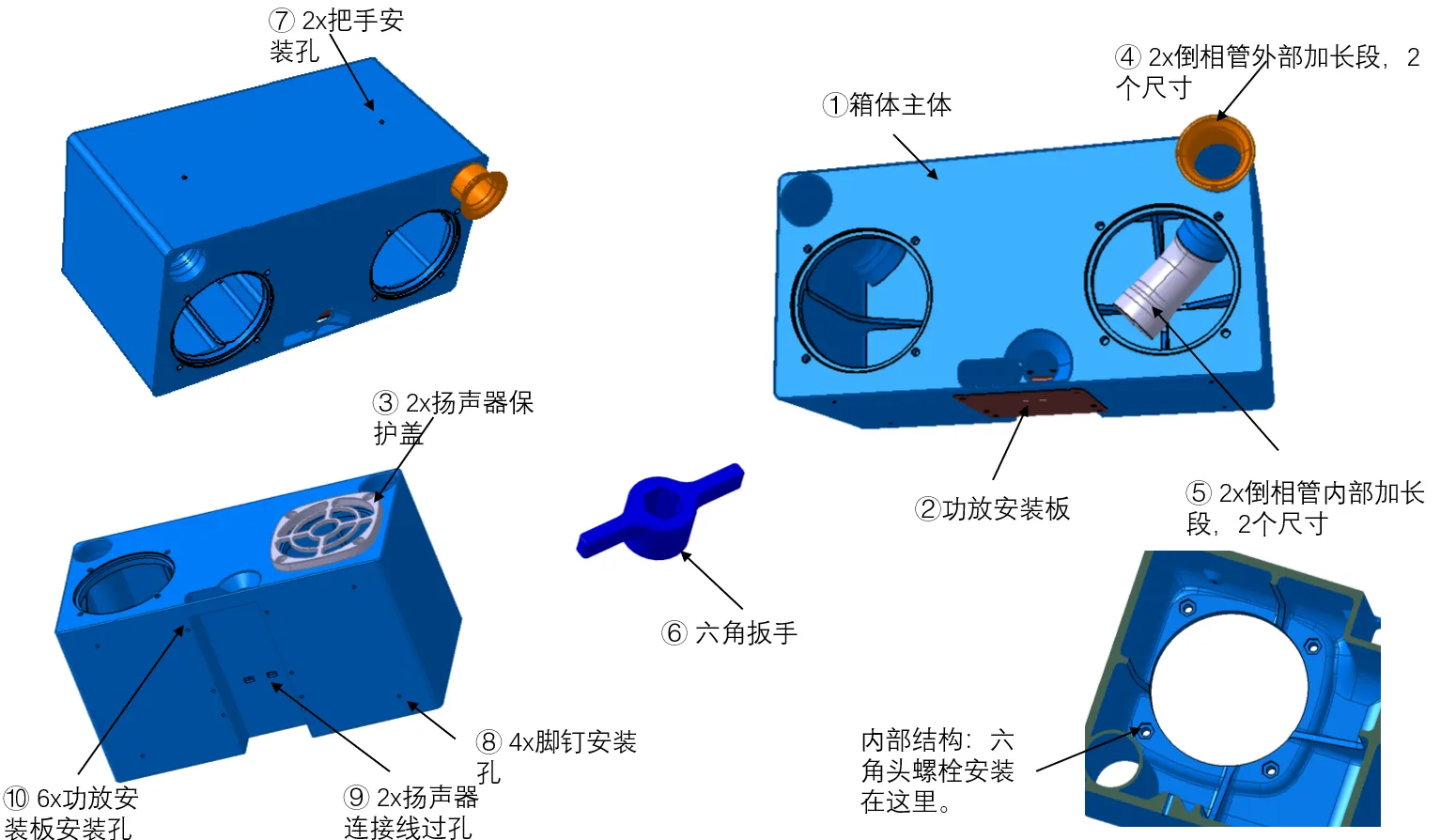
Precautions:
A. Due to the interference fit described below, some situations may prevent installation, while others may result in a loose fit. Please print a test piece first and then adjust the XY compensation. PETG is more flexible than PLA and better suited for printing these small parts with interference fits
1. The speaker protective cover is snap-fitted onto the speaker mounting nuts via interference. 2. The bass reflex port is also held securely in place by interference fit. 3. The amplifier mounting plate's edges must precisely match the amplifier's dimensions to secure the amplifier board properly
B. For the initial few layers, the bridging and subsequent top layers, please use standard printing speed. Other layers can use sport mode to save time. When printing the enclosure, be careful to prevent warping
C. Pay attention to sealing during assembly; proper sealing ensures correct sound, otherwise there will be no bass. Since it's one-piece printing, there are only three areas that need sealing: the speaker wire pass-through holes, the speaker mounting holes, and the speaker mounting bolt holes
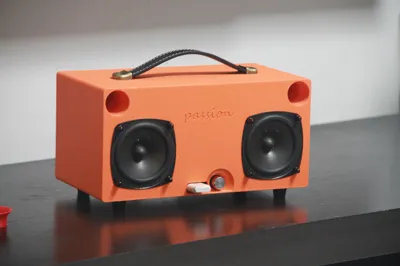
D. Please add the text in the middle of the speaker panel yourself; it's very convenient to add it in the slicing software, you can even write a poem. Haha
Acoustic Considerations
1. This enclosure completely separates the speaker space and amplifier space, with the speaker space being approximately 1.6L
2. Calculated using the Helmholtz formula, and based on the experience of others and recommended speaker volumes on Taobao, the target resonant frequency Fb=73hz is estimated and set as the goal
3. With this approximately 1.6L small enclosure (without subtracting the volume of the bass reflex port and speaker), and a bass reflex port diameter of 25mm (slightly thicker ends not included in the calculation), the rough calculation for the bass reflex port length is 152mm
4. The one-piece printed bass reflex port is approximately 102.5mm long (calculated using the Helmholtz formula, fb is about 87hz); this state sounds a bit headache-inducing. AI says 100-200hz is the headache zone, so both theoretically and practically, the bass reflex port needs to be lengthened
5. Currently, an external extension tube as shown in the picture is connected; after several listening tests, the extension tube was moved inside the speaker. (AI says the effect of the same length externally and internally is different, and fine-tuning is still needed. Since I don't have testing equipment, I rely entirely on my years of playing guitar and tuning equipment by ear. I adjust based on the proportions and overall feel of the kick drum, snare drum, bass, and vocals in familiar songs)
Regrets:
1. When playing from a USB drive, the lowest volume is a bit too loud for me. This might be related to choosing this 4-ohm high-sensitivity speaker
2. Optimizing layer print time can reduce shrinkage marks, but the top infill layer after infilling takes a long time, and I haven't found a way to reduce that time
Shopping list and Taobao links are in the attachment: Shopping list and instructions.
Documentation (1)
License

You shall not share, sub-license, sell, rent, host, transfer, or distribute in any way the digital or 3D printed versions of this object, nor any other derivative work of this object in its digital or physical format (including - but not limited to - remixes of this object, and hosting on other digital platforms). The objects may not be used without permission in any way whatsoever in which you charge money, or collect fees.


Comment & Rating (0)