
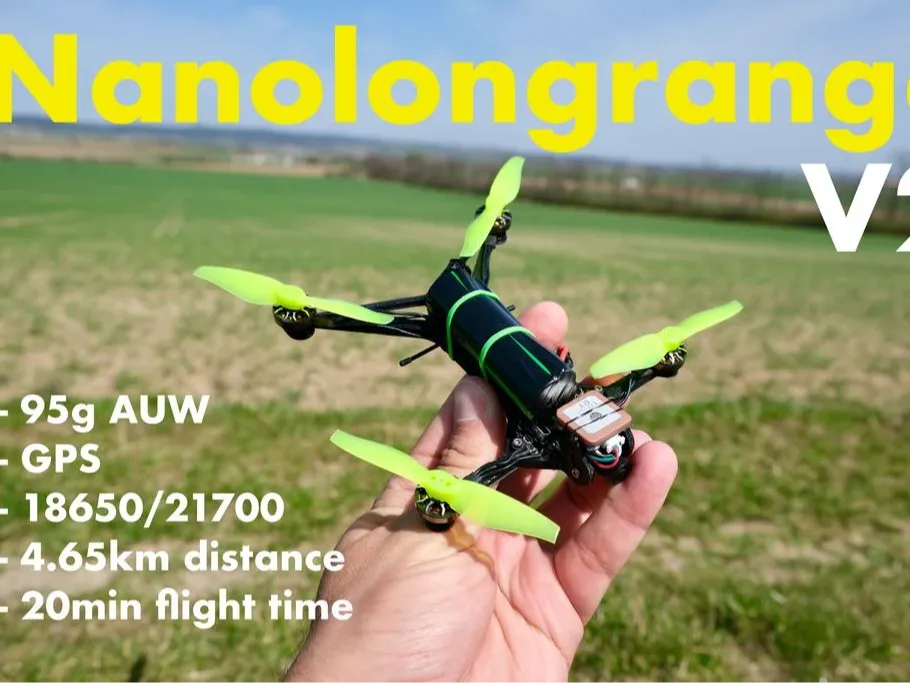
Nanolongrange V2 GPS FPV drone with single 18650
Print Profile(1)
Description
Boost Me (for free)
Hi MakerWorld community 👋
If you find this model useful, I’d really appreciate a Boost. This design was created with print reliability, clean geometry, and real-world usability in mind, and it has been tested to work well on common printer setups. Boosts help support continued development and new free models. Thanks for your support and happy printing! 🚀🖨️
Here is the improved version of my Nanolongrange FPV drone frame. Main advantages over V1 are
- 18650 and 21700 battery capable
- lighter (<95g AUW)
- GPS
Build:
The frame is based on the currently lightest available Whoop AIO board which need to be used due to its smaller form factor. The build is a bit more difficult as you need to solder! Moreover, the solder pads are quite small so you need a steady hand. The video shows all the building steps.
Parts used:
- Happymodel DiamondF4 AIO
- Flywoo Robo 1202.5 11500kv
- Gemfan 3018 props
- Beitian BN-180
- Caddx Ant
- Longrange RC System like Crossfire, Tracer, ELRS... I used ImmersionRC Ghost
- 3x 6mm and 10x 4mm M2 screws (I used Titanium to save around 1g over steel)
- rubber bands
Update:
After extensive testing I can provide you with more information on my Nanolongrange V2 design. Therefore, I've created a video with testing, tips and tricks. First of all, make sure you got the VTX settings right if you experience a short FPV range (if your local regulations allow). Second, a higher VTX output interferes with the GPS. Thus, power up via USB to get a quick fix and reposition the GPS module on the frame. Third, using an omni-directional antenna brings a cleaner FPV feed. However, you need to desolder the monopole copper antenna and solder the omni antenna directly on the FC. I also tried a step up module. It brings some interference into the FPV feed but ensures that the VTX keeps a high output at a low battery voltage. In addition, I ve tested its freestyle capabilities and a 21700 battery (Samsung INR21700).
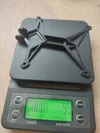
I also designed a new version of the frame. It allows for standard sized tinywhoop AIO boards. A cheap solution is Jhemcu Play F4 There is also more space to use an external VTX like IRC Tramp nano with step up module The frame comes in under 10g (PLA+) as it is beefier. Therefore, I call it NanolongrangeV2b(beefy).
Update 2:
Nanolongrange V2b allows you to use standard sized tinywhoop boards and an external VTX with a step up module. On +500mW FPV range is no issue anymore. I strongly recommend you to print the frame with PETG, it is very robust although slightly heavier than PLA+ (2g). The best GPS for this drone is in my opinion from a Gopro (I have tested Beitian 180 and 220 as well as a small Goteck) which can be salvaged from broken Hero 6,7 and 8 cameras. Finally, make sure that the cut off voltage of the step up module is well below 3V!!!
License

You shall not share, sub-license, sell, rent, host, transfer, or distribute in any way the digital or 3D printed versions of this object, nor any other derivative work of this object in its digital or physical format (including - but not limited to - remixes of this object, and hosting on other digital platforms). The objects may not be used without permission in any way whatsoever in which you charge money, or collect fees.


Comment & Rating (5)