
Molle
Print Profile(1)

Description
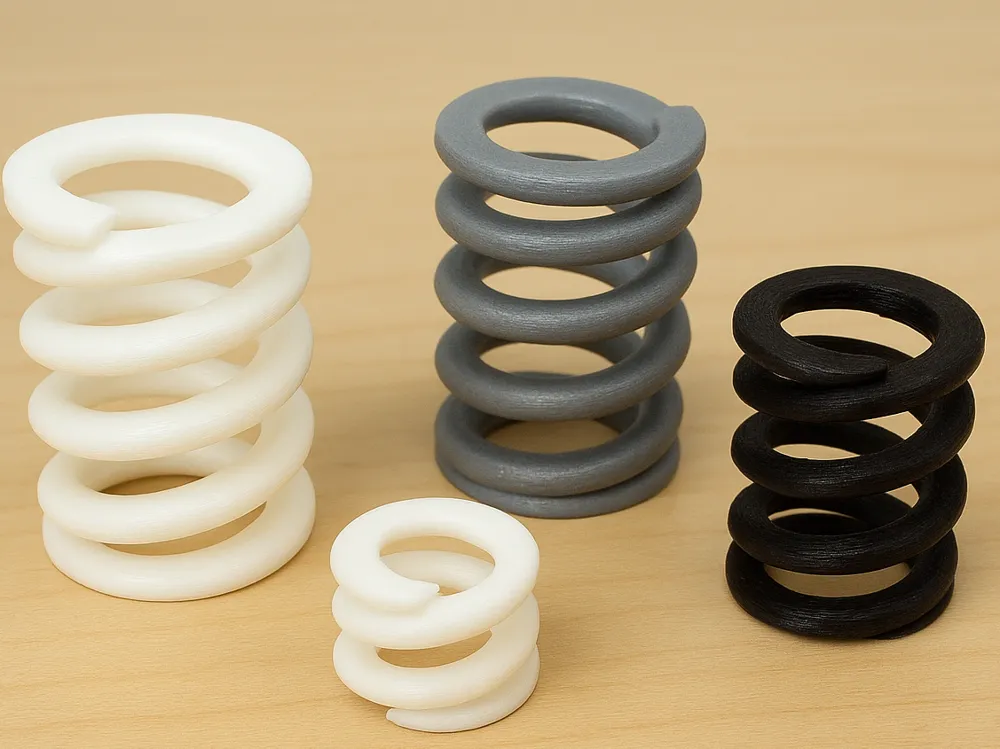
🔧 Product Description – 3D Printed Springs
These springs are made using 3D printing and represent a versatile solution for prototypes, school projects, model making, and lightweight applications where high mechanical strength is not required.
The spiral design ensures good elasticity in light compressions, while maintaining stability and shape.
They are ideal for:
- mechanical demonstrations
- functional models
- educational projects
- elastic supports for small tolerances
⚠️ Disclaimer: The springs shown were created based on models available on Tinkercad.
🧪 Material Advice
Printing truly functional 3D springs is complex because most FDM materials do not have natural elasticity. Here are the best materials based on needs:
🥇 Recommended Best Material: TPU (85A–95A)
✔ elastic
✔ fatigue resistant
✔ returns to shape without deforming
✔ perfect for truly functional springs
TPU allows for springs that behave much more like real ones compared to PLA or PETG.
The A1 mini prints TPU without problems if the model is well designed.
🥈 Good alternative: PETG
✔ more flexible than PLA
✔ better fatigue resistance
✔ more durable over time
It is not as elastic as TPU, but it can work for rigid or demonstration springs.
🥉 PLA (not recommended for functional use)
✔ easy to print
✔ perfect for prototypes and visualization
❌ low elasticity
❌ deforms and can break easily under stress
PLA is only good for aesthetic or demonstration springs, not for real loads.
🔎 Recommended Material Summary
| Material | Elasticity | Print Difficulty | Indication |
|---|---|---|---|
| TPU | ⭐⭐⭐⭐⭐ | Medium | Best for truly functional springs |
| PETG | ⭐⭐⭐ | Easy | For rigid springs and semi-functional prototypes |
| PLA | ⭐ | Very easy | Only for aesthetic prototypes or mock-ups |
This remix is based on

License



Comment & Rating (2)