
Resonix - passive phone amplifier
Print Profile(2)

Description
Resonix
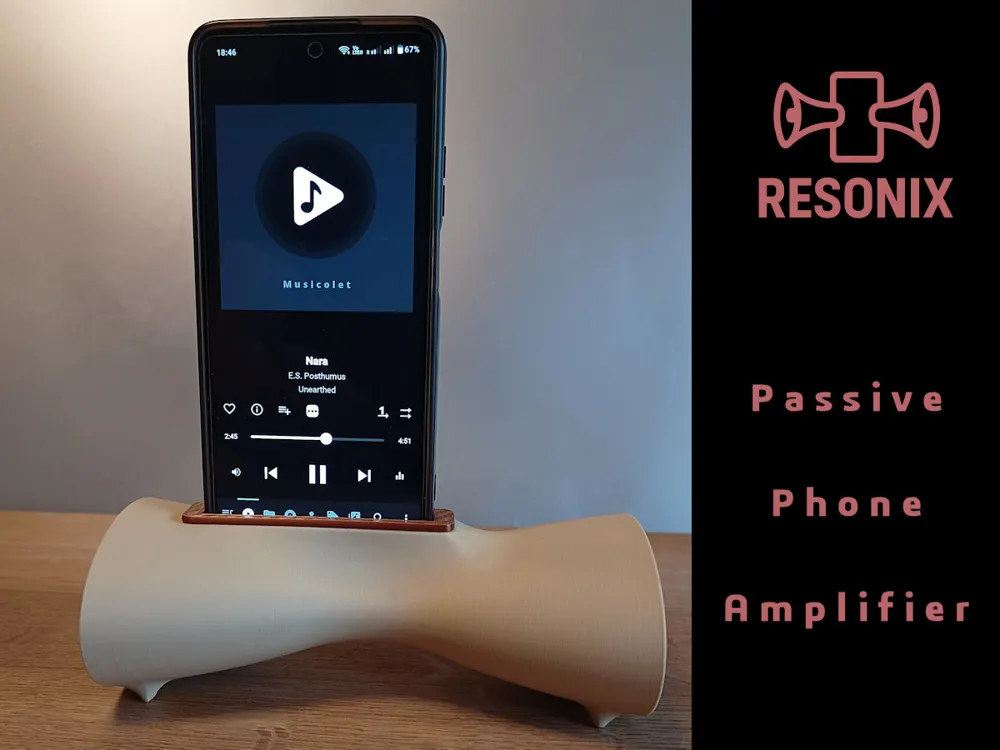
Resonix is a passive amplifier created in a single 3D print, with no moving parts or electronics. Your smartphone’s sound is guided through internal channels and resonance chambers, naturally boosting its volume. The phone is deliberately placed slightly off-center, so that the phone’s speaker aligns exactly with the center of the acoustic pathway. This ensures optimal amplification and a perfectly balanced sound distribution. The dual outlets create a wider soundstage and a surprisingly rich result. A perfect print project that blends design with acoustics.
Resonix – Assembly & Printing Guide
The Resonix consists of two parts:
- The speaker body
- The phone bracket
After printing, simply snap the bracket into the speaker body.
Adjusting the Bracket Size
The opening in the bracket can be customized to fit your phone dimensions. This is done by modifying the negative part (included in the print profile).
- Measure the width and thickness of your phone.
- If you use a phone case, include it in the measurement.
- Use a caliper for best accuracy, or estimate with a ruler.
- Add at least 0.5 mm to both the width and thickness to ensure a proper fit.
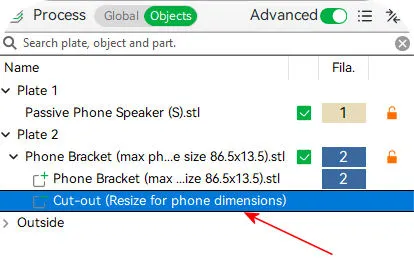
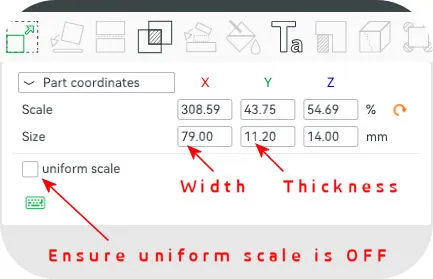
- In Bambu Studio, select the negative part (named cut-out) from the left menu.
- Click resize.
- Under X, set the width.
- Under Y, set the thickness.
- ⚠️ Make sure “uniform scale” is turned off, and do not scale in Z!
The maximum size for the cut-out is:
- Width (X): 86.5 mm
Thickness (Y): 13.5 mm
Pro Tip
If you increase the thickness (Y) slightly (by 1–2 mm), the phone will lean back a bit when placed. Just be careful not to exceed the maximum dimensions.
Scaling the Model
It’s possible to scale up the entire model for larger devices, but note that it will no longer fit on an A1 Mini printer bed.
Boost Me (for free)
✨ Enjoying the Resonix? ✨
If you printed this design and like the result, I’d really appreciate it if you gave it a boost / like / comment on the platform.
It helps more makers discover the passive amplifier and keeps me motivated to create new designs.
Your feedback — whether it’s a photo, a short review, or just a quick like — means a lot. 🙏
Thank you for supporting creative 3D printing!
License

You shall not share, sub-license, sell, rent, host, transfer, or distribute in any way the digital or 3D printed versions of this object, nor any other derivative work of this object in its digital or physical format (including - but not limited to - remixes of this object, and hosting on other digital platforms). The objects may not be used without permission in any way whatsoever in which you charge money, or collect fees.


Comment & Rating (11)