
Pocket Saxophone
Print Profile(1)

Description
Membership
Unlock Commercial Use
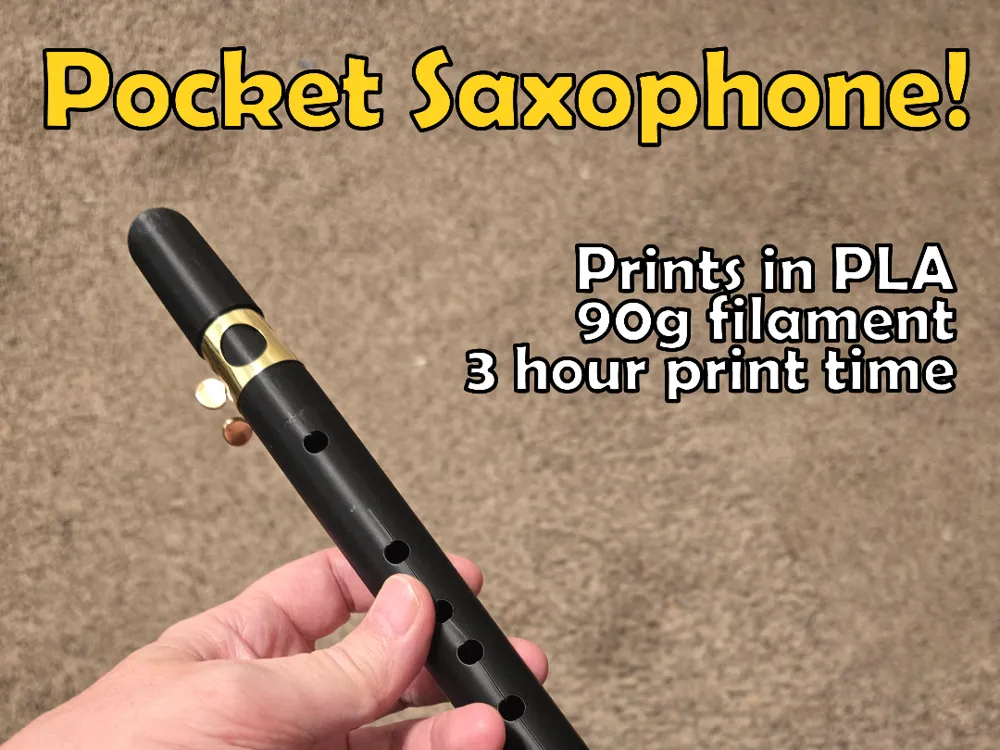
Print your own pocket saxophone! This D-major model plays with a regular tenor sax reed and soprano ligature. Just glue the mouthpiece, add a reed, and start honking!
To complete this model, you will need:
- One (1) tenor saxophone reed
- 2.0 is a good beginner strength
- One (1) soprano saxophone ligature (the metal bit holding the reed to the instrument
- Some way to glue both pieces together with an airtight seal (I use 3D Gloop)
This is my take on a 3D printed pocket saxophone, modeled after the general style of a Xaphoon®*. It plays in the key of D Major (all holes closed sounds the note D). The instrument should require no major voicing to play as printed.
Unlike the Xaphoon® my instrument has all of the tone holes centered along the body, rather than offset. I don't find this difficult to play, and allows the instrument to be played "right handed" or "left handed" (right or left hand on top). Since I play tinwhistle left handed, I've always found the traditional Xaphoon® to be a challenge.
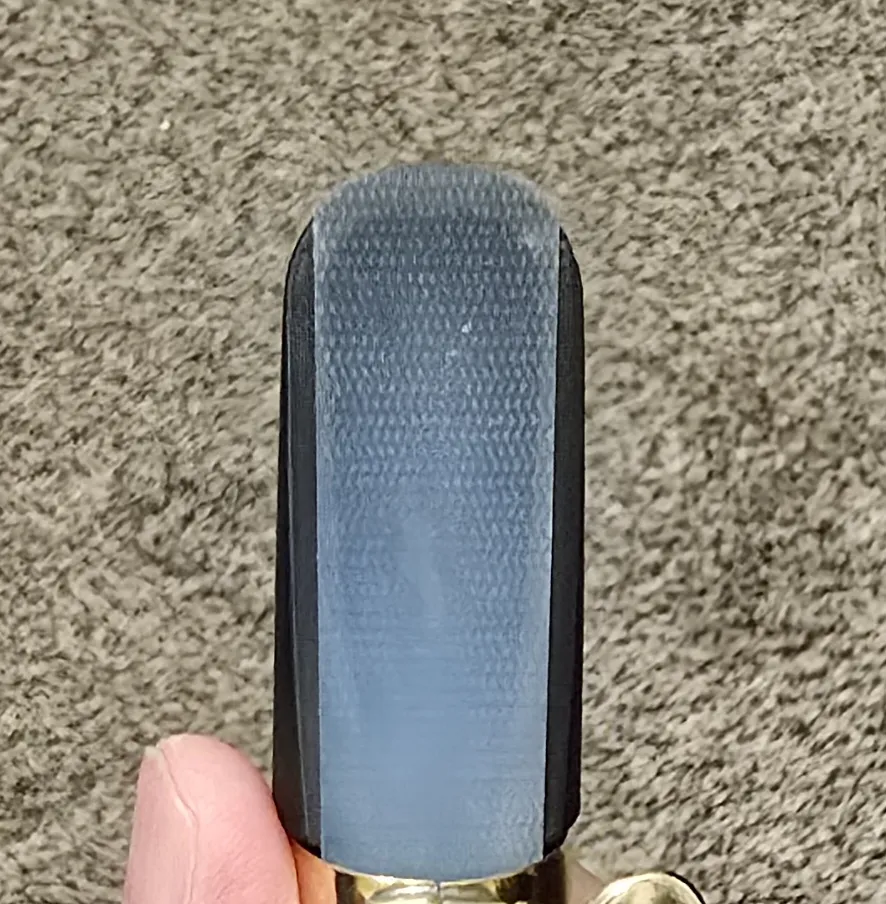
I’ve attached the reed with an inexpensive soprano sax ligature that I sourced from my local music store. Bring the reed to the very tip of the mouthpiece as in this photo:
Here is a short demo of me playing a few bars of When the Saints Come Marching In. I'm not a pro player with reed instruments by any stretch, so please forgive the flubs.
The video was recorded using a Legere 2.0 synthetic reed, but you can also use any standard tenor saxophone reed. Synthetic reeds last longer, but cane reeds (like Rico) are much cheaper if you’re just starting out. Be aware that reeds are consumable parts, and you'll have to keep replacing them over time.
The supports inside the sax body can be a bit of a challenge to get out. I have the best luck grabbing the tree support securely with a pair pliers and twisting until they break free of the tone holes. Supports are two walls thick, so they're fairly sturdy and grippable.
The posts and holes for connecting the body and the mouthpiece are there to act as a guide. They will not hold the the mouthpiece on or make an airtight seal. The mouthpiece must be glued to the body using something that will create an airtight seal. I use a thin layer of 3D Gloop, and have not tried cyanoacrylate (super glue).
*NOTE Xaphoon® is a registered trademark of Brian Lee Wittman. I’m not affiliated with, endorsed by, or sponsored by them.
License

You shall not share, sub-license, sell, rent, host, transfer, or distribute in any way the digital or 3D printed versions of this object, nor any other derivative work of this object in its digital or physical format (including - but not limited to - remixes of this object, and hosting on other digital platforms). The objects may not be used without permission in any way whatsoever in which you charge money, or collect fees.


Comment & Rating (109)