
Filament Roller Bearing - Customizable Model
Print Profile(9)


Description
Boost Me (for free)
If you find this model useful, a boost would be greatly appreciated to help others discover it.
Why this model
After experimenting with many print-in-place bearing designs, I realized that for sizes smaller than 608 they often become unreliable. Common issues include excess axial play and side-to-side wobble, which are inherent to print-in-place construction.
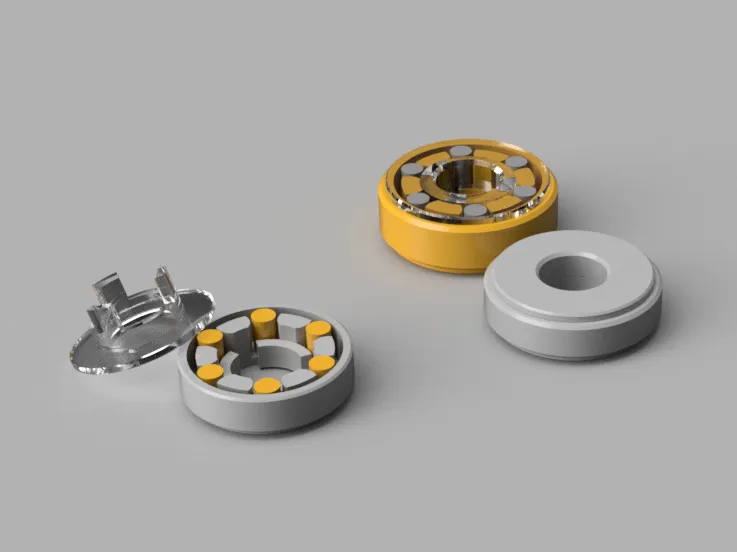
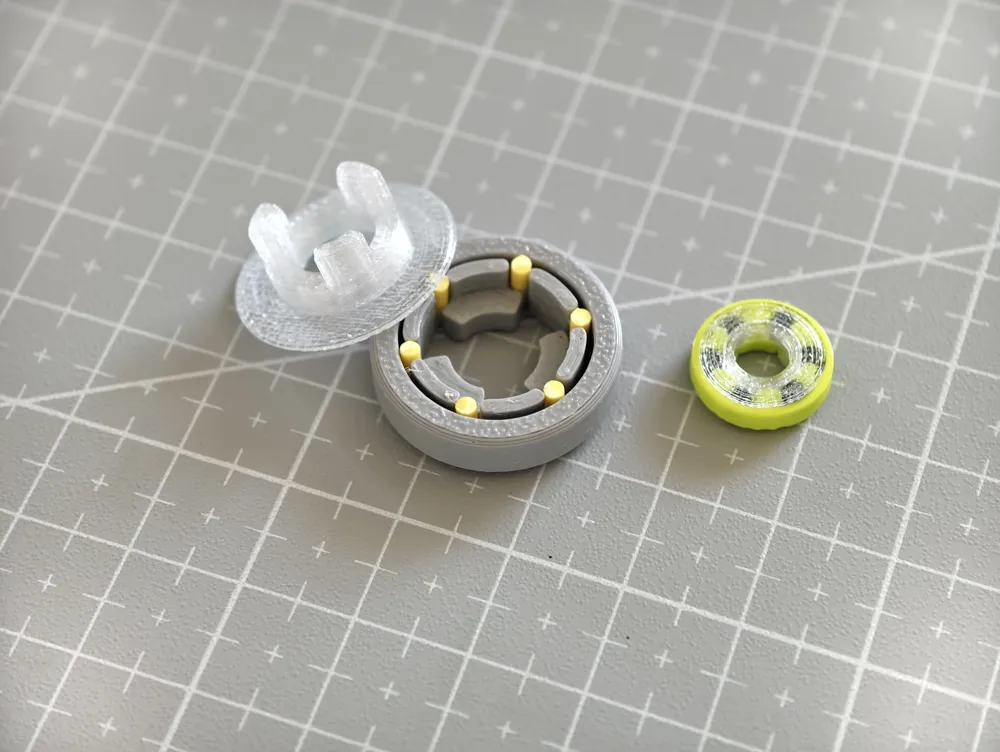
This design takes a different approach: it uses short pieces of filament as rollers, combined with an easy snap-together assembly. This choice has several key advantages:
Standard and accurate diameter: filament is manufactured to tight tolerances, giving more consistent rollers than 3D printed parts.
No extra hardware needed: unlike using ball bearings, no additional components are required — just cut filament.
Stronger than PTFE tube rollers: hollow tubing tends to deform under load, while solid filament holds shape.
- Optimized for small bearings: the slim filament rollers fit into compact sizes while still leaving room for reasonable wall thickness.
The result is a smooth, reliable small bearing that can handle light loads, making it practical for hobby projects and prototypes.
Features
Optimized for small sizes: structure intentionally designed without a roller cage. This simplifies the build and reinforces the bearing wall, making it more reliable at miniature scales.
Works at small sizes: tested successfully with MR125, 605, 606, 607, 608, 695, and 696.
Customizable: generate other sizes with the online customization tool.
Fusion 360 source included: for deeper edits or remixes.
- Multiple clearances: each size profile is available in both normal and tight fits.
Printing notes
Set seam position to random for smoother rolling surfaces.
- Use PETG instead of PLA for better self-lubrication and durability.
Assembly

- Cut filament pieces to the required length for your chosen bearing size.
If you plan to build a lot of bearings, consider using a filament cutting tool for accuracy and convenience. Otherwise, you can always cut rollers with a ruler and a blade knife.
- Place filament rollers evenly around the track.
Using a tweezer can be very helpful if you are dealing with the pins for small size bearings and happen to have big fingers like me — that could save you some frustration.
Snap the two halves together and you are done!
Roller cutting length guide
- MR125 → 2 mm
- 605 → 3 mm
- 606 → 4 mm
- 607 → 4 mm
- 608 → 5 mm
- 695 → 2 mm
696 → 3 mm
Feedback & Share
I’ve only tested this design in limited scenarios, so I’d love to see how you use it in your own projects. Any feedback, photos, or remixes are more than welcome!
License



Comment & Rating (3)