
JC's Grid Quest – Retro Strategy Tile Game
Print Profile(1)

Description
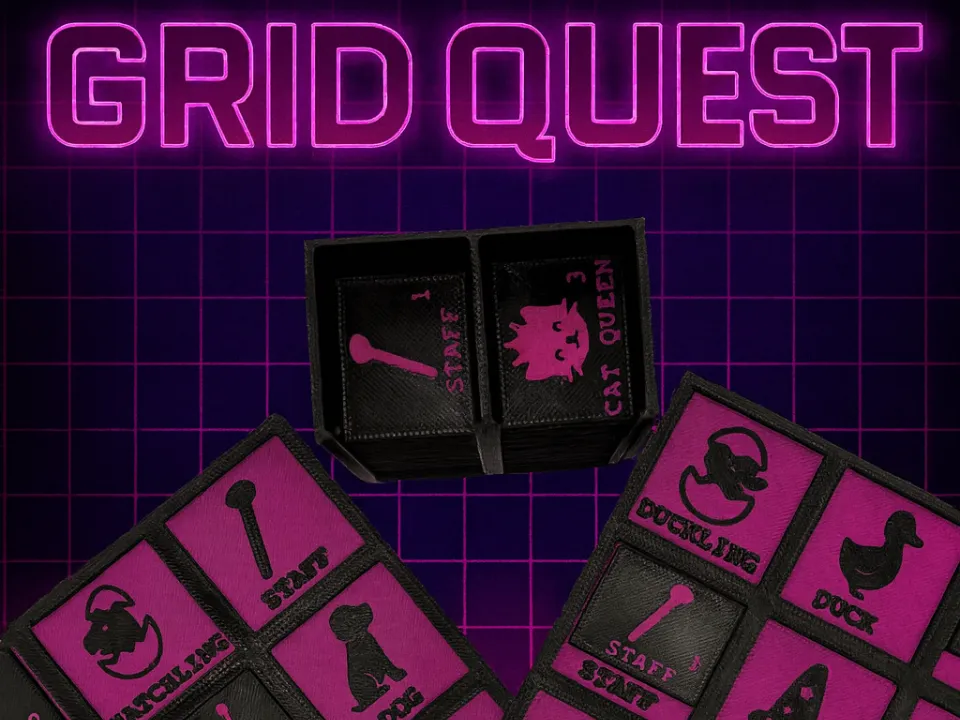
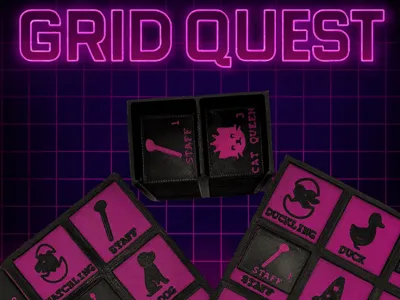
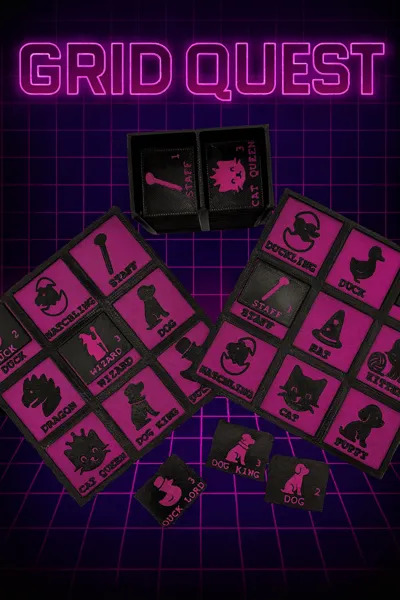
Step into the neon glow of the 80’s arcade era with Grid Quest — a 7-in-1 tabletop strategy game that’s fast, flexible, and unforgettable. Built on the rivalry of five whimsical families — Dragons, Cats, Dogs, Wizards, and Ducks — every round feels like a new showdown in the grid.
🌟 What Makes It Special
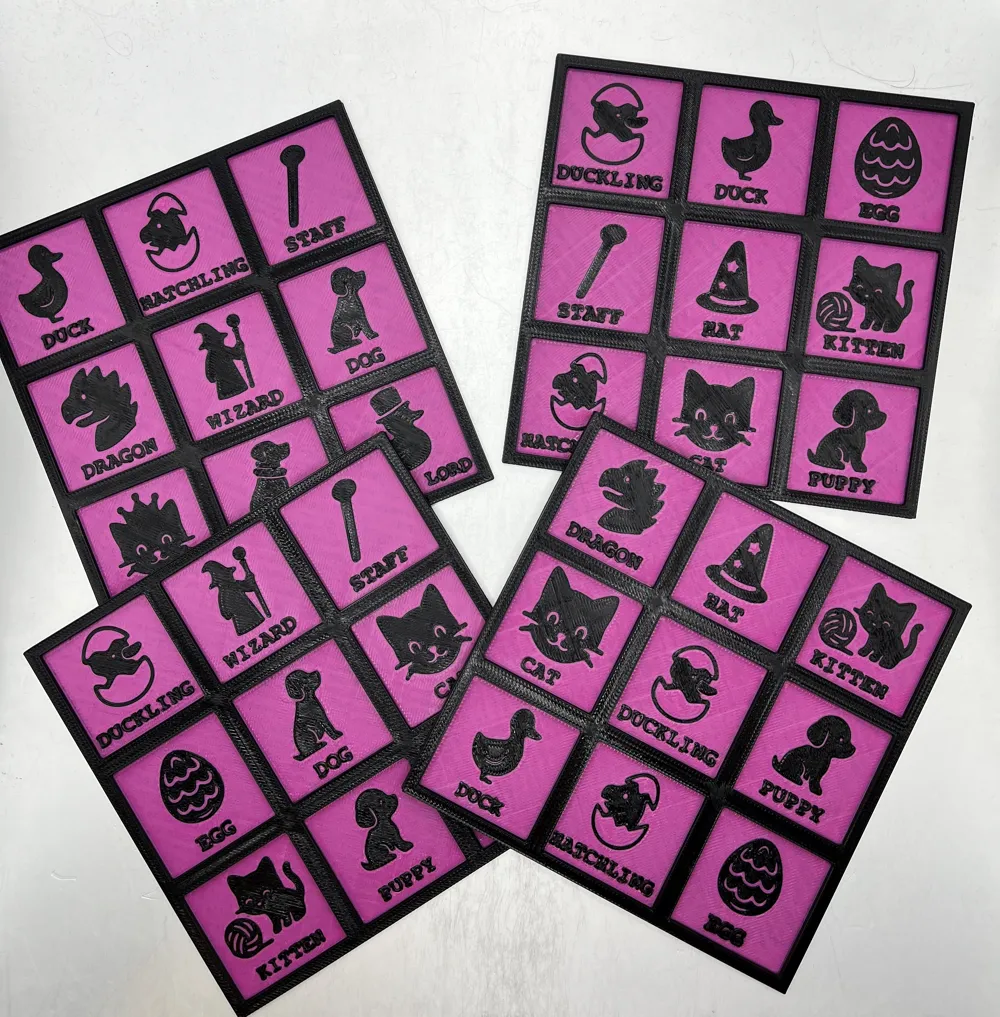
- Five Families, Endless Rivalries: 15 unique icons across Ducks, Dragons, Wizards, Cats, and Dogs — each family bringing its own flavor and fun.
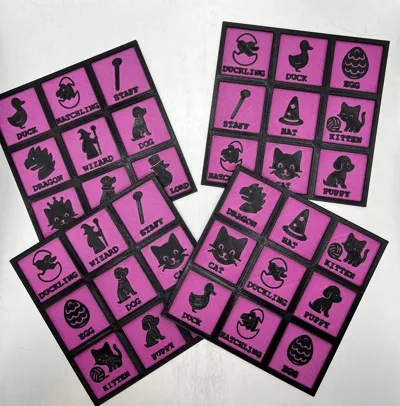
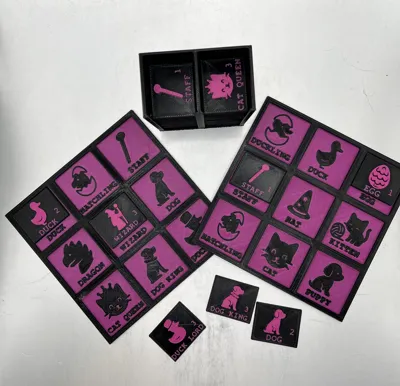
- Four Unique Player Boards: Each 9×9 board features a different distribution, strategically designed to ensure no one has an advantage. Every match feels fair, fresh, and unpredictable.
- Seven Distinct Modes: Classic, Speed, Chaos, Stack, Simple, Solo, and Battle Quest — from lightning-fast rounds to deep strategic duels.
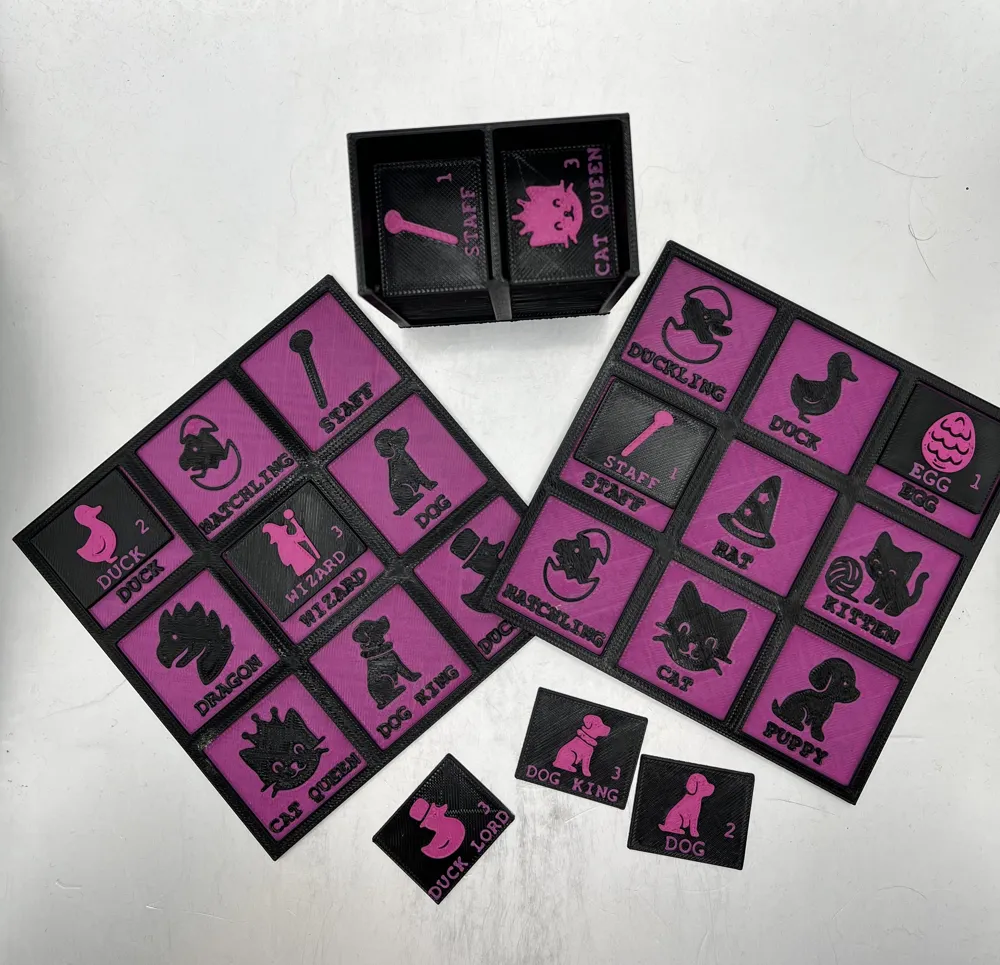
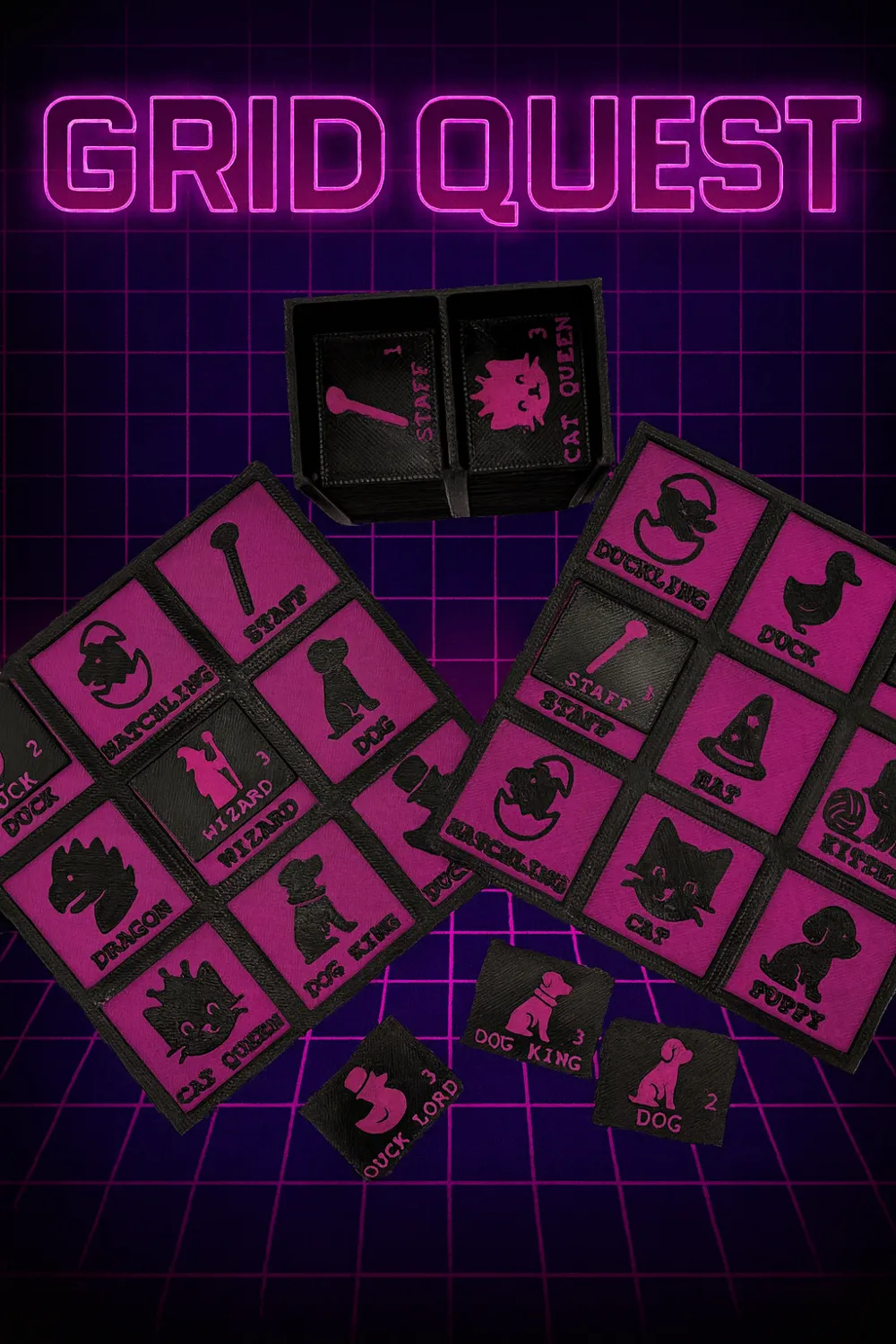
- The Tile Tower: A custom holder that keeps the game flowing. Play with tiles right-side-up for organized control — or flip it for a mystery reveal that cranks up the chaos.
- Retro-Inspired Design: Bold black-and-magenta neon aesthetic that makes every play feel like stepping into a synthwave arcade.
- The Wild JC Burst: A single tile that changes everything — whether it fills a gap, stacks to finish a family, or blasts your opponent’s Life Points in battle.
🎮 Who It’s For
- Family Game Nights → silly rivalries, Ducks vs Dragons vs Cats vs Dogs vs Wizards.
- Party Groups → chaos, speed, and laughs for kids and adults alike.
- Duelists & Strategists → unique boards, tactical stacks, and head-to-head Battle Quests.
⚡ Grid Quest isn’t just one game — it’s seven experiences bound together by five unforgettable families. With unique boards for balance, a versatile Tile Tower, and gameplay that shifts from casual to competitive, Grid Quest is designed to be your go-to retro flagship game.
Full Instructions:
📘 Grid Quest Rulebook
🎯 Objective
Players compete to score points (Classic modes), stack strategically, or duel in battle.
- Classic & Speed Quest: First to 51 points wins.
- Stack Quest: Stack tiles to win; play best 2 of 3 rounds.
- Simple Mode: First to complete a blackout wins.
- Battle Quest: Reduce opponent to 0 Life Points.
🎲 Components
- 15 icons across 5 families (Ducks, Dragons, Wizards, Cats, Dogs) with 3 designs each.
- 3 copies of each icon (45 tiles total).
- 1 Wild JC Burst tile (special).
- 4 player boards (9×9 layout with unique distributions).
- Tile Holder (Caller Stack) — used in Classic, Speed, Stack, Sudden Death, and Simple.
🧩 Tile Rules
- Tiles go only to their matching spots on the board.
- Wild JC Burst: special placement/use depending on game mode.
- Tiles cannot be shifted once placed, except during special stacking rules.
🛠 Setup Instructions
Player Counts
- Classic, Speed, Stack, Simple: 3–4 players (one acts as Caller, so 2–3 active players).
- Chaos Quest: Same as above, but caller sets the tiles differently.
- Battle Quest: 2 players only.
- Solo Quest: 1 player.
How to Start
- Shuffle all tiles.
- Load them into the Tile Holder.
- In Chaos Quest only → Caller places all tiles face-up on the table while players look away, then announces when to begin.
🎙 Caller Role
- The Caller flips tiles from the Tile Holder one at a time (or as specified by the mode).
- Announces the tile aloud (or “JC Burst” if flipped).
- Caller does not play on a board (works especially well for a parent).
- Caller ensures fairness in ties and timing.
🎮 Game Modes
1. Classic Quest
- Caller flips one tile at a time, announces the icon.
- Players shout if they have it; first to call claims it.
- In ties → resolve by rock–paper–scissors or dice roll.
- Tile goes to its matching board spot.
- Scoring Patterns:
- Row = 5 points
- 4 Corners = 10 points
- Cross (+) = 15 points
- X = 20 points
- Blackout = 25 points
- Win Condition: First player to 51 points wins.
- Caller may declare a “win mode” (X, Cross, or Blackout) to focus the round.
2. Speed Quest
- Same rules as Classic.
- Caller flips two tiles per turn.
- Players may call one or both; the first to call wins each.
- Both tiles may go to the same player if they call them first and have the spaces available.
- Mis-Call Penalty (Optional): If a player calls a tile they do not have, they forfeit their right to call tiles for the remainder of that round.
3. Chaos Quest
- Caller places all tiles face-up while players look away.
- Caller signals when play begins.
- Players race to fill their boards as fast as possible.
- Win Condition: First player to complete their board wins.
- Tie Condition: If two players finish at the same moment, resolve with rock–paper–scissors.
4. Stack Quest
A strategic stacking mode where players build towers to win.
- Players may stack tiles up to 2 high on matching spots.
- Tiles must be stacked in numerical family progression (1 → 2 → 3).
- Example: Kitten → Cat → Cat Queen
- The Wild JC Burst may substitute as the 3 of any family.
- Example: Kitten → Cat → JC Burst (counts as a complete family stack).
- Win Conditions:
- Fill all 4 corners with stacks of 2 tiles each (1+2 or 2+3).
- OR complete two full family stacks (1 → 2 → 3).
- Scoring:
- This mode does not use point scoring.
- Instead, play best 2 of 3 rounds.
- Boards must be switched between rounds.
- Draw Caveat:
- If tiles run out or a round cannot be completed, reshuffle all tiles into the Tile Holder and continue until a win condition is met.
- Notes:
- Standard scoring patterns (rows, crosses, X, blackout) do not apply here.
- Blackout is not a win condition in this mode.
5. Sudden Death Quest
- Used as a tiebreaker.
- Each player must declare their win condition (X or Cross) before play begins.
- Both options are fair — each requires the same number of tiles.
- Caller flips tiles until one player completes their declared pattern first.
- Caller has no influence over win conditions in this mode.
6. Solo Quest
- Single-player mode.
- Flip tiles one at a time to fill your board.
- Count how many turns it took to complete.
- Lower turn count = better score.
7. Simple Mode (for very young players)
- No points.
- Caller flips tiles one at a time.
- First player to achieve Blackout wins.
- Quick, repeatable, and easy for kids.
🌟 Wild JC Burst
In Caller Modes (Classic, Speed, Stack, Sudden Death, Simple)
- If the caller flips Wild JC Burst, players may call it just like any other tile.
- First to shout claims the Wild.
- Place it on any empty spot on your board.
- Once placed, it cannot be moved.
- If multiple players shout at the same time → resolve by rock–paper–scissors or dice roll.
In Battle Quest
- When drawn, it is played instantly from hand.
- Opponent immediately loses 4 Life Points.
- After use, the Wild is removed from the game permanently.
- Cannot be used as Attacker or Defender.
⚔️ Battle Quest
A separate duel mode using the same tiles.
Setup
- Shuffle tiles into a draw pile.
- Each player starts with 10 or 15 LP (Quick or Extended Duel).
- Each player begins with 1 face-up Defender.
- First turn: draw 2 tiles. Later turns: draw 1 tile.
- Hand limit: 5 (discard at end of turn if exceeded).
Turn Actions
On your turn, you may do one of the following:
- Attack: Play 1 tile forward as an Attacker.
- Defend: Place 1 tile behind your Attacker (max 2 defenders stacked).
- You cannot do both in the same turn.
- Forced Attack Rule: If you already have 2 defenders, you must attack.
Combat
- Attacker > Defender → Defender removed; leftover damage carries.
- Attacker = Defender → Both removed; rear Defender moves up.
- Attacker < Defender → Defender blocks; no damage carries.
Discards
- Discarded tiles are removed from the game permanently.
- If the draw pile runs out, the game ends.
- Win Check: Player with more LP remaining wins.
- Sudden Death Rule: If LP is tied, transition to a Sudden Death Quest round using game boards to determine the final winner.
Victory
- Game ends when LP = 0.
- If draw pile empties: higher LP wins (or Sudden Death if tied).
Advanced Rules (Optional)
Add type advantages for more strategy (rock–paper–scissors style):
- Ducks → double vs Dogs, half vs Dragons
- Dogs → double vs Cats, half vs Ducks
- Cats → double vs Wizards, half vs Dogs
- Wizards → double vs Dragons, half vs Cats
- Dragons → double vs Ducks, half vs Wizards
How it works:
- Only the Attacker applies multipliers.
- Round down fractions if needed.
- Wild JC Burst is unaffected (always instant LP damage).
⏱ Playtime Guide
- Classic Quest: 5–10 minutes
- Speed Quest: 3–8 minutes
- Stack Quest: ~10 minutes per round (best of 3)
- Simple Quest: 5–10 minutes
- Chaos Quest: 2–3 minutes
- Sudden Death Quest: 3–5 minutes
- Solo Quest: 5–10 minutes
- Battle Quest: 10–20 minutes
🎂 Recommended Ages
- Classic, Speed, Stack, Chaos, Sudden Death, Solo: 8+
- Simple Mode: 4+
- Battle Quest: 10+
Membership
Turn these designs into something you can share! Commercial Members are welcome to sell physical prints of JC Unboxed creations. Your support helps me keep designing new artwork, useful prints, games, and strange little characters like Monty, Henry & friends. Thanks for opening the box!
License

You shall not share, sub-license, sell, rent, host, transfer, or distribute in any way the digital or 3D printed versions of this object, nor any other derivative work of this object in its digital or physical format (including - but not limited to - remixes of this object, and hosting on other digital platforms). The objects may not be used without permission in any way whatsoever in which you charge money, or collect fees.


Comment & Rating (0)