
Gyrocopter AutoGyro MT03
Print Profile(1)

Description
This is my inaugural significant project utilizing Fusion 360.
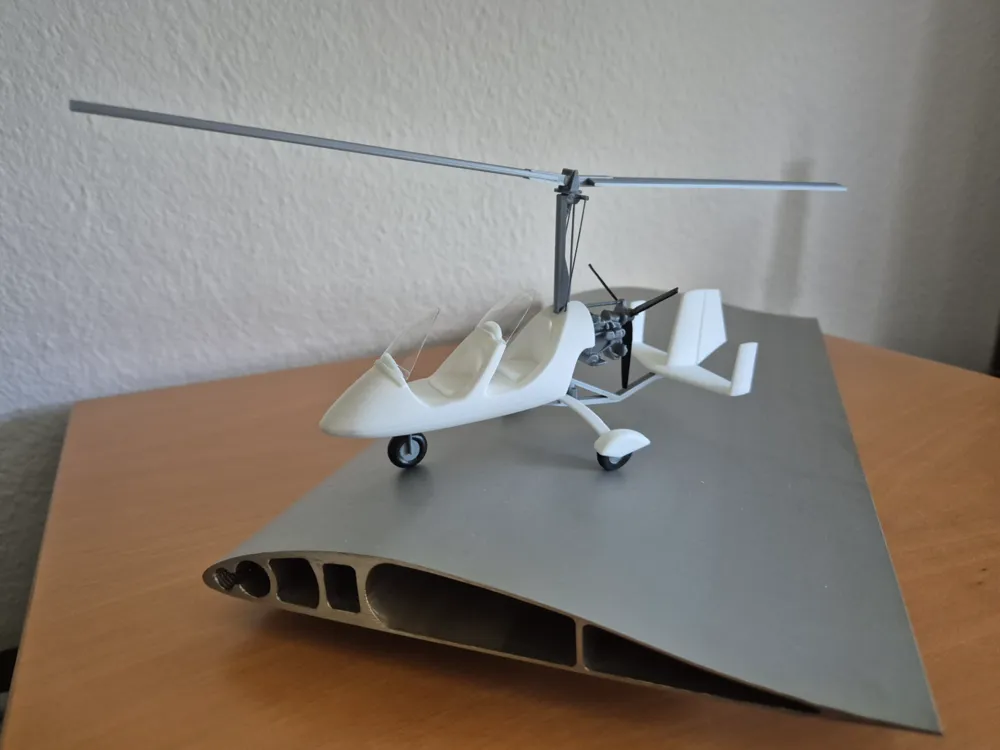
Two years ago, I divested myself of my AutoGyro MT03, prompting my desire for a corresponding model to grace my sideboard. Regrettably, an MT03 STL file proved elusive online. Consequently, I meticulously crafted it myself, a labor of weeks.
The initial STL file depicts the fully assembled MT03. However, this rendition is less than ideal for printing due to extensive overhangs.
Therefore, I partitioned the files into discrete, readily printable components. This also affords the advantage of employing diverse colors. Assembly of the complete model is straightforward, employing adhesive. Dichloromethane-dissolved PLA has demonstrated exceptional efficacy (provided the parts are PLA-printed). While pure dichloromethane functions, its fluidity renders precise application challenging. Dichloromethane presents inherent risks. Those unfamiliar with its handling should opt for superglue. I disclaim any liability for the aforementioned suggestions. Should superglue be utilized, a medium-to-high viscosity formulation is recommended. Thin superglue proves less suitable owing to its tendency to stray from the intended application area.
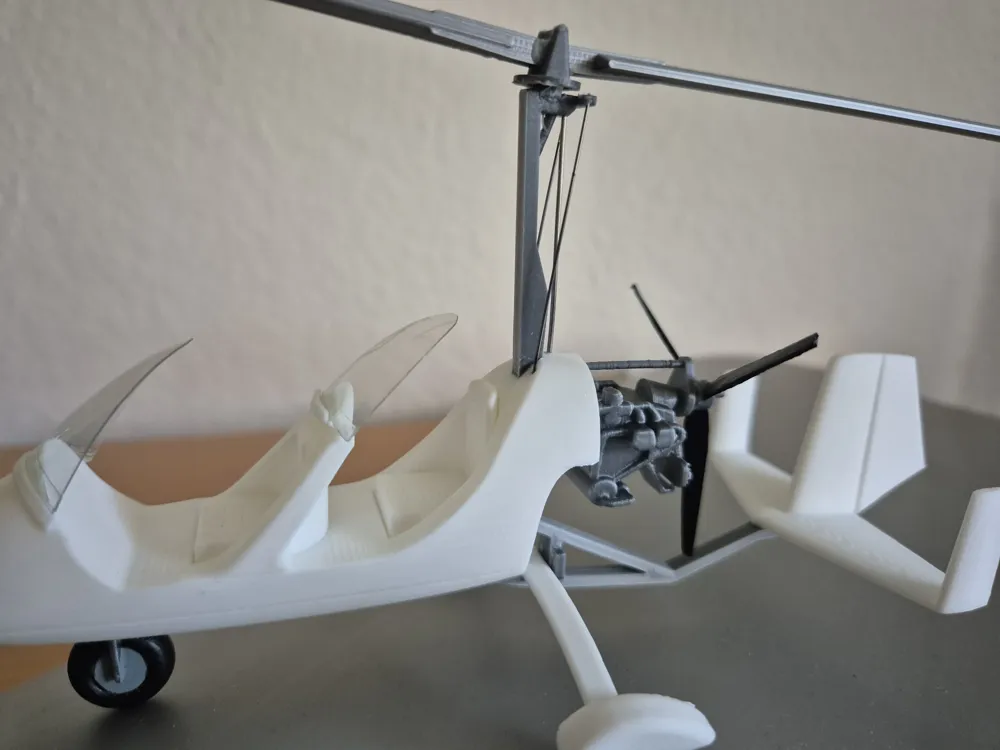
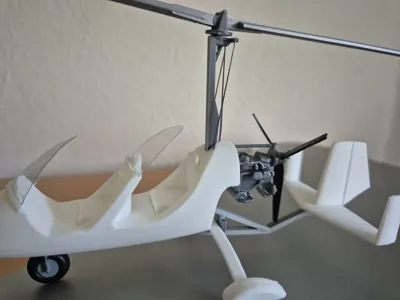
The windshields were fashioned from thin PET packaging, secured with fletching tape typically used in archery. A suitable plastic adhesive, such as Ruderer L530, also serves adequately.
Within the slicer (Bambulab Studio in my case), I adjusted the scale to 35% to ensure the largest component, the rotor, remained within the confines of my print bed. This yields a 1:28.5 scale MT03. I have also successfully printed the MT03 at 30% (1:33.2 scale). For the conventional 1:32 model scale, all components require a 31.2% slicer adjustment.
The nose wheel incorporates a base plate, subsequently removed post-printing. Its function is to prevent dislodgement from the print bed during the process (a simple brim proved insufficient).
The fuselage connectors might necessitate minor size adjustments within the slicer to guarantee seamless integration with the upper and lower fuselage holes (depending on printer precision).
The pushrods and pre-rotator shaft for the rotor head were fabricated from slender spring steel wires (0.5mm for pushrods, 0.8mm for the pre-rotator shaft). Their diminutive dimensions render them unsuitable for direct printing.
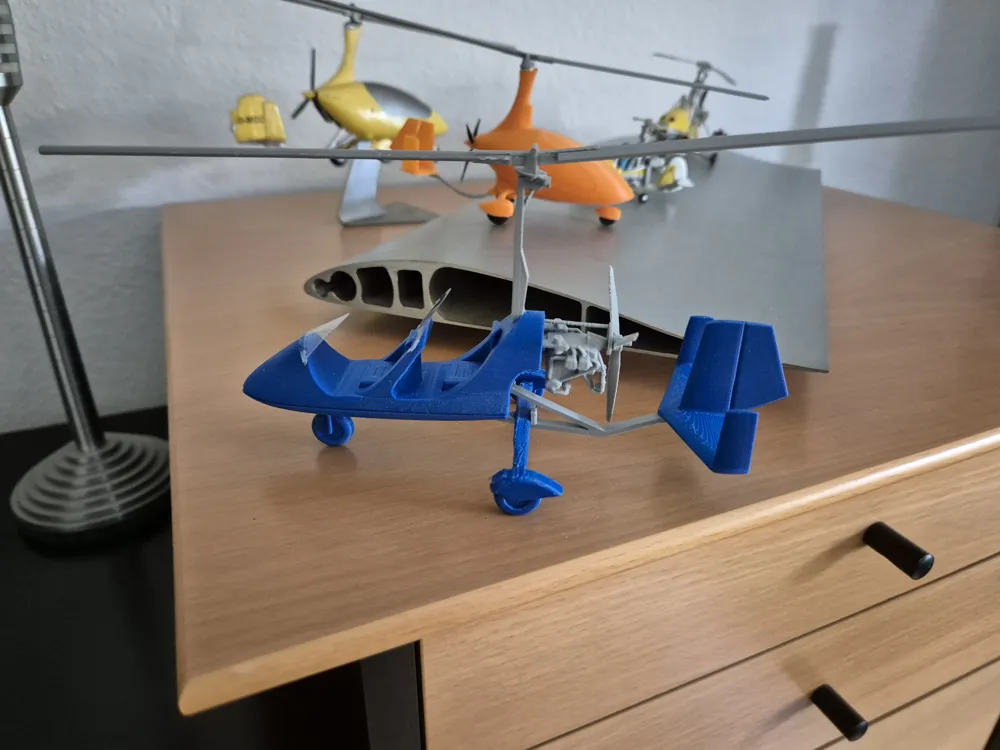
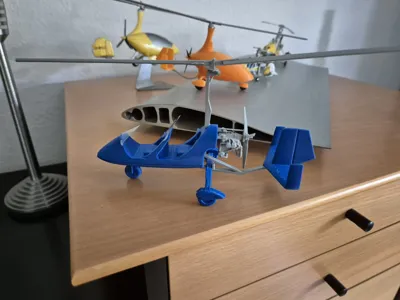
The blue MT03 showcased in the imagery represents my initial prototype, exhibiting imperfections in areas such as the main landing gear and windshields, falling short of my envisioned aesthetic. Subsequently, I incorporated refinements and segmented the main landing gear for optimal printability.
All parts were printed using a 0.4mm nozzle and 0.08mm layer height on my Bambulab P1S.
Filament: PLA basic white, Bambulab PLA silver.
May your construction endeavors prove enjoyable.
License



Comment & Rating (17)