
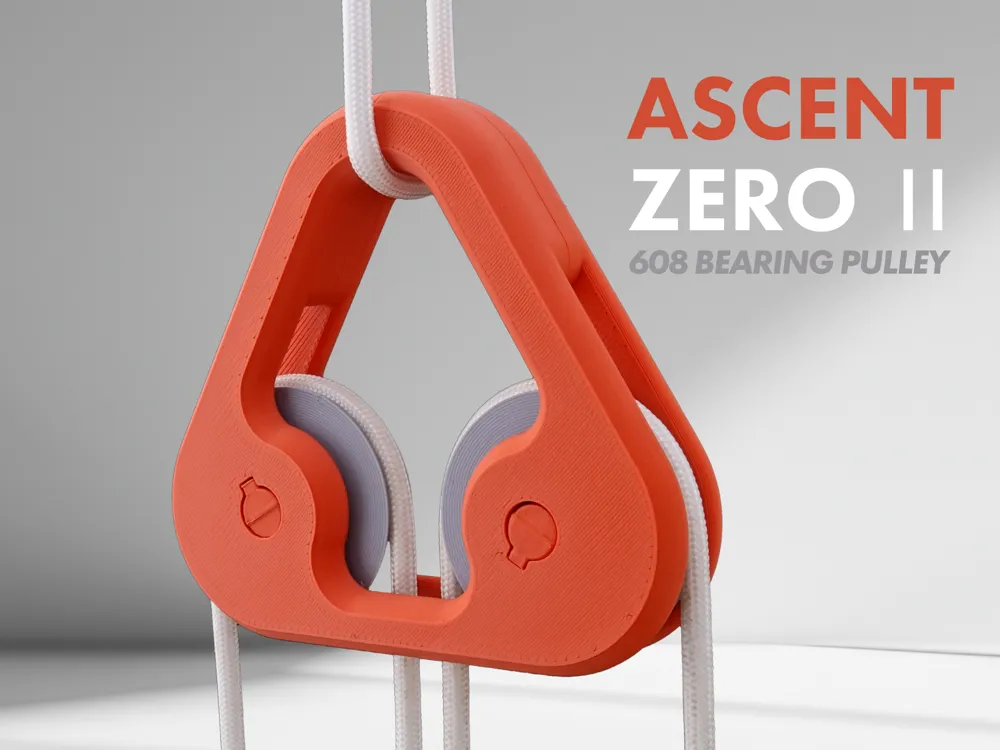
Double Pulley Block (2x608) – Ascent Zero 2
Print Profile(2)


Bill of Materials

Description
Compact double pulley designed for high mechanical advantage.
2×608; Zero axle + M5 variant for PETG-HF slip control.
Ascent Zero 2 Notes
- If you print my profile you will get a very dense and sturdy print. However, because of the slight variations in expansion of PLA and PETG at these very high infill percentages, it is unlikely that you can assemble this by hand without a little hammering. These printed great for me with Bambu Basic PLA on an A1-Mini using my profile the parts had just the right tightness.
- The compression fit axles are keyed so they are easy to insert correctly but to get them all the way in you'll need to bash it lightly with a plastic hammer (ideal) or the butt of a screwdriver, or a regular metal hammer.
- The wheel is meant to be a very tight fit around the bearing. Some hammering may be required.
- Once the axles are sunk in flush and the body halves are fully mated, you should have a very strong pulley ready to do some light-duty work.
- I've tested this model in Bambu's PETG HF and the finished parts are so slick that the compression axle does not perform as intended. For PETG of this type I strongly suggest printing the M5 bolt variant.
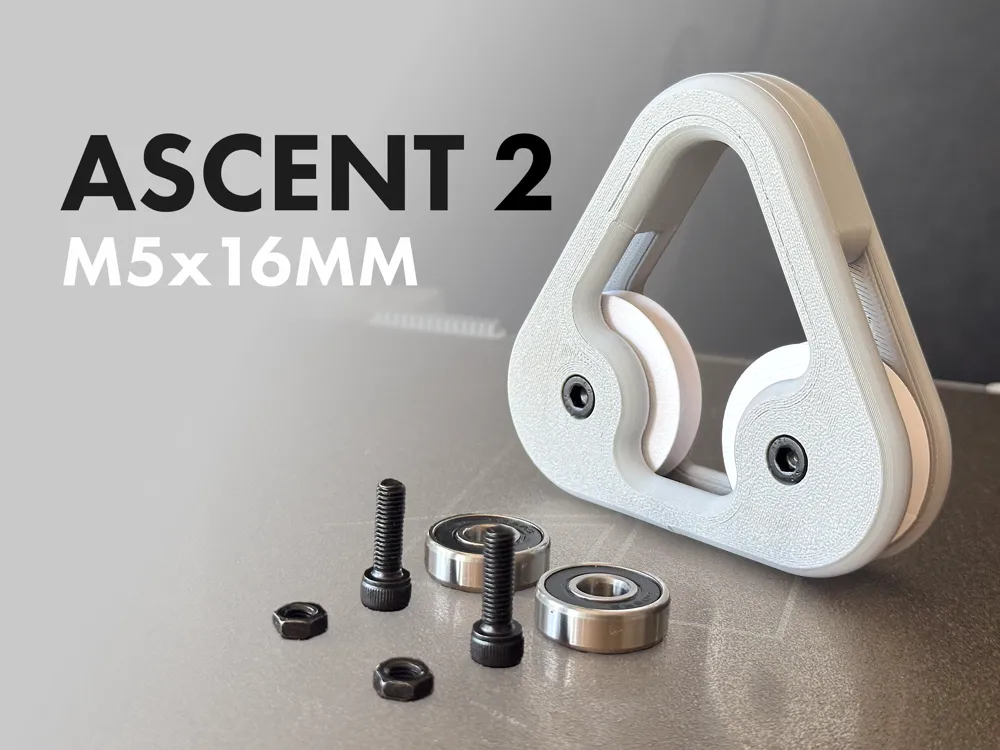
NEW Hardware Version for PETG-HF (June 20, 2025)
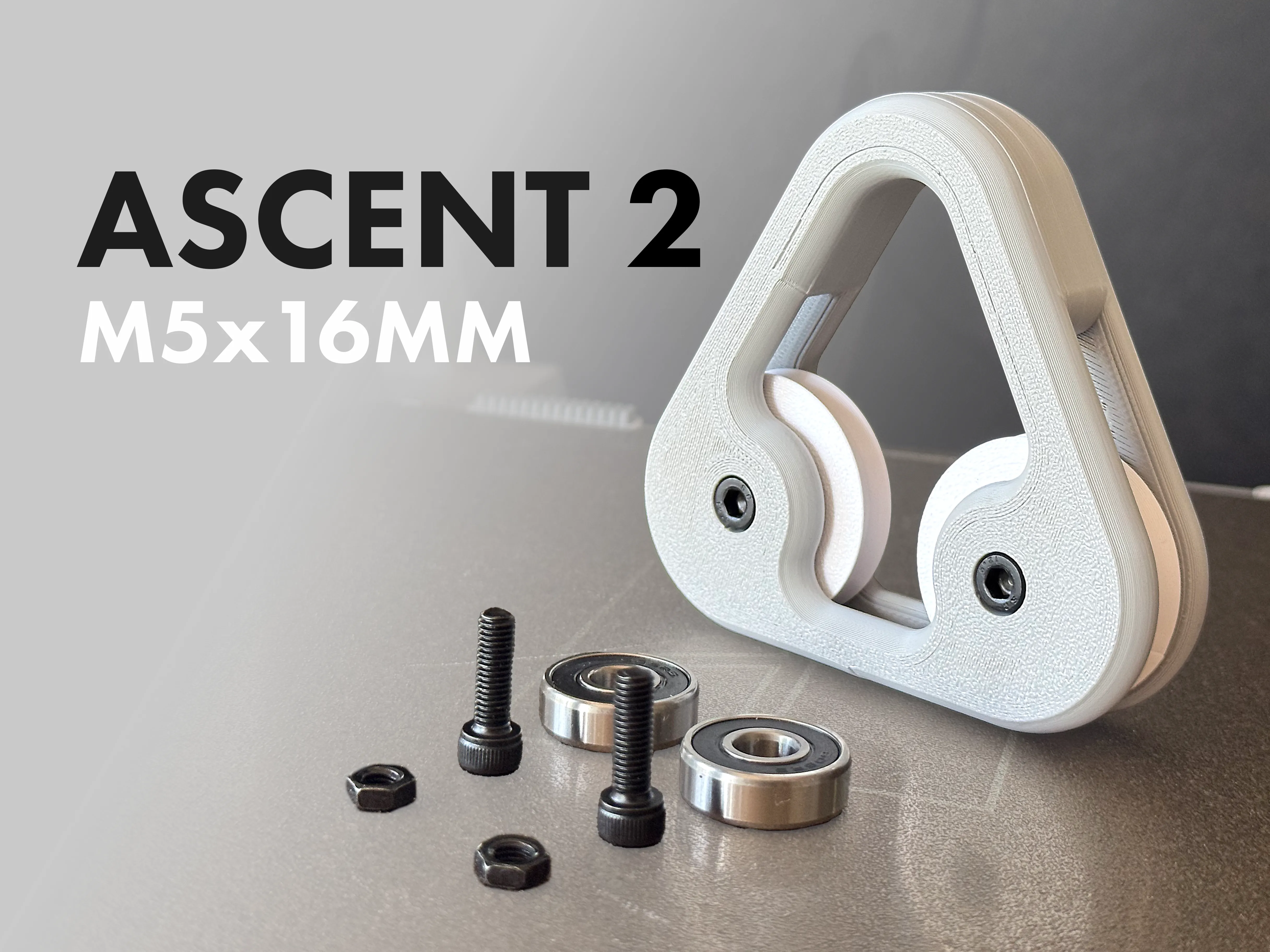
Ascent 3 M5 x 16mm Notes
- Best option for Bambu PETG-HF
- Hardware Requirements BOM
- 2x 608 Bearing
- 2x M5 x 16mm Hex Socket Head Cap Bolts
- 2x M5 Thin Hex Nut
Design Notes
Ascent Zero is a totally new double pulley design that offers many different advantages over my other models. My first Double Pulley model is vertically stacked, with two wheels of different sizes. There are many advantages to that first design, including the integrated rings for tying off the working end of a cord. Nevertheless, I was determined to come up with a pulley design that keeps the bearings side-by-side in a smaller more compact body. Many of the commercially available (metal) pulleys found in a hardware store put the wheels parallel to each other-- "so why wouldn't that work for me?" I asked myself… It seemed like a trivial matter to just design one up and it would be a winner. The side-by-side layout is an old and reliable design. It seems to also be the most compact design possible but it requires an axle rod that can pass through both wheels. As much as I tried to design a “Zero” (no metal bolts or rods) printable model that shared this approach, there were always too many concessions which I just couldn't concede and I had scrapped many half finished models.
Every successive pulley design I've made has narrowed my focus and increased my determination not to give in on a few key design goals. Because my pulleys require at least one metal bearing I feel that it's my duty to do my best not to require any additional hardware. Every non-printed component that is required must dramatically reduce the number of prints. I figure that most people don't have 608 bearings just lying around but I'll take my chances because the metal bearing pulley is a genuinely functional and reliable part that doesn't even compare to a pulley with a printed bearing.
My first few snatch block models required M2 or M3 bolts of varying lengths. To avoid this requirement, I completed a design cycle to develop a compression fit axle (a sort of printed nail) and a slightly less sturdy printed screw. The compression fit axle is a fool-proof install and very strong solution, so I want to use it in every design. The compression comes from a slight 2 degree draft on the split halves of the axle. This draft works great as long as the length is less than 20mm-ish but longer than that and the halves become almost completely wedge shaped and awkward. This unfortunately meant that every design for a “Zero” double pulley led me towards considering a non-printed axle or some sort of complex assembly that really degraded the form of the design.
The Ascent is my first double wheel design that actually hits all the goals, and it came from a spontaneous idea that crossed my mind to put three pulleys in a triangle configuration and to explore what that might look like and how it could be useful. Quickly the Ascent Zero Triple Pulley came to life. During the design exploration it occurred to me that I could simply drop out one of the wheels and fortify a sort of ring for hanging the pulley from something like a hook. After I had made those changes, then the Ascent Zero Double Pulley revealed itself as a solution to my long search for a better double pulley.
The Ascent doesn't have side-by-side wheels like I was attempting to figure out. The wheels are still aligned on the same plane and (depending on which direction you hold it) its not really that different from the Double Pulley in its orientation, but it totally avoids the need for different sized wheels and its so much more compact. It can even be used like a single pulley, with one of the wheels left unused. This pulley really does its magic when it's paired with a second Ascent to achieve that awesome 1:4 mechanical advantage.
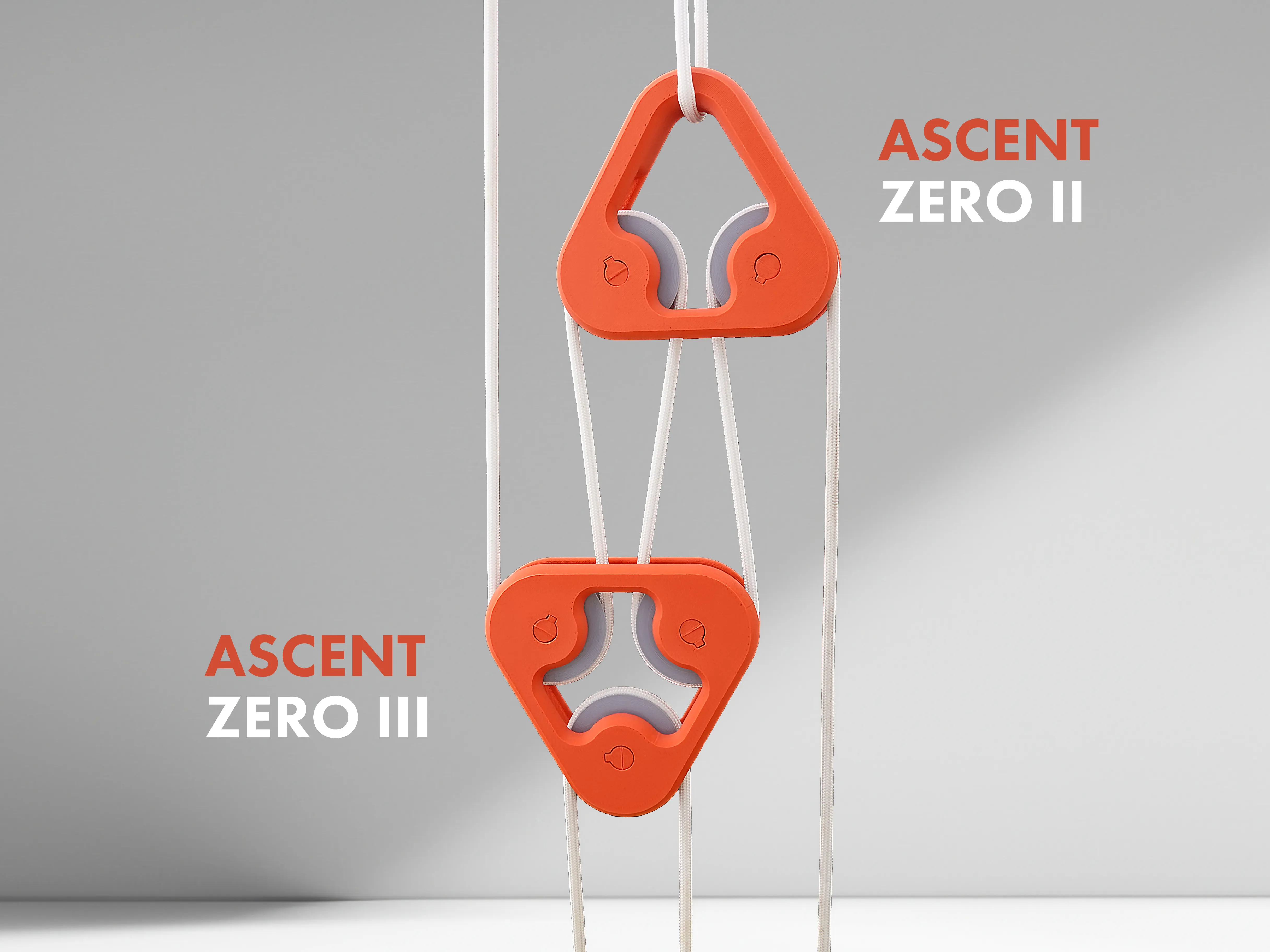
Related Models
Attach Ascent 2 to a wall or ceiling with Anchor.
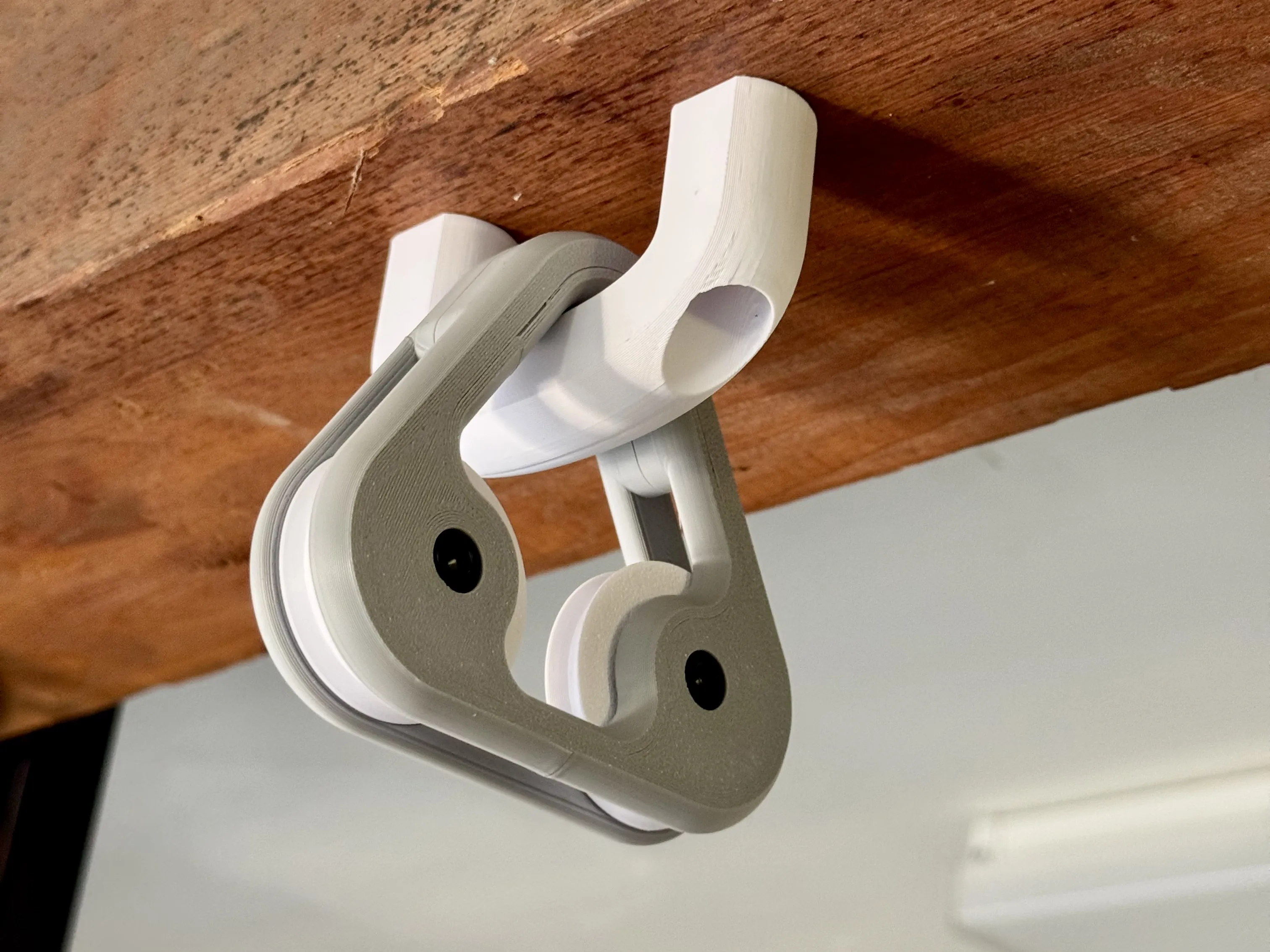
Boost Me (for free)
Your boosts help me to buy filament which goes towards designing and prototyping new models. Thank you for your support.
License

You shall not share, sub-license, sell, rent, host, transfer, or distribute in any way the digital or 3D printed versions of this object, nor any other derivative work of this object in its digital or physical format (including - but not limited to - remixes of this object, and hosting on other digital platforms). The objects may not be used without permission in any way whatsoever in which you charge money, or collect fees.


Comment & Rating (71)