
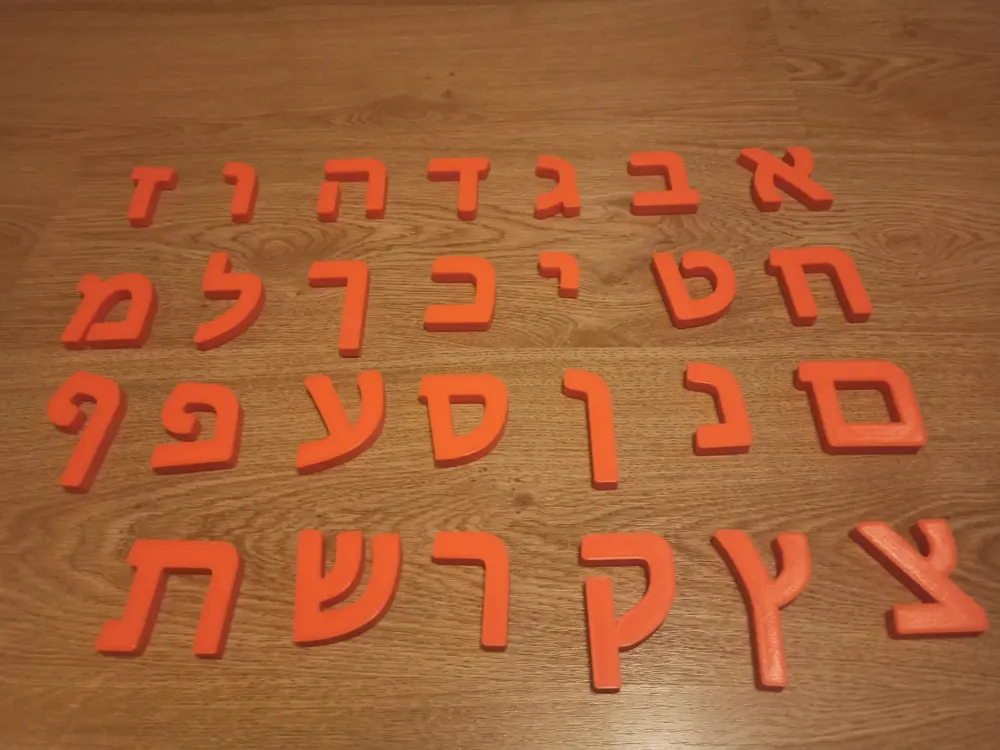
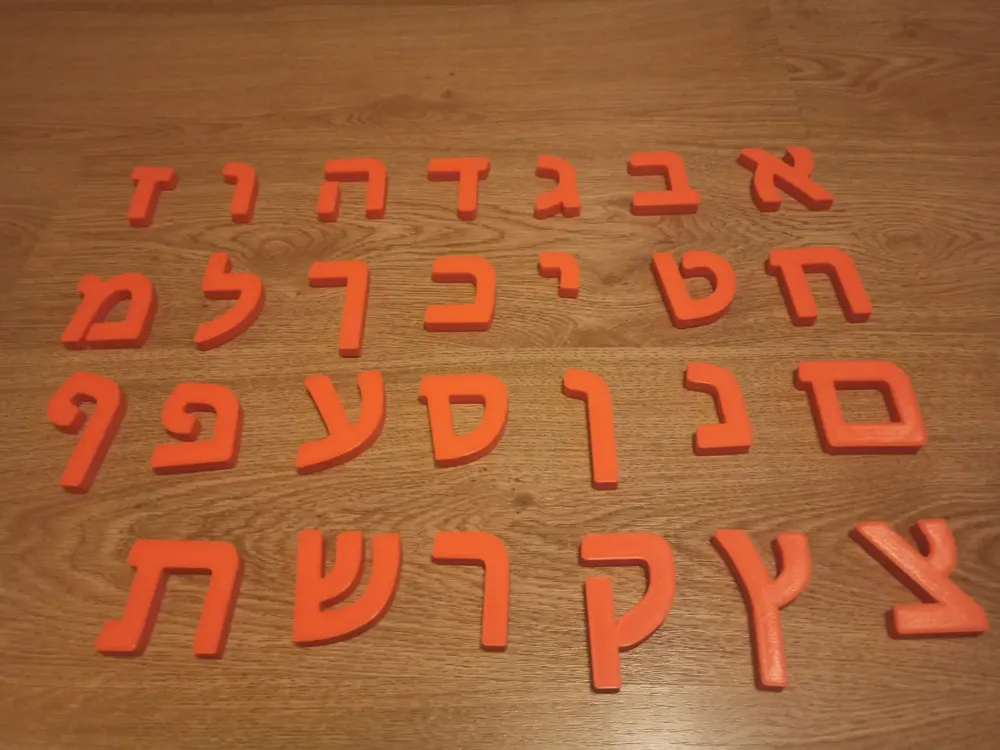
Aleph Bet-Hebrew Alphabet אלף בית
Print Profile(2)


Description
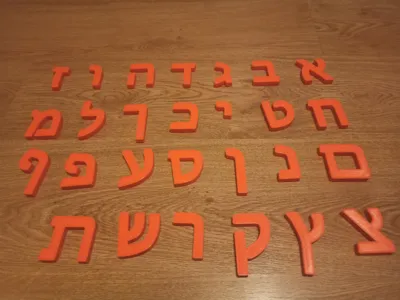
All letters of the alphabet, from the back side are openings for neodymium magnets.
.כל אותיות האלפבית, מהצד האחורי הן פתחים למגנטים של ניאודימיום
Ideal for teaching Hebrew
.אידיאלי להוראת עברית
- Material: PLA :חומר
- Nozzle: 0.4 mm :זרבובית
- Infill: 10-20% :מילוי
- Megnets: (3x2mm 80pcs)
I recommend sticking the magnets with instant glue.
אני ממליץ להדביק את המגנטים עם דבק מיידי.
Thanks for the download, I'd love for you to share your creations.
תודה על ההורדה, אשמח שתשתפו את היצירות שלכם
The Basics of the Hebrew Alphabet (Aleph-Bet)
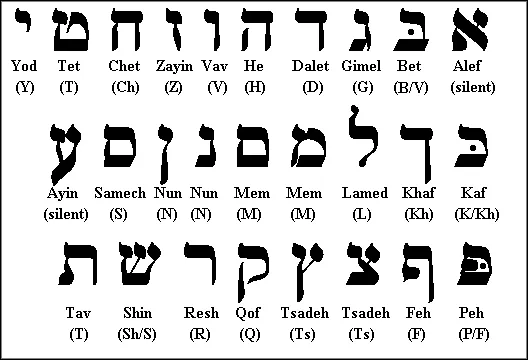
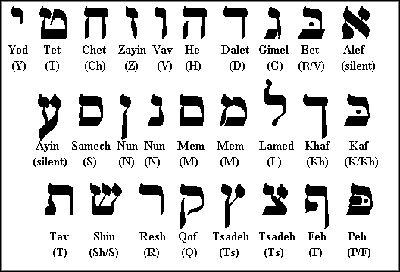
The Hebrew alphabet, known as the "Aleph-Bet" from its first two letters, is the foundation of the Hebrew language. Here are the key points to understand:
1. A Consonantal Script (Abjad): The most important thing to know is that the Hebrew alphabet consists primarily of 22 consonants. Unlike the Latin alphabet, vowels (a, e, i, o, u) are not part of the main alphabet. Imagine writing the English word "house" as just "hs." Native speakers would likely understand it from context.
2. Direction of Reading: Hebrew is written and read from right to left, which is the opposite of English.
3. The Letters and Their Shapes: Each of the 22 letters has its own name, sound, and specific shape. For example:
- א (Aleph): The first letter, which is silent on its own. It acts as a "carrier" for a vowel sound.
- ב (Bet): Makes a "b" or "v" sound.
- ג (Gimel): Makes a "g" sound.
- ד (Dalet): Makes a "d" sound. ...and so on.
4. Final Forms (Sofit): Five Hebrew letters change their shape when they appear at the end of a word. These are:
- Kaf (כ) becomes ך (Kaf Sofit) at the end of a word.
- Mem (מ) becomes ם (Mem Sofit) at the end of a word.
- Nun (נ) becomes ן (Nun Sofit) at the end of a word.
- Pe (פ) becomes ף (Pe Sofit) at the end of a word.
- Tsadi (צ) becomes ץ (Tsadi Sofit) at the end of a word.
These final forms (known as "sofit" forms) do not change the letter's pronunciation, only its appearance.
What is Nikkud?
Since you mentioned that your 3D models include "nikkud," you have the key to reading Hebrew with full pronunciation.
Nikkud (Hebrew: נִקּוּד) is a system of dots and dashes that are added to the consonant letters to indicate which vowel sound follows them. This system essentially "adds" the missing vowels to the text.
How it works: Take the letter ב (Bet), which by itself sounds like "b." By adding nikkud, we can give it different vowel sounds:
- בָ (with a dash underneath) is read as "ba".
- בֶ (with two dots side-by-side underneath) is read as "be".
- בִ (with a single dot underneath) is read as "bi".
- בֹ (with a dot above and to the left) is read as "bo".
- בוּ (with a dot inside the following letter Vav) is read as "bu".
Where is Nikkud Used? In modern, everyday Hebrew (like in newspapers or books for adults), nikkud is rarely used. Fluent readers understand the words from context. However, nikkud is essential in:
- Religious texts (like the Torah), where precise pronunciation is critical.
- Poetry.
- Children's books and materials for people learning Hebrew.
- Dictionaries, to show the exact pronunciation of a word.
Gematria (Hebrew: גִימַטְרִיָה), a traditional method where each letter of the Hebrew alphabet is assigned a specific number.
The sum of the numerical values of the letters in a word or phrase can then reveal a hidden meaning or a connection to other words that share the same numerical value.
Simply put: In Hebrew, letters are also numbers.
The System of Assigning Values
The numerical values are assigned systematically according to the letter's position in the alphabet:
The first 9 letters (Aleph through Tet) have the values 1 through 9.
The next 9 letters (Yud through Tsadi) represent the tens: 10 through 90.
The final 4 letters (Qof through Tav) represent the hundreds: 100 through 400.
Table of Numerical Values
Here is the complete chart for the 22 letters:
| Letter | Name | Value |
|---|---|---|
| א | Aleph | 1 |
| ב | Bet | 2 |
| ג | Gimel | 3 |
| ד | Dalet | 4 |
| ה | He | 5 |
| ו | Vav | 6 |
| ז | Zayin | 7 |
| ח | Chet | 8 |
| ט | Tet | 9 |
| י | Yud | 10 |
| כ | Kaf | 20 |
| ל | Lamed | 30 |
| מ | Mem | 40 |
| נ | Nun | 50 |
| ס | Samekh | 60 |
| ע | Ayin | 70 |
| פ | Pe | 80 |
| צ | Tsadi | 90 |
| ק | Qof | 100 |
| ר | Resh | 200 |
| ש | Shin | 300 |
| ת | Tav | 400 |
An Important Note on Final Letters (Sofit):
In the standard system of Gematria, the final forms of letters (ך, ם, ן, ף, ץ) have the same value as their standard forms. For example, both Kaf (כ) and Kaf Sofit (ך) have the value of 20.
Interestingly: Some Kabbalistic systems assign higher values to the final forms (500, 600, 700, 800, 900) to extend the number system, but this is not the standard method.
A Practical Example: The Word "Chai" (Life)
A very famous example is the Hebrew word חי (Chai), which means "life."
It is spelled with the letters Chet (ח) and Yud (י).
The value of Chet (ח) is 8.
The value of Yud (י) is 10.
The sum is: 8 + 10 = 18
For this reason, the number 18 is considered a lucky and special number in Jewish culture, symbolizing life. People often give gifts or charitable donations in multiples of 18.
License


Comment & Rating (14)