
Euler’s equation









Print Profile(1)

Description
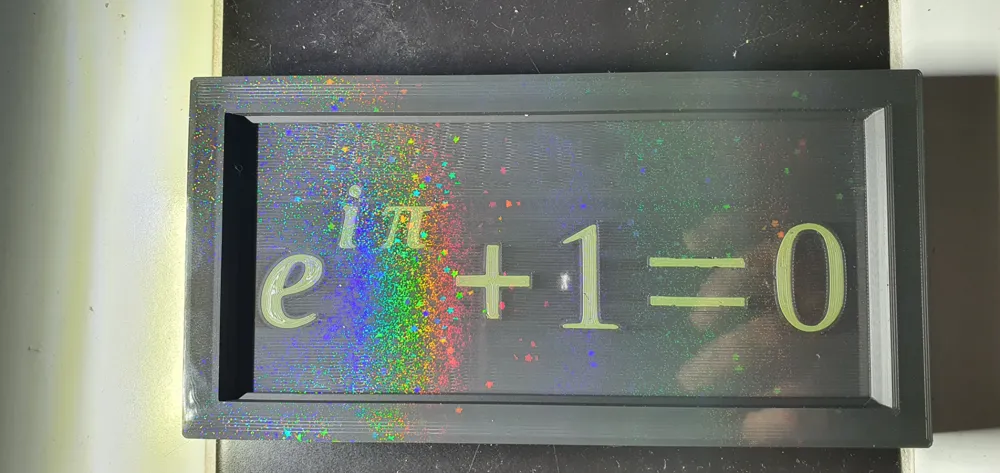
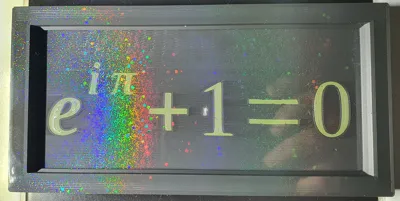
Euler’s equation
the most beautiful formula in mathematics
Euler's identity links five key numbers: e, i, π, 1, and 0,
showcasing the beauty of mathematics in one elegant formula.
Collection
https://makerworld.com/en/collections/2655531
This print
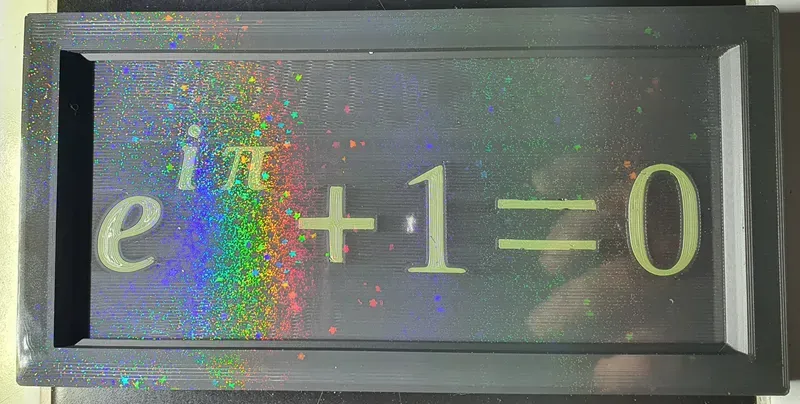
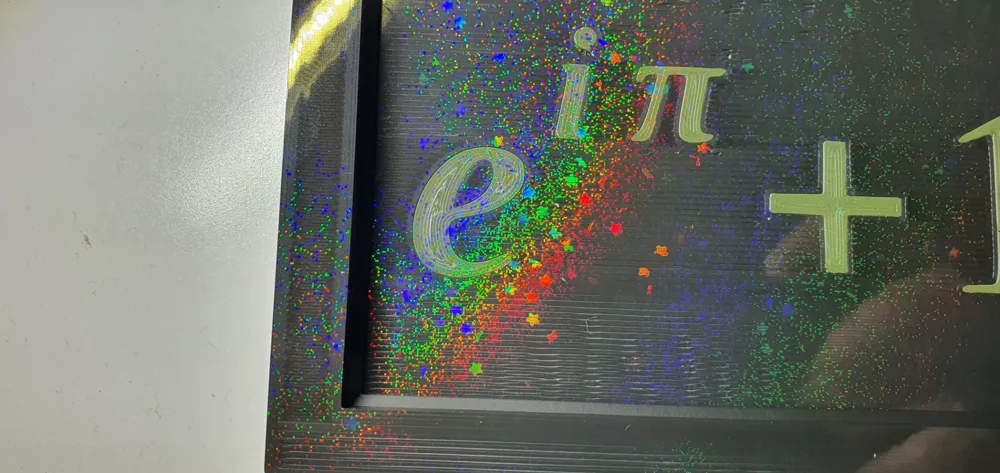
close up (note to myself IPA damages this kind of plates)
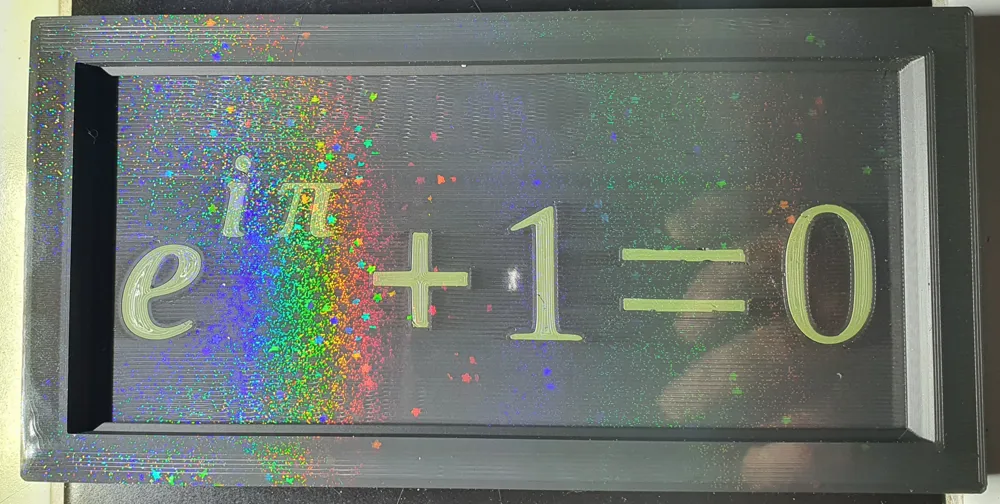
Black and Green PLA printed on an color illusion plate.
The sparkles are only an optical effect.
You will find very cheap ones on amazon/aliexpress.
The 257x257 fit without problems on P1/A1/X1/mk3/mk4/coreOne
1 - the number one
Identity Element: In arithmetic and algebra, 1 is the multiplicative identity. This means that any number multiplied by 1 remains unchanged, i.e., a * 1 = a. It's the starting point for defining and understanding other numbers.
Building Block of Natural Numbers: The number 1 is the first positive integer and forms the basis for counting. It's the first step in the sequence of natural numbers (1, 2, 3, ...). In this sense, it is the origin from which all other natural numbers emerge through the process of addition.
Prime Number: Though there has been historical debate, 1 is often considered a unit rather than a prime. However, its role in prime factorization is crucial because it is the product of no prime factors and the identity for multiplication.
Unity in Ratios and Proportions: The number 1 represents the concept of unity or equality. In ratios and proportions, the ratio 1:1 signifies equality. For example, in geometry, similar shapes maintain a constant ratio of 1 between corresponding sides.
Exponential and Logarithmic Properties: In exponential terms, raising any number to the power of 0 yields 1 (e.g., a⁰ = 1). In logarithms, the logarithm of 1 to any base is 0 (logb(1) = 0). These properties make 1 a pivotal reference point in exponential and logarithmic functions.
Fundamental in Abstract Algebra: In group theory, 1 often represents the identity element in a multiplicative group. It's the element that leaves other elements unchanged when combined with them.
0
Historical Development of Zero
Ancient Mesopotamia: The concept of zero first appeared in ancient Mesopotamia around 2000 BC. The Babylonians used a placeholder symbol to indicate the absence of a value in their positional number system.
Ancient India: The true concept of zero as both a symbol and a number was developed in India. Around 650 AD, the Indian mathematician Brahmagupta formalized arithmetic operations using zero and introduced the idea of zero as a number with its own value. He used dots to represent zero and called it "sunya" (empty) or "kha" (place).
Mayan Civilization: Independently, the Mayans in Central America also developed a zero-like symbol around 350 AD for their calendar system. However, their zero was primarily a placeholder.
Spread to the Middle East and Europe: The concept of zero spread from India to the Middle East, where it was adopted by mathematicians like Mohammed ibn-Musa al-Khowarizmi around 773 AD. Al-Khowarizmi's work on algebra further integrated zero into mathematical operations.
Arabic Numerals: By the 10th century, zero had become a part of the Arabic numeral system, resembling the oval shape we use today. It was introduced to Europe around the 12th century, largely thanks to the work of Fibonacci, who popularized the Arabic numeral system in his book "Liber Abaci" (1202).
Importance of Zero
Placeholder: Zero serves as a placeholder in positional number systems, allowing for the representation of large numbers efficiently. For example, in the number 1025, the zero indicates the absence of hundreds.
Identity Element for Addition: Zero is the additive identity in arithmetic, meaning that adding zero to any number does not change the number (e.g., a + 0 = a).
Foundation of Calculus: Zero is crucial in the development of calculus, particularly in the concepts of limits, derivatives, and integrals. The idea of approaching zero is fundamental to these mathematical fields.
Binary System: In computer science, zero is a fundamental part of the binary number system (0 and 1), which is the basis of all modern computing.
Mathematical Operations: Zero plays a key role in various mathematical operations, such as subtraction (e.g., 5 - 5 = 0) and division (e.g., division by zero is undefined).
Philosophical and Conceptual Significance: Zero represents the concept of "nothingness" and has philosophical implications in various fields, including mathematics, science, and philosophy.
Source
https://archive-yaleglobal.yale.edu/history-zero
https://www.history.com/news/who-invented-the-zero
π
Historical Development of Pi
Ancient Civilizations: The quest to understand π dates back to ancient civilizations. The ancient Egyptians and Babylonians were among the first to approximate the value of π. The Egyptians used a value of 3.1605, while the Babylonians used 3.125.
Archimedes of Syracuse: Around 250 BC, the Greek mathematician Archimedes made significant contributions to the understanding of π. He used the method of inscribed and circumscribed polygons to approximate π, providing bounds for its value between 3.1408 and 3.1429. This method laid the foundation for future studies of π.
Liu Hui and Zu Chongzhi: In the 3rd century, the Chinese mathematician Liu Hui improved the approximation of π using a similar polygonal method. Later, in the 5th century, another Chinese mathematician, Zu Chongzhi, calculated π to be between 3.1415926 and 3.1415927, an incredibly accurate approximation for his time.
Medieval and Renaissance Europe: During the medieval period, mathematicians in Europe continued to explore π. In the 15th century, the Indian mathematician Madhava of Sangamagrama developed infinite series to approximate π more accurately. These series were later rediscovered and expanded upon by European mathematicians in the 17th century.
Modern Mathematics: The advent of calculus in the 17th century by Isaac Newton and Gottfried Wilhelm Leibniz led to new methods for approximating π. The development of infinite series, such as the Gregory-Leibniz series, provided more accurate values for π.
Irrationality and Transcendence: In 1768, Johann Lambert proved that π is an irrational number, meaning it cannot be expressed as a simple fraction. Later, in 1882, Ferdinand von Lindemann proved that π is transcendental, meaning it is not the root of any non-zero polynomial equation with rational coefficients.
Importance of Pi
Geometry and Trigonometry: π is essential in geometry and trigonometry, particularly in calculations involving circles. The circumference of a circle is given by 2πr, and the area by πr².
Mathematical Analysis: In calculus and mathematical analysis, π appears in various formulas and integrals. For example, the integral of the Gaussian function is related to π.
Physics and Engineering: π plays a crucial role in physics and engineering, appearing in formulas for wave propagation, circular motion, and quantum mechanics.
Statistics and Probability: In statistics, π is involved in the distribution of random variables and the calculation of probabilities, particularly in the normal distribution.
Technology and Cryptography: π is used in computer algorithms and cryptographic systems. Its infinite, non-repeating decimal expansion makes it useful in random number generation and encryption.
e – Eulers Number
Historical Development of e
Early Origins: The number e began to emerge in the 17th century, primarily in the context of logarithms and the study of continuously compounded interest. The Scottish mathematician John Napier laid the groundwork with his development of logarithms in the early 1600s, although he didn't explicitly identify e.
Jacob Bernoulli: The Swiss mathematician Jacob Bernoulli made significant contributions to the understanding of e while studying compound interest. He discovered that as the number of compounding periods per year increases, the limit of (1+1/n)n approaches e as n tends to infinity.
Leonhard Euler: The formal introduction and popularization of the number e are attributed to Leonhard Euler in the early 18th century. Euler defined e and explored its properties, including its role in exponential functions and logarithms. He introduced the symbol e to represent this constant.
Further Developments: Subsequent mathematicians expanded on Euler's work, exploring the irrational and transcendental nature of e. Joseph Fourier and other mathematicians demonstrated its significance in various mathematical fields, including analysis and differential equations.
Importance of e
Exponential Growth and Decay: e is the base of the natural logarithm and is fundamental to the study of exponential growth and decay. It appears in the formula y=ex, which describes processes like population growth, radioactive decay, and continuously compounded interest.
Calculus: In calculus, e plays a crucial role in defining the derivative and integral of the exponential function. The function f(x)=ex is unique because its derivative is itself, and the area under the curve ex from 0 to x is ex - 1.
Complex Analysis: Euler's formula, eix = cos(x) + i*sin(x), where i is the imaginary unit, establishes a deep connection between exponential functions and trigonometric functions. This relationship is foundational in complex analysis and has applications in engineering and physics.
Probability and Statistics: e appears in probability theory, particularly in the context of distributions like the normal distribution and the Poisson distribution. The number e is also crucial in calculating compound probabilities and in various statistical models.
Series and Sequences: e is the sum of the infinite series 1 + 1/1! + 1/2! + 1/3! + ... This series representation makes e an essential constant in mathematical analysis and number theory.
i - a number that is as real as any number
Historical Development of I
Early Concepts: The concept of imaginary numbers arose from the need to solve polynomial equations. In the 16th century, Italian mathematicians like Girolamo Cardano and Rafael Bombelli began to encounter solutions to cubic and quartic equations that involved the square roots of negative numbers. Bombelli was one of the first to systematically use and accept these "imaginary" quantities.
Notational Development: Despite early skepticism and resistance, the utility of imaginary numbers became more evident. In the 18th century, Leonhard Euler introduced the notation i to represent the imaginary unit, defined as √-1.
Acceptance and Expansion: By the 19th century, Carl Friedrich Gauss and other mathematicians had established a more rigorous foundation for complex numbers (numbers of the form a + bi, where a and b are real numbers, and i is the imaginary unit). Gauss's work helped gain wider acceptance for the use of imaginary numbers in mathematics.
Geometric Interpretation: Jean-Robert Argand and Caspar Wessel developed the geometric interpretation of complex numbers, representing them as points or vectors in the complex plane. This visualization helped further solidify the concept of complex numbers and their applications.
Importance of i
Complex Numbers: The imaginary unit i is the foundation of complex numbers, which are essential in solving many polynomial equations that have no real solutions. Complex numbers are of the form a + bi, where i is the imaginary unit.
Euler's Formula: One of the most famous and beautiful results in mathematics is Euler's formula, which relates complex exponentiation to trigonometric functions: eix = cos(x) + i*sin(x). This formula connects the exponential function with the circular functions and is fundamental in complex analysis.
Electrical Engineering: Imaginary numbers are crucial in electrical engineering, particularly in the study of alternating current (AC) circuits. The use of complex numbers simplifies the analysis and calculation of AC signals, impedances, and power.
Quantum Mechanics: In quantum mechanics, complex numbers play a central role in the formulation of wave functions and the Schrödinger equation. The use of imaginary units allows for the representation of quantum states and the evolution of systems over time.
Signal Processing: Imaginary numbers are used in signal processing to represent and manipulate sinusoidal signals. The Fourier transform, a fundamental tool in signal analysis, employs complex numbers to decompose signals into their frequency components.
License



Comment & Rating (0)