
Leaf Shutter - Educational model

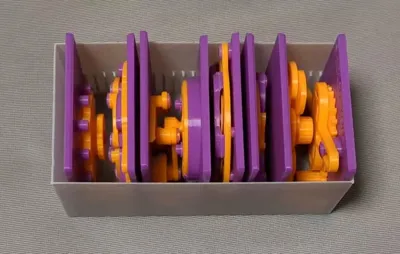
Print Profile(2)


Description
My Educational Mechanical Examples Series
This model is one of my educational mechanical mechanism examples on 80mm x 80mm base plates.
You can find all models of the series in this collection => [Mechanical Mechanism Examples]
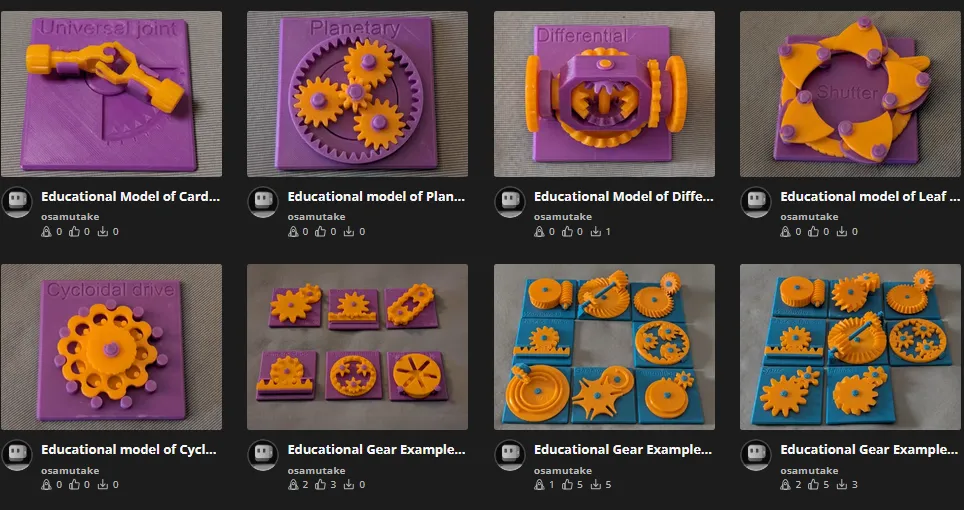
This model
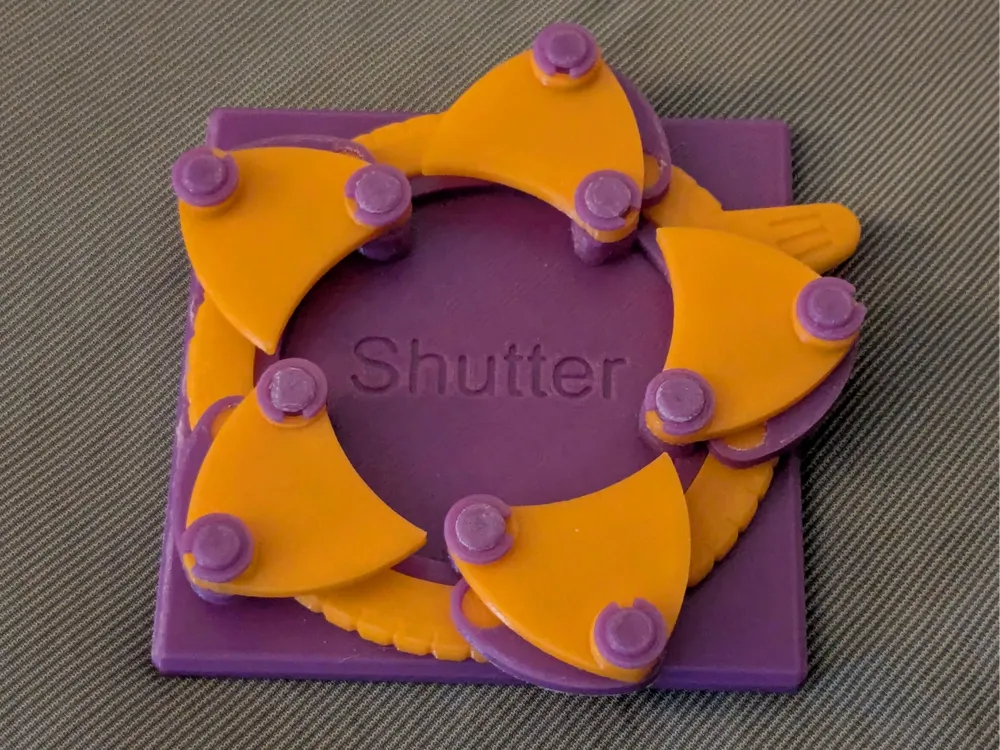
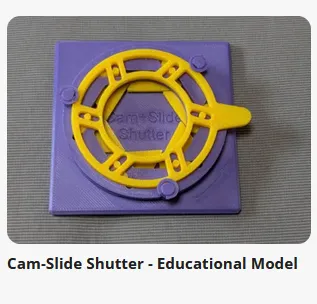
This is an educational model of a leaf shutter, in which the motion of each blade is realized by a four-bar mechanism.


Brief Description
This model demonstrates a mechanical leaf shutter mechanism made of several blades, which are the leaves, arranged around a central opening. You can open or close the shutter by rotating the outer ring.

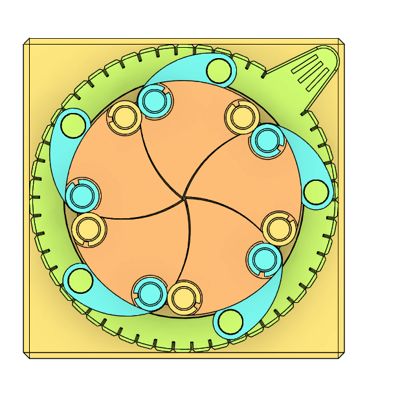
In this model, each blade, its corresponding arm, the outer ring and the base plate together form a small four-bar linkage (→ Wikipedia), as illustrated below. There, the input link and the central joint is virtual. Notice that the joint on the outer ring moves in a circular path around the central pivot. This implies the presence of a virtual link between them. When the outer ring is rotated back and forth, this motion corresponds to the rocking of this virtual input link, and it causes the rocking of the output link, which is the swing of the shutter blade in and out. Repeated around the circle, these small four-bar linkages operate together to open and close all the shutter blades simultaneously.
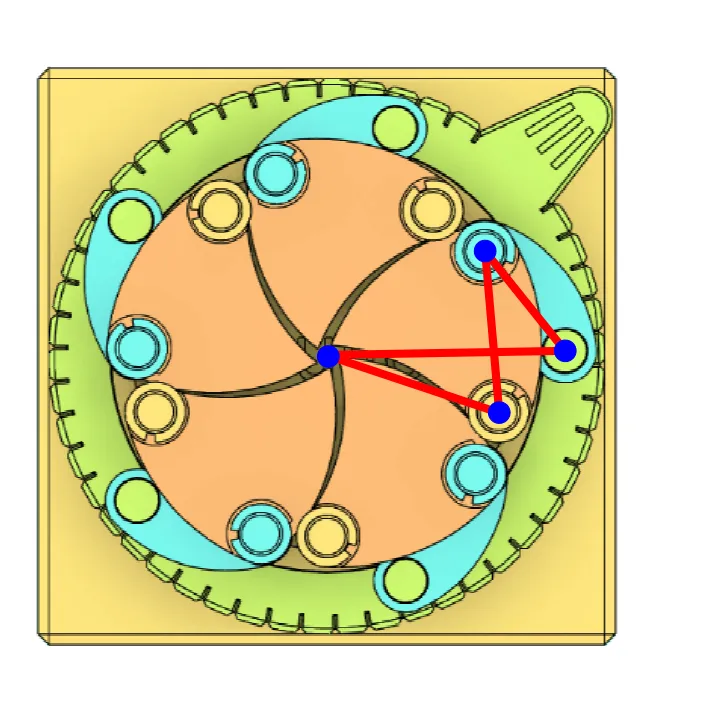
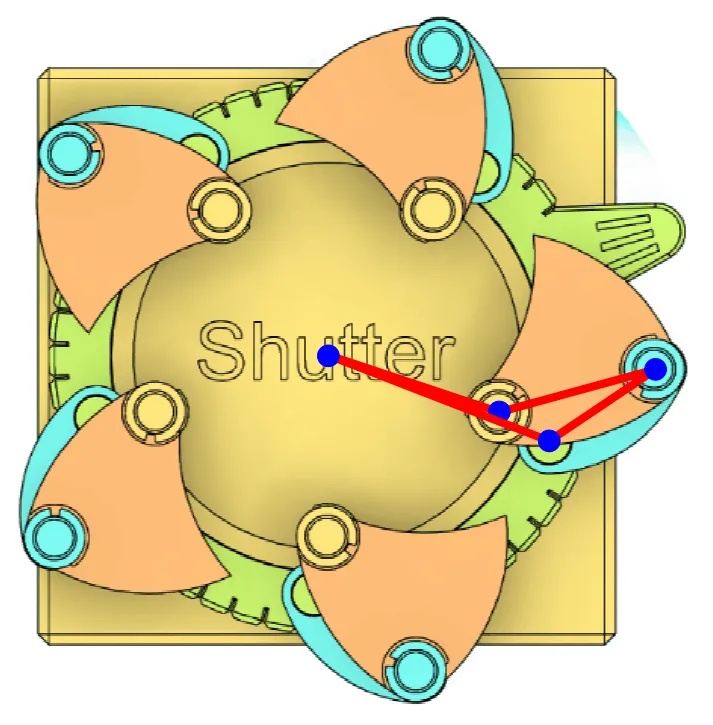
Unlike the blades in a camera iris, which must be thin and flexible to form an almost circular opening, the blades in this mechanism can be thicker and rigid because each one moves as a solid piece. However, the opening formed by this shutter is not circular during the motion.
Compared to a focal-plane shutter, a leaf shutter produces less mechanical vibration and fewer image artifacts when shooting fast-moving subjects or using flash, thanks to its relatively isotropic opening and closing near the aperture position inside the lens. On the other hand, a leaf shutter cannot achieve very high shutter speeds.
*In the real application, small gears are often used to rotate the leaves instead of link arms.
Reference
Related Models

Case
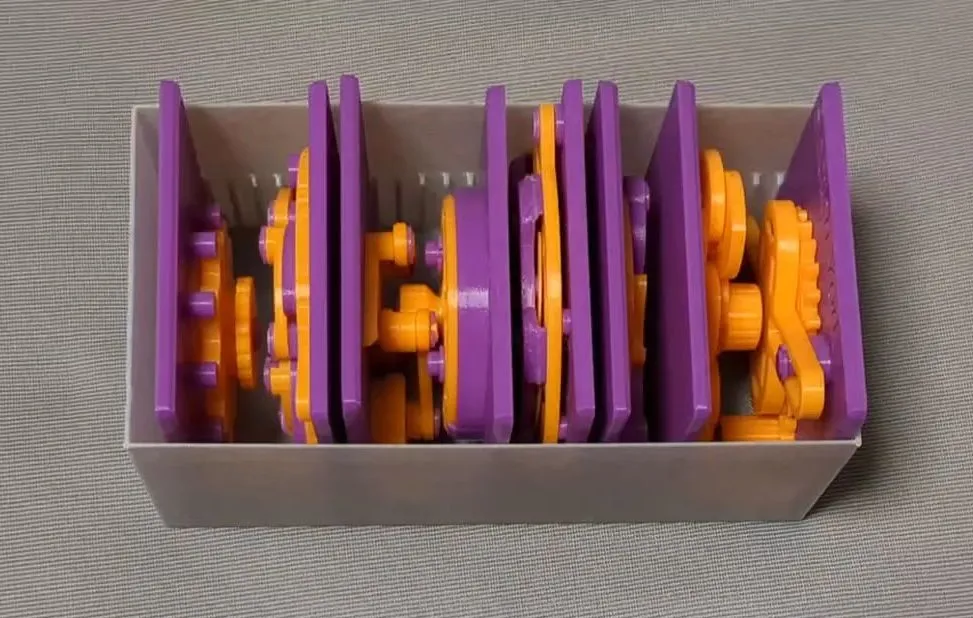
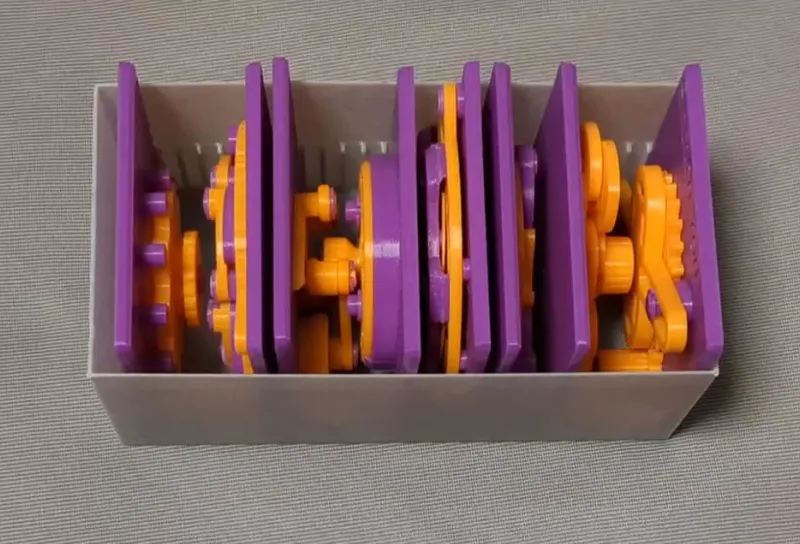
This model is compatible with the case included in my first set.
Printing
- Use the models named ???-printable.stl for printing.
The models named ???-assembled.stl are provided just to show how they should be assembled.
- Use well-dried PETG to have better dimensional accuracy.
- Use 0.1 mm or 0.08 mm layer height to have smoother surfaces.
- Use slow printing speed for overhangs.
- Select “Random” seam position to have smoother rotation.
Randomly distributed seam should be easily worn out after some wearing.
Sanding and Filing
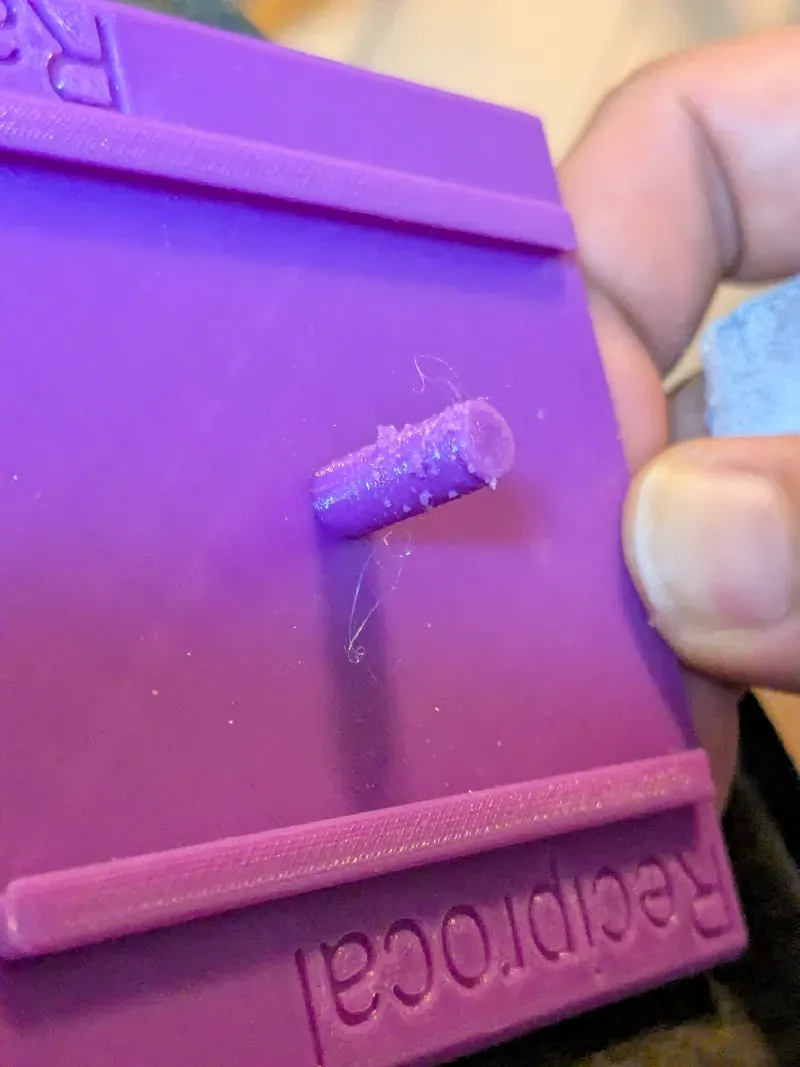
Sometimes, the gears suffer from the stringing effect and/or elephant foot effect, resulting in a too tight fit to the shafts (they are designed with a 0.15 mm radial clearance).
If you see rough surface on the shafts due to stringing, sand off the roughness with a small piece of sand paper.
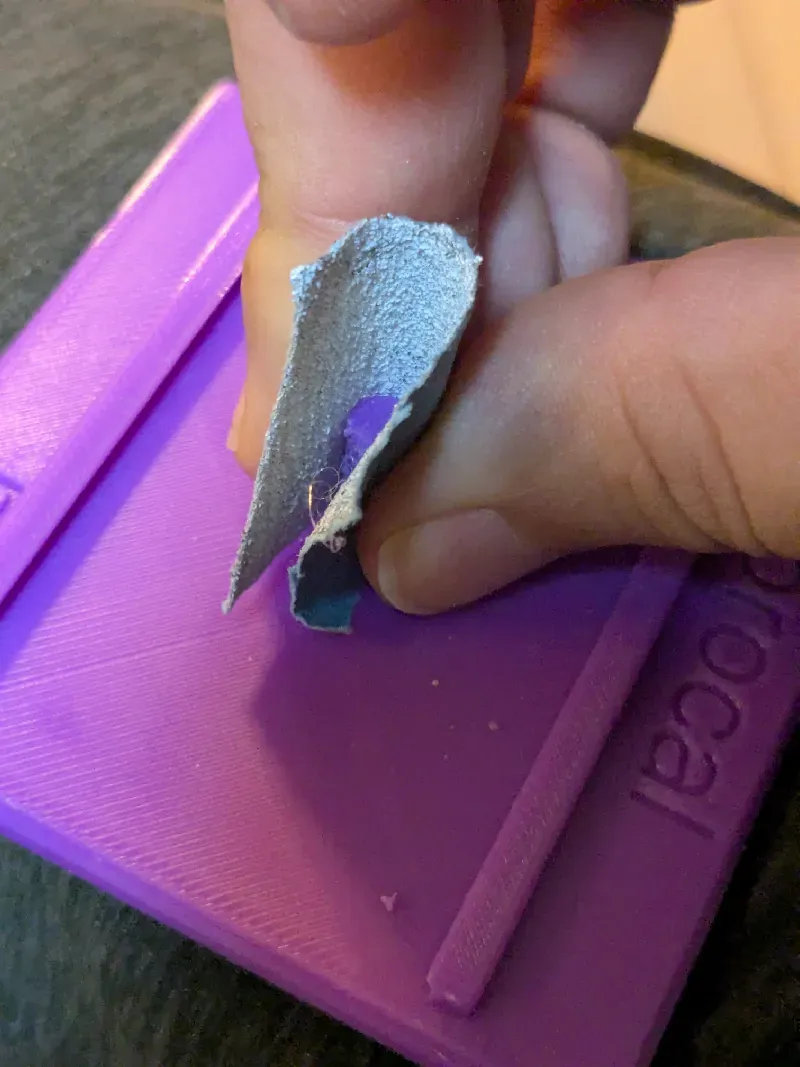
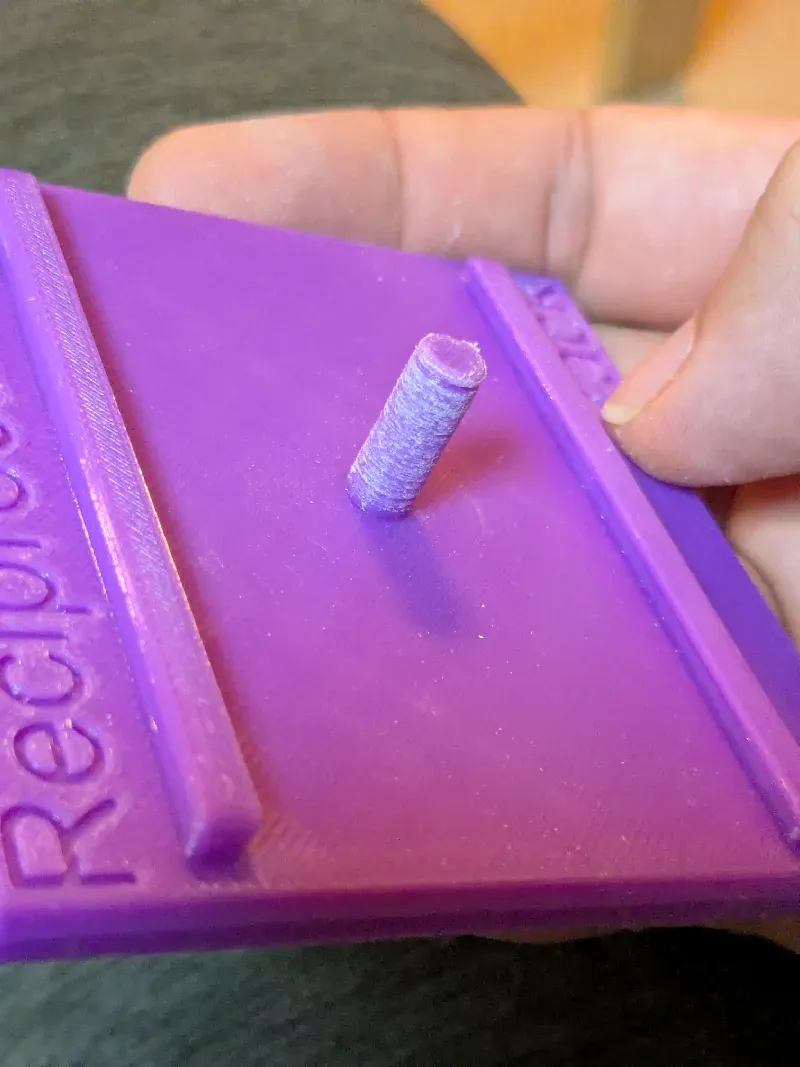
If you feel the gears do not rotate smoothly due to an elephant effect, widen the hole slightly by using a thin round bar file.
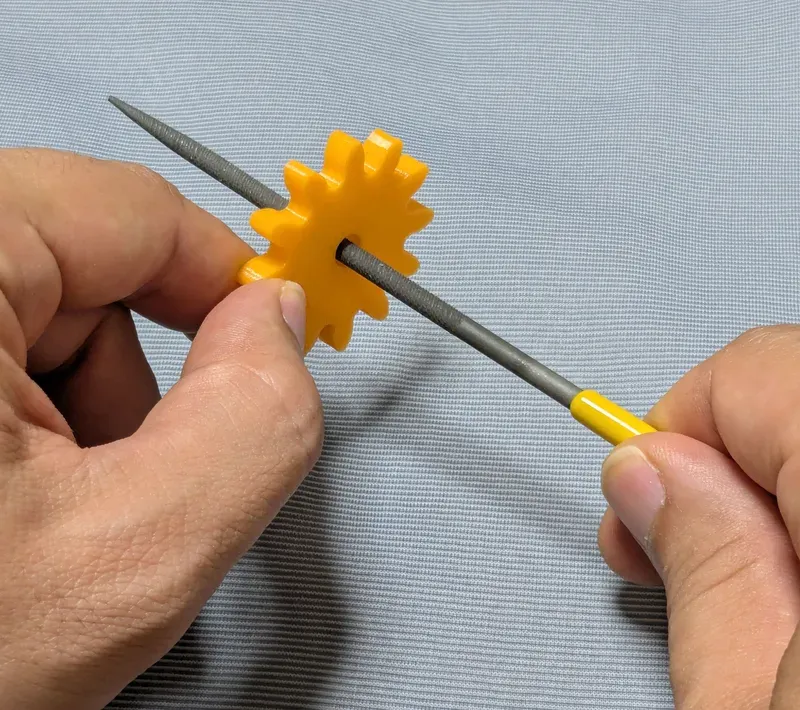
Without those issues, the model should open / close smoothly with minimal friction.
Assembly
No glue is needed.
Just snap the retaining rings onto the shafts.
Other educational models
You may also be interested in the models in my educational mechanical mechanism examples.
Find them in this collection:
https://makerworld.com/collections/15048577-my-educational-mechanism-models
Acknowledgement
I got into gears thanks to K.$uzuki's amazing articles and YouTube videos. Many of the mechanisms shown in this series came from the introductions on his website. He also makes excellent gear models himself. This series wouldn’t have existed without his inspiration.
I learned a lot about technical detail of designing gear tooth profiles from Haguruma-No-Hanashi website. I’m truly grateful for that.
License (2026-03-13 updated)
- The 3D model(s) are licensed under Creative Commons Attribution 4.0 International. (unchanged)
- However, the text and images on this page are copyright reserved. (added on 2026-03-13)
License



Comment & Rating (4)