
Unitrix
Print Profile(0)
Description
Introduction
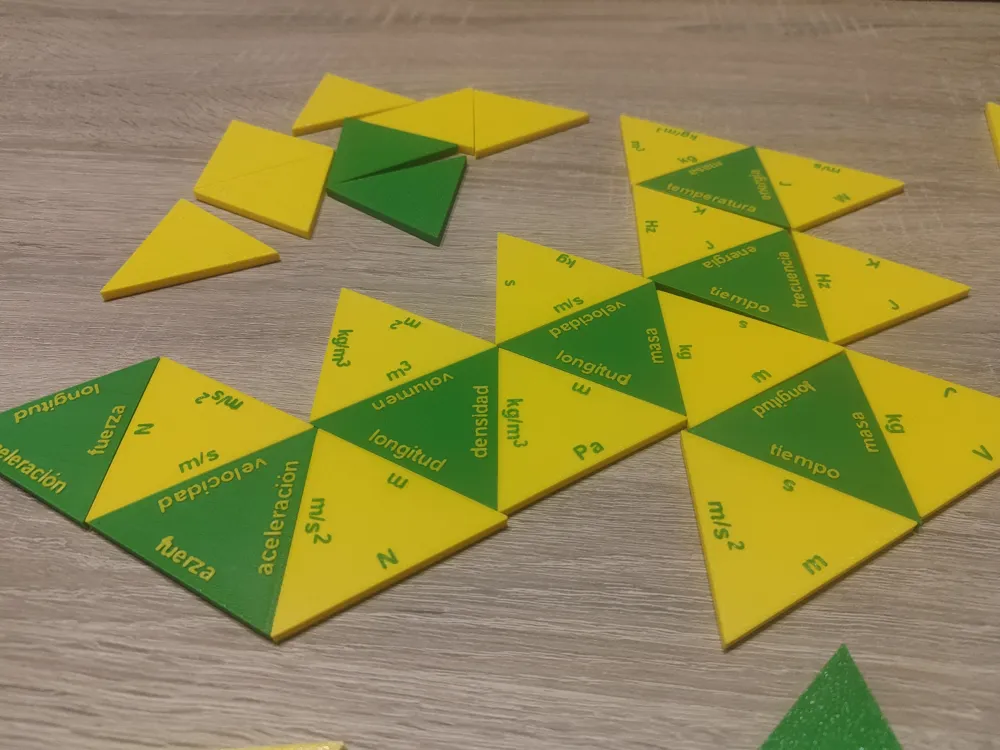
A tridomino-type game called Unitrix has been created using the main physical quantities and units of the International System. The model is now available in English, Spanish, and Dutch, designed for bilingual or multilingual use with students aged 13 to 15 in physics and chemistry learning. The game is intended for groups of 2 to 4 students.
Each piece is provided as an individual .stl. Also whole sets prepared to be printed are provided as a group .stl. Just check the different folders for the best option.
The PLA printing has been made in two colors, distinguishing the triangle base from the magnitudes and units. The color change has been made on layer 21.
I've used an external perimeter of 0,42 mm and layers of 0.2 mm.
UniTriX Instructions
Objective of the Game:
The objective is to gain points by connecting pieces of physical quantities with their corresponding units.
Alternatively, to control time, the teacher can make students play up to a previously decided amount of points.
Materials:
A total of 63 triangular pieces, divided into three types:
- 31 pieces of physical quantities.
- 31 pieces of units.
- 1 joker
Game Instructions:
Preparation:
Distribute:
- 9 pieces if you are 2 players.
- 7 pieces if you are 3 or 4 players.
The rest of the pieces remain inside the storage bag forming the reserve.
Start of the Game:
The player who has the piece with the magnitudes: Length, Mass and Time (or the corresponding piece of units: Meter, Kilogram, Second) begins the game by placing the piece in the center of the table. If none of these pieces are in play, the player who has had the closest birthday will start.
The players continue clockwise.
Placement of Parts:
Players must place a piece so that at least one of the physical quantities matches their corresponding units already present on the table.
The joker symbol can be placed anywhere.
Matches are scored as follows:
- 3 matches: 15 points.
- 2 matches: 7 points.
- 1 match: 3 points.
If a player cannot place any piece, the player must draw one from the pile and can directly place it, if possible.
End of the Game:
When a player draws the last piece of the pile, a final round is played and the game ends.
The player with the most points at the end of the game is the winner.
In the table you can find all the pieces that are provided in the game. The numbers in the .stl indicates the position in the table.
| Pieces of magnitudes (in order) | Pieces of units (in order) |
|
|
This remix is based on

License

Comment & Rating (9)