
Print Profile(2)

Description
Boost Me (for free)
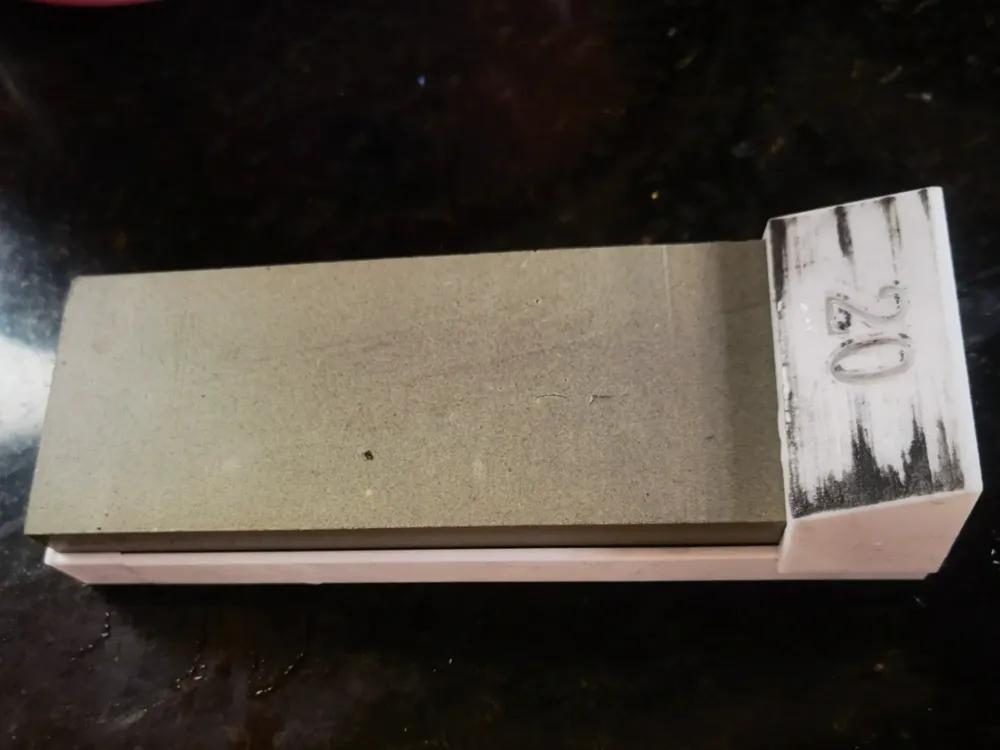

Base Interior Dimensions: 184 x 62 x 15 mm, Total Height: 30 mm
1. Defining Angles
- Single-Side Angle: The angle between one side of the blade and the sharpening stone. For example, 20 degrees per side results in a 40-degree total bevel angle.
- Total Bevel Angle: The sum of both side angles, directly impacting the sharpness and durability of the blade.
2. Recommended Angle Ranges
- Chinese Cleavers: Typically thicker and heavier, used for bone and hard materials. A recommended 20°–25° per side (40°–50° total) balances sharpness and durability.
- Western Chef's Knives: Emphasize slicing; 15°–20° per side (30°–40° total) is recommended for superior sharpness.
- Japanese Santoku Knives: Designed for precise cuts. Typically sharpened to 12°–15° per side (24°–30° total), resulting in extremely thin blades requiring careful use.
3. Impact of Angle
- Smaller Angles (below 15°): Blades are sharper but prone to rolling or chipping, suitable for soft ingredients.
- Larger Angles (above 25°): Blades are more durable, ideal for hard materials, but sharpness decreases.
4. Adjustment Recommendations
- Processing Hard Materials (e.g., bone): Increase the angle to a total of 40°–50°.
- Daily Slicing: Reduce the angle to a total of 30°–40° to enhance sharpness.
- Blade Material: High-hardness steel (e.g., VG-10) tolerates smaller angles; ordinary steel requires a moderate angle.
5. Sharpening Techniques
- Maintain Consistent Angle: Use a sharpening guide or hone your hand technique.
- Multi-Stage Sharpening: Coarse sharpening (correcting the blade shape) → Fine sharpening (polishing the edge).
- Test Sharpness: Use paper or a tomato to ensure even sharpness.
6. Tool Selection
- Sharpening Stones: Double-sided (coarse/fine) natural or synthetic stones are recommended for manual angle adjustment.
- Sharpening Guides: Ideal for beginners, ensuring consistent angles.
- Honing Rods: Quickly touch up the edge for everyday maintenance.
1. Basic Concept of Grit
Grit: Refers to the coarseness of the abrasive particles. Higher grit signifies finer particles, resulting in a smoother edge but weaker cutting ability.
Low Grit (200-800 grit): Coarse particles, strong cutting power, suitable for repairing chips or significant wear on the blade.
High Grit (3000 grit and above): Fine particles, used for polishing the edge to enhance sharpness and smoothness.
2. Recommended Grit for Different Scenarios
(1) Daily Maintenance (Slight Dullness)
Medium-High Grit (1000–3000 grit)
Use 1000 grit to repair minor burrs, then polish with 3000 grit for quick home sharpening.
(2) Repairing Severe Wear or Chips
Coarse Sharpening (200–800 grit)
Repair chipped or severely dulled blades, quickly reshaping the edge.
Medium Sharpening (1000–2000 grit)
Refine the edge, removing coarse sharpening marks.
Fine Sharpening (3000–6000 grit)
Polish the edge for a razor-sharp finish.
(3) Professional-Grade Sharpness (e.g., Japanese Knives)
Ultra-High Grit (8000–12000 grit)
Extreme polishing, suitable for achieving a mirror-like finish on sashimi knives or razor-like sharpness.
3. Impact of Blade Material
Ordinary Carbon Steel/Stainless Steel: 1000–3000 grit is recommended for a balance of efficiency and effectiveness.
High-Hardness Steel (e.g., VG-10, Powder Steel): Requires higher grit (5000 grit and above) for fine polishing to prevent chipping.
4. Practical Combination Schemes
Economical Home Use: Double-sided sharpening stone (1000/3000 grit) to meet daily needs.
Professional Repair: Three-stone combination (400 grit + 1000 grit + 5000 grit) for multi-stage sharpening.
Quick Maintenance: Ceramic honing rod (approximately 2000 grit) for immediate edge touch-ups.
5. Operational Suggestions
Multi-Stage Sharpening:
Coarse Sharpening (200-800 grit) → Repairing the blade shape
Medium Sharpening (1000-2000 grit) → Refining the edge
Fine Sharpening (3000 grit and above) → Polishing to enhance sharpness
Avoid Grit Skipping: The difference between consecutive grits should not exceed 3 times (e.g., 400→1000→3000 grit).
Test Sharpness: After fine sharpening, test with paper or a tomato to ensure even cutting.
6. Precautions
Soft Steel Blades (e.g., Chinese cleavers): Do not use excessively high grit (3000 grit is sufficient), otherwise rolling may occur.
Hard Steel Blades (e.g., Japanese kitchen knives): Fine polishing (5000 grit and above) is recommended to prolong sharpness retention.
Do Not Start Directly with High Grit: Skipping coarse sharpening when the blade has chips will lead to low efficiency.
Summary
Daily Home Use: 1000 grit for sharpening + 3000 grit for polishing.
Professional Repair: 400 grit → 1000 grit → 5000 grit multi-stage sharpening.
Ultimate Sharpness: 8000 grit and above mirror polishing (requires high-hardness steel).
License

You shall not share, sub-license, sell, rent, host, transfer, or distribute in any way the digital or 3D printed versions of this object, nor any other derivative work of this object in its digital or physical format (including - but not limited to - remixes of this object, and hosting on other digital platforms). The objects may not be used without permission in any way whatsoever in which you charge money, or collect fees.


Comment & Rating (0)