Search models, users, collections, and posts

anto
@anto_3d
Bio
I am a passionate technological bachelor student that loves 3d printing and everything related to it. Each like, download, print and/or boost means a world for me. I also encourage you to subscribe and stay tuned cause I try to be a really active creator. :) Currently, I am focused on developing my skills in modeling in Fusion 360, and I am eager to collaborate on projects that push the boundaries of 3D printing and bring creative ideas to life. Always ready to learn and grow in this exciting field! 😊😁✌️
Achievements

MakerWorld Guardian
Active more than 20 days out of last 30 days UTC time
Recent Article
Printing Math in 3D
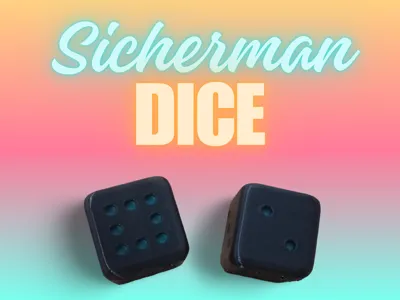
Printing Math in 3DThe Fascinating World of Sicherman Dice: Printing Math in 3DDice are more than just gaming tools; they are little cubes of mathematics that hide centuries of probability theory inside their six faces. Most people are familiar with the standard six-sided die, numbered 1 through 6, with opposite sides summing to 7. But in 1977, George Sicherman discovered something remarkable: there exists another way to number two dice with positive integers so that their combined sums mimic the exact same distribution as two ordinary dice. These are now known as Sicherman dice, and they offer a beautiful demonstration of probability, number theory, and creativity.With 3D printing, anyone can now create their own pair of these unique dice, turning abstract mathematical concepts into tangible objects.What Makes Sicherman Dice Special?When you roll two standard six-sided dice, the possible sums range from 2 to 12. But the sums are not equally likely—rolling a 7 is much more common than rolling a 2 or 12. The full distribution looks like this:P(sum = n) = number of combinations that make n / 36since there are 36 total outcomes (6 × 6).SumWaysProbability211/36 ≈ 2.78%322/36 ≈ 5.56%433/36 ≈ 8.33%544/36 ≈ 11.11%655/36 ≈ 13.89%766/36 ≈ 16.67%855/36 ≈ 13.89%944/36 ≈ 11.11%1033/36 ≈ 8.33%1122/36 ≈ 5.56%1211/36 ≈ 2.78%This famous triangular distribution is what makes dice games like Monopoly and Craps work as they do.Now, here’s the fascinating part: Sicherman dice reproduce this exact distribution, but with different face values. Instead of two dice numbered 1–6, they are numbered as follows:Die A: 1, 2, 2, 3, 3, 4Die B: 1, 3, 4, 5, 6, 8Roll them together, and the same probability table emerges.Why Does This Work? A Mathematical ExplanationThe key to understanding Sicherman dice is the use of generating functions in probability.For a standard die, the generating function is:f(x) = x1 + x2 + x3 + x4 + x5 + x6For two dice, we multiply:f(x)2 = (x1 + x2 + x3 + x4 + x5 + x6)2When expanded, the coefficient in front of each power of x shows the number of ways to get that sum. For example, the coefficient of x7 is 6, which corresponds to the six ways to roll a 7.George Sicherman found that this polynomial could be factored differently:(x1 + x2 + x2 + x3 + x3 + x4) × (x1 + x3 + x4 + x5 + x6 + x8)This corresponds to the face values of the two Sicherman dice. In other words, these dice are the only known positive-integer alternative labeling of two six-sided dice that keeps the same sum distribution.Printing Sicherman Dice in 3D3D printing makes these mathematical curiosities come alive. Unlike buying ordinary dice, you can customize them, highlight their unique numbering, and even use dual-color filament to make the unusual faces stand out.Printing Specs:Material: PLA, PETG, or ABSLayer height: 0.2 mmWalls: 2–3Infill: 15–20%Supports: None requiredOrientation: Print flat on one faceEducational ValueSicherman dice are more than game accessories—they are excellent teaching tools.In math classrooms, they provide a hands-on way to explore probability, distributions, and generating functions.In gaming clubs, they demonstrate how different dice designs can yield identical game mechanics.For hobbyists, they embody the spirit of making: combining creativity, mathematics, and technology.Teachers often use them to ask: “How can two dice with different faces behave exactly the same as standard dice?” The answer sparks deeper exploration into algebra and probability.Gaming ApplicationsWhile Sicherman dice behave like standard dice in terms of sums, they add novelty to any board game. Players are often surprised when they see the “8” face, or when a die has two “2”s. Yet the outcomes remain fair, ensuring gameplay isn’t disrupted.They’re especially fun in role-playing games, where unusual dice are already part of the culture. Adding Sicherman dice to your set is a way to stand out while still keeping traditional mechanics intact.A Symbol of Creativity in MathThe beauty of Sicherman dice is that they remind us that mathematics is not rigid—it allows for creativity, alternative perspectives, and unexpected elegance. For makers, they are a way to hold a piece of probability theory in your hand.By 3D printing them, you don’t just get a new pair of dice. You get a story to tell, an educational tool, and a conversation starter that bridges the gap between abstract mathematics and real-world fun.Final ThoughtsSicherman dice are proof that math is everywhere, even in the simplest objects we take for granted. They combine elegance, utility, and curiosity into a compact cube that rolls across tables around the world. With 3D printing, their story is no longer confined to textbooks or math circles—it becomes part of gaming nights, classrooms, and maker projects.So, the next time someone picks up your unusual dice and asks, “Why does this one have an 8?” you can smile and explain how probability, combinatorics, and George Sicherman changed the way we look at randomness—one roll at a time.