Search models, users, collections, and posts

Unitrix

Remixed by

Print Profile(0)


Add the first print profile to earn points

Boost
3
6
9
1
3
1
Released 

Description

Introduction

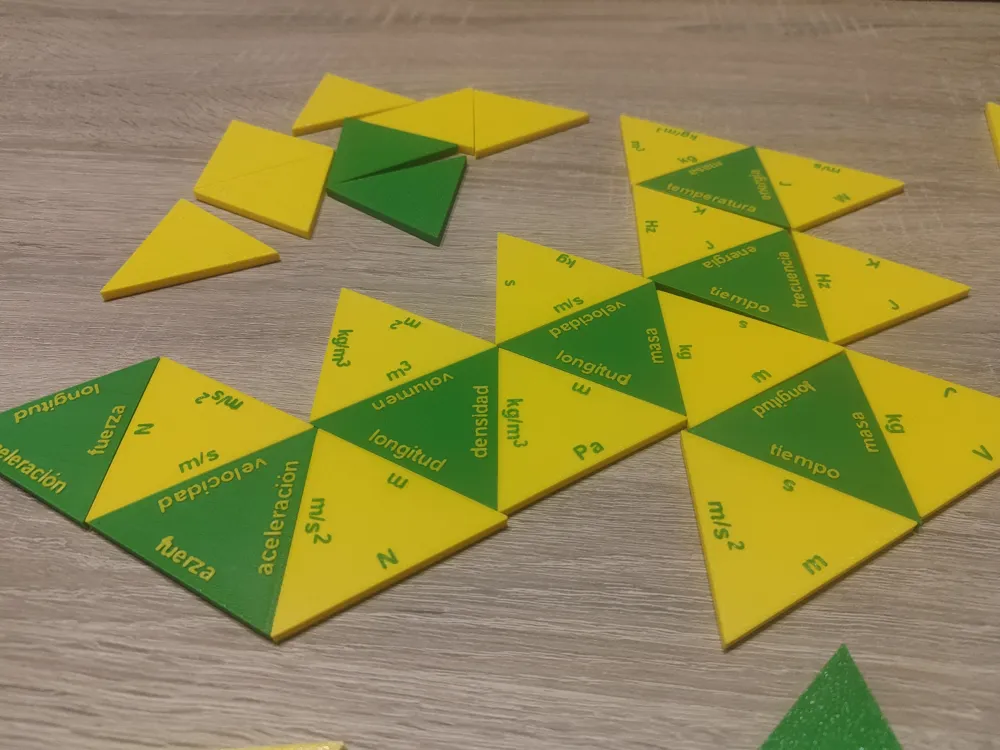
A tridomino-type game called Unitrix has been created using the main physical quantities and units of the International System. The model is now available in English, Spanish, and Dutch, designed for bilingual or multilingual use with students aged 13 to 15 in physics and chemistry learning. The game is intended for groups of 2 to 4 students.

Each piece is provided as an individual .stl. Also whole sets prepared to be printed are provided as a group .stl. Just check the different folders for the best option.

The PLA printing has been made in two colors, distinguishing the triangle base from the magnitudes and units. The color change has been made on layer 21.

I've used an external perimeter of 0,42 mm and layers of 0.2 mm.

UniTriX Instructions

Objective of the Game: 

The objective is to gain points by connecting pieces of physical quantities with their corresponding units.

Alternatively, to control time, the teacher can make students play up to a previously decided amount of points.

Materials:

A total of 63 triangular pieces, divided into three types:

  • 31 pieces of physical quantities.
  • 31 pieces of units.
  • 1 joker

Game Instructions:

Preparation:

Distribute:

  • 9 pieces if you are 2 players.
  • 7 pieces if you are 3 or 4 players.

The rest of the pieces remain inside the storage bag forming the reserve.

Start of the Game:

The player who has the piece with the magnitudes: Length, Mass and Time (or the corresponding piece of units: Meter, Kilogram, Second) begins the game by placing the piece in the center of the table. If none of these pieces are in play, the player who has had the closest birthday will start.

The players continue clockwise.

Placement of Parts:

Players must place a piece so that at least one of the physical quantities matches their corresponding units already present on the table.

The joker symbol can be placed anywhere.

Matches are scored as follows:

  • 3 matches: 15 points.
  • 2 matches: 7 points.
  • 1 match: 3 points.

If a player cannot place any piece, the player must draw one from the pile and can directly place it, if possible.

End of the Game:

When a player draws the last piece of the pile, a final round is played and the game ends.

The player with the most points at the end of the game is the winner.

In the table you can find all the pieces that are provided in the game. The numbers in the .stl indicates the position in the table.

Pieces of magnitudes (in order)Pieces of units (in order)
  • Length, Mass, Time
  • Speed, Acceleration, Force
  • Energy, Power, Mass
  • Length, Volume, Density
  • Mass, Energy, Temperature
  • Electric Charge, Electric Resistance, Voltage
  • Length, Mass, Speed
  • Power, Strength, Area
  • Time, Frequency, Energy
  • Pressure, Volume, Temperature
  • Current Intensity, Voltage, Electrical Resistance
  • Length, Acceleration, Force
  • Area, Volume, Density
  • Energy, Pressure, Power
  • Mass, Time, Speed
  • Temperature, Energy, Frequency
  • Electric Charge, Current Intensity, Power
  • Volume, Pressure, Temperature
  • Acceleration, Force, Energy
  • Length, Density, Pressure
  • Ground, Energy, Voltage
  • Power, Speed, Strength
  • Area, Volume, Temperature
  • Length, Acceleration, Time
  • Density, Mass, Volume
  • Force, Energy, Pressure
  • Speed, Frequency, Energy
  • Pressure, Power, Strength
  • Length, Time, Frequency
  • Length, Power, Power
  • Density, speed, acceleration
  • Meter(m), Kilogram(kg), Second(s)
  • Meter per second (m/s), Meter per second quare (m/s²), Newton (N)
  • Julio (J), Vatio (W), Newton (N)
  • Cubic meter (m³), Kilogram per cubic meter (kg/m³), Square meter (m²)
  • Kelvin (K), Julio (J), Hertz (Hz)
  • Culombio (C), Ohmio (Ω), Voltio (V)
  • Meter (m), Kilogram (kg), Meter per second (m/s)
  • Vatio (W), Newton (N), Square metre (m²)
  • Second(s), Hertz(Hz), July(J)
  • Pascal (Pa), Cubic Meter (m³), Kelvin (K)
  • Amperio (A), Voltio (V), Ohmio (Ω)
  • Meter (m), Meter per second squared (m/s²), Newton (N)
  • Square Meter (m²), Cubic Meter (m³), Kilogram per Cubic Meter (kg/m³)
  • Julio (J), Pascal (Pa), Newton (no)
  • Kilogram (kg), Second(s), Meter per second (m/s)
  • Kelvin (K), Joule (J), Hertz (Hz)
  • Coulomb (C), Ampere (A), Watt (W)
  • Cubic Meter (m³), Pascal (Pa), Kelvin (K)
  • Meter per second square (m/s²), Newton (N), Joule (J)
  • Meter(m), Kilogram per cubic meter(kg/m³), Pascal(Pa)
  • Kilogram (kg), Joule (J), Volt (V)
  • Watt (W), Meter per second (m/s), Joule (J)
  • Square Meter (m²), Cubic Meter (m³), Kelvin (K)
  • Meter (m), Meter per second square (m/s²), Second(s)
  • Kilogram per cubic meter (kg/m³), Kilogram (kg), Cubic meter (m³)
  • Newton (N), Joule (J), Watt (W)
  • Meter per second (m/s), Hertz (Hz), Joule (J)
  • Pascal (Pa), Watt (W), Newton (N)
  • Meter (m), Second(s), Hertz (Hz)
  • Kilogram (kg), Joule (J), Square meter (m²)
  • Kilogram per cubic meter (kg/m³), Meter per square second (m/s²), Pascal (Pa)

Comment & Rating (9)

(0/1000)

Boosted
Printed well, happy with the Dutch translation tiles.
The designer has replied
designer
1
Reply
Thank you for showing me how it's turning out. I love it!
0
Reply
Boosted
I love to try this game with my students. Is there an easy way to change the magnitude names to the Dutch names so I can use them in my Dutch classroom? I can provide a list containing the correct Dutch names if necessary.
The designer has replied
0
Reply
Hello, sorry for the late reply. It's “easy,” but it's tedious, since you have to modify them one by one. I can provide you with the Fusion 360 project so you can change them yourself. If you don't know how to use it, send me the list of names and I'll try to find some time to do it.
0
Reply
Boosted
Replying to @rocafuentes :
Thank you for your reply. I really love your design. I'm a novice and have only used Tinkercad. I have never used Fusion 360 unfortunately. :-( If it's easy to do I can try to modify them myself. But if it is not too much work for you, I'd really appreciate your help! I'll share the Dutch MakerWorld-link with my physics colleagues! Please find the Dutch translations below. I've placed them all in lowercase, that is the most common for us I think. Acceleration: versnelling Area: oppervlakte Current Intensity: stroomsterkte Density: dichtheid Electric Charge: lading Electric Resistance: weerstand Energy: energie Force: kracht Frequency: frequentie Ground: massa Length: lengte Mass: massa Power: vermogen Pressure: druk Speed: snelheid Strength: kracht Temperature: temperatuur Time: tijd Voltage: spanning Volume: volume
0
Reply
Replying to @evdleur :
Okay, I'll try to do it next week. I'll let you know when it's ready. If I have any questions about any of the magnitude names, I'll ask you.
0
Reply
No more