
Congruence Clock
Print Profile(1)
Bill of Materials

Description
It's π o' clock!
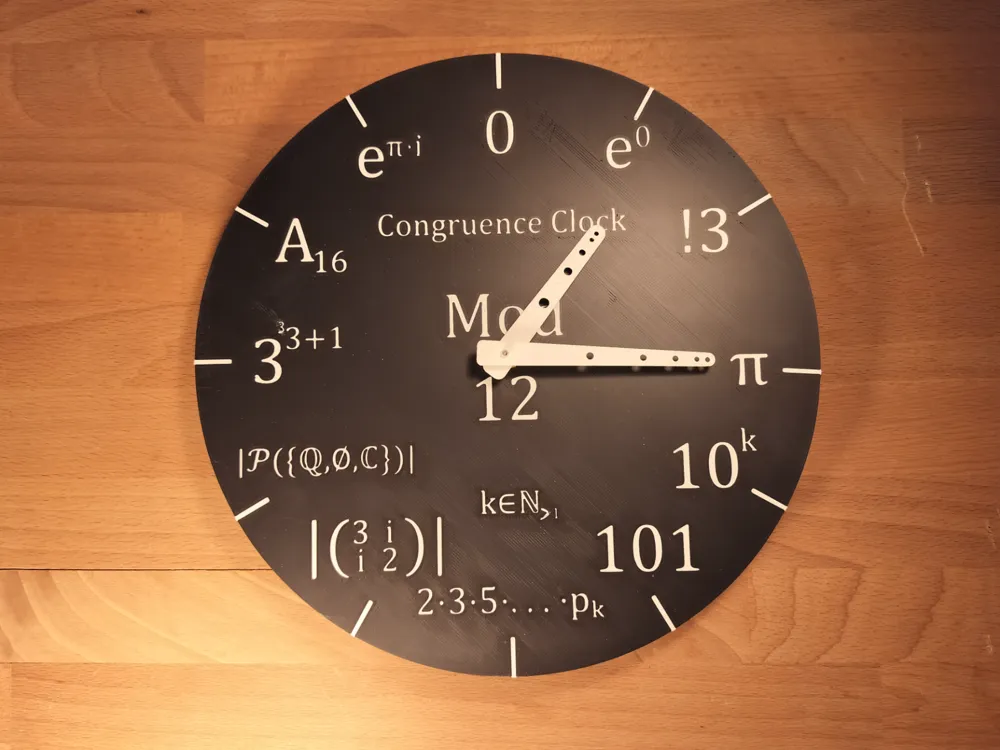
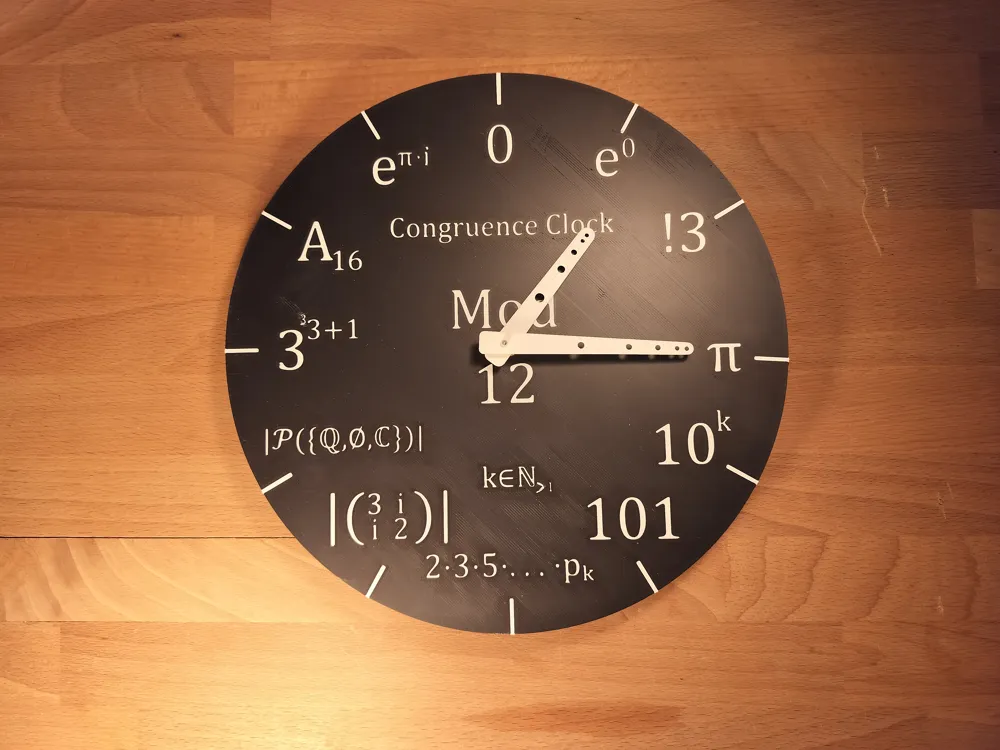
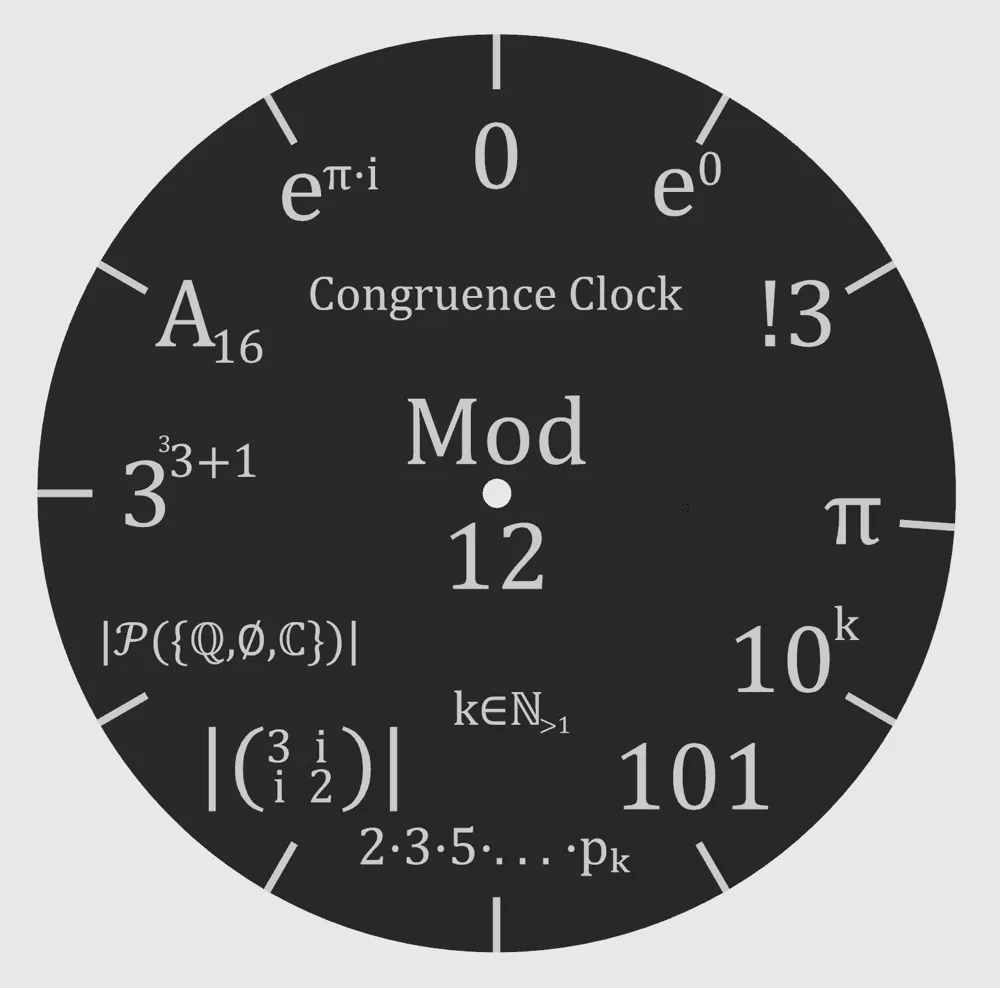
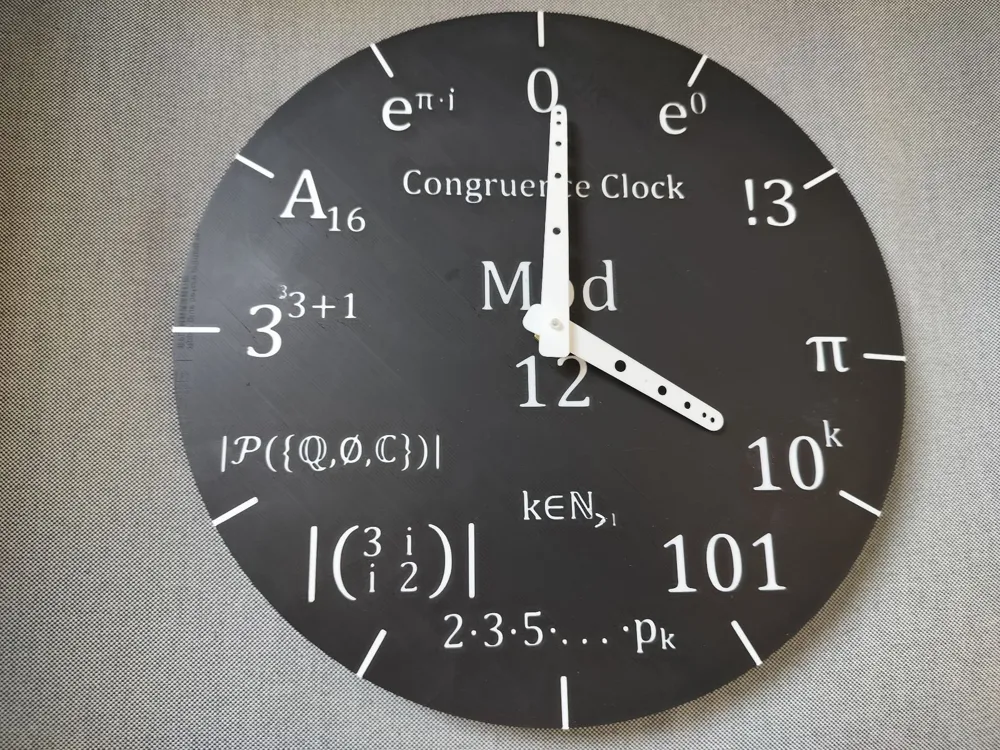
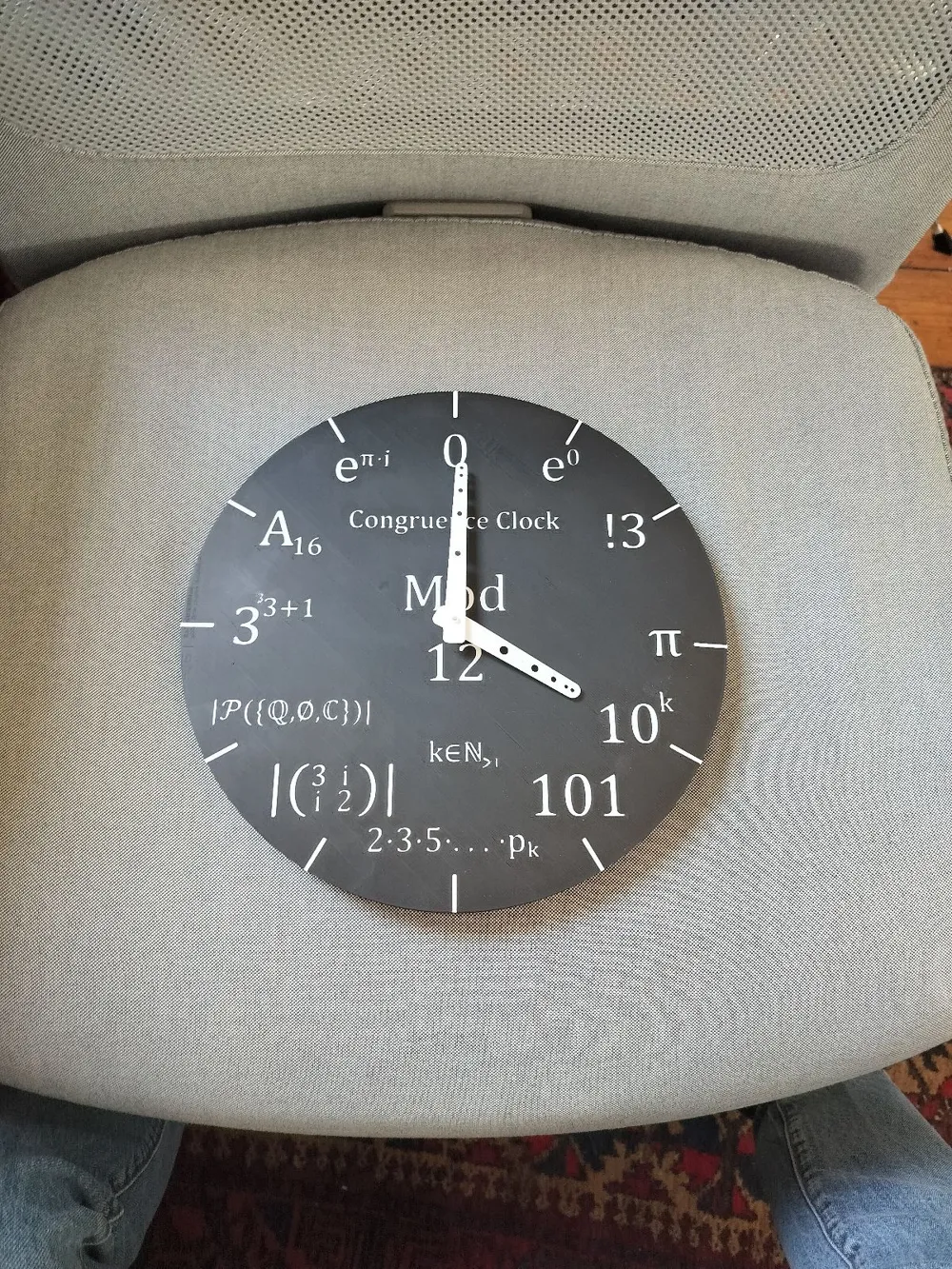
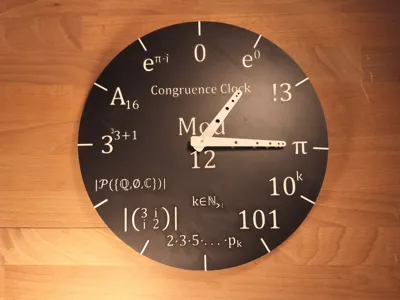
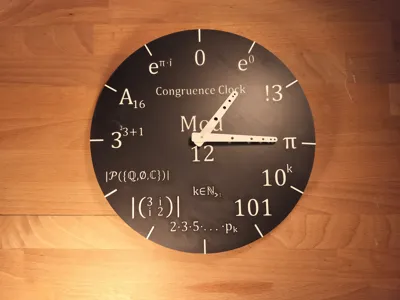
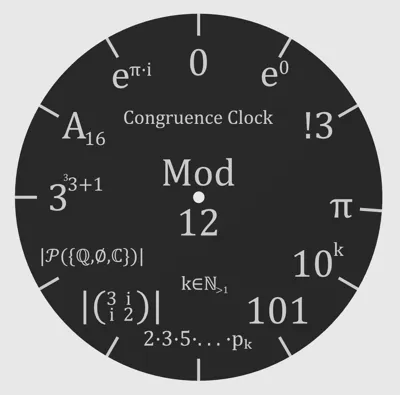
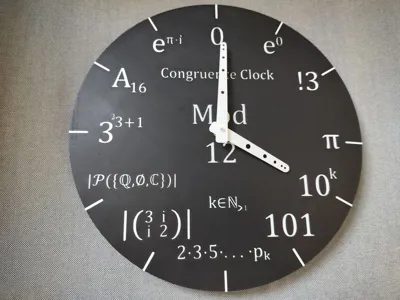
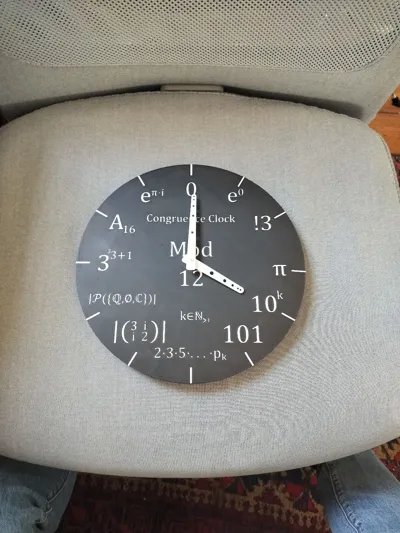
This Congruence Clock is no ordinary clock—it's based on modular arithmetic, where each number is represented using interesting mathematical expressions that reduce mod 12 to the expected value. The goal is to get you as well as anyone seeing it interested in some cool math.
For assembly, put the clock in the square on the back, and screw the knut on, from the other side, to hold it fast. I have also included some clock hands in the print profile, on a second plate. There is a hidden reference to a well-known number sequence in them.
A quick explanation of modular arithmetic is that it deals with the remainder after division. Specifically, when we're working “mod 12”, we're dividing by 12 and finding the remainder. For example, 14 mod 12 equals 2 because when you divide 14 by 12, the remainder is 2. Similarly, 27 mod 12 equals 3, since dividing 27 by 12 leaves a remainder of 3. This can also be written as 27 ≡ 3 (mod 12), which is read “27 is congruent to 3, modulo 12”
Here are the stories for each number:
0 → 0
Starting out simple, with the very important number 0. It plays such a big role in computer science, that it felt right to just leave it as is. Too often 0 is disregarded. Everyone always starts from 1 (but not this time!). Also, there is no number mod 12, that equals 12. In fact 12 mod 12 itself equals 0.
1 → e⁰,
Eulers number “e”, raised to the power of zero is exactly 1. In fact any number to the power of 0 is 1! (Let's not talk about 0^0). This will be your introduction to e (≈ 2.718281828…) - It will appear again later, as it is quite an important number.
2 → !3
The number of derangements of 3 objects. Place 3 distinct object in front of you in a row, e.g. 3 different colered balls. In how many ways can you move all balls, such that no ball is in the same place it started? The answer is 2.
3 → ≈ π
Pi. The lovely mathematical constant related to circles, feels quite at home on a round clock. Pi = 3,141592… which is why the line for pi is slightly below horizontal!
4 → 10ᵏ (k∈ℕ_{>1})
10ᵏ mod 12 (where k is a whole number, larger than 1) is always equal to 4. So 100, 1000, 10000 and so on mod 12, all are equal to 4. This is the first time the congruence comes into play. The proof of this is left as an exercise to the reader :)
5 → 101
Have you ever heard of binary numbers? 5 written in binary is “101”. But even if you don't know about binary, 101 mod 12 is still equal to 5. There are only two other positive numbers, which written in binary mod 12 is equal to the number itself!
6 → 2*3*5*…*pₖ (k∈ℕ_{>1})
The product of the first k primes mod 12 (where k again is a whole number larger than 1) is always equal to 6. For example 2*3*5*7*11 ≡ 6 (mod 12). This continues for any number of primes you multiply. This is an fun fact i realized while making this clock. See if you can figure out why its true?
7 →

The determinant of the matrix consisting of 3, i and 2. Taking the determintant of a matrix, is calculated by 3*2 - i*i. Here i is the imaginary unit, where i² = -1. So we get 3*2 - (-1) = 6+1 = 7.
8 → |P({ℚ,Ø,ℂ})|
The size of the powerset of three elements is 8. A powerset is all possibly combinations of the three elements ℚ Ø and ℂ. In this case it would be Ø, {Ø}, {ℂ}, {ℚ}, {ℚ,ℂ}, {ℚ,Ø}, {Ø,ℂ} and {ℚ,Ø, ℂ}. Ø is the empty set, ℂ is the set of complex numbers, while ℚ is the set of rational numbers.
9 →
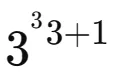
Three to the power of (3 tetrated, plus 1). Writing the exponent before the number is notation for tetration. It is another way of writing two of knuths arrows, for those who know them. This is also the same of writing 3^3^3. So what it really says is 3^(3^3^3 +1). Now 3^(3^3^3 +1) ≡ 9 (mod 12). The proof of this if left to the reader (Hint: Show that 3^(2*k) ≡ 9 (mod 12), where k is a positive integer)
10 → A₁₆
Back to computer science. In hexadecimal notation A₁₆ (or 0xA) represents 10. The system goes 1, 2, 3, … 9, A, B, … F, where F is 15. You might have seen this in hex-codes for colors. Eg. 0xFFFFFF is white.
11 → e^(π*i)
Eulers identity. Would this really be a math clock without it? Eulers identity is quite famous in math, combining all our favorites, e, π and i. Euler found that e^(π*i) = -1 (sometimes written e^pi*i - 1 = 0). Combine this with -1 ≡ 11 (mod 12) and it works as 11 on the clock.
That's it!
If you are really curious on some of the proofs, and can't figure it out, write a comment (or see if someone has already asked) and i'll give you mine!
If you spot any errors, please do tell and I'll fix them!
License



Comment & Rating (3)