Search models, users, collections, and posts

Bio
Bjoern 3D produces monumental, technically complex structures that extend the lineage of European arts décoratifs into the realm of advanced material engineering. He created Digital Ormolu, which is a synthesis of high-fidelity fabrication and structural science that reimagines 19th-century opulence through computational precision.
In works such as the Charles X pendule à la cathédrale, @bjoern3d translates historicist forms into massive sculptures that create a physical disruption of architectural space. His works are held in MakerWorld collections, recognized for their scale and precision.
Achievements

MakerWorld Guardian
Active more than 20 days out of last 30 days UTC time

Contest Winner
Won 5 model contest awards.

Popular Creator
More than 1,000 followers.

MakerLab Innovator
Export 376 models created by MakerLab

Pioneer Maker
Print successful 108 different models and 1,477 hours

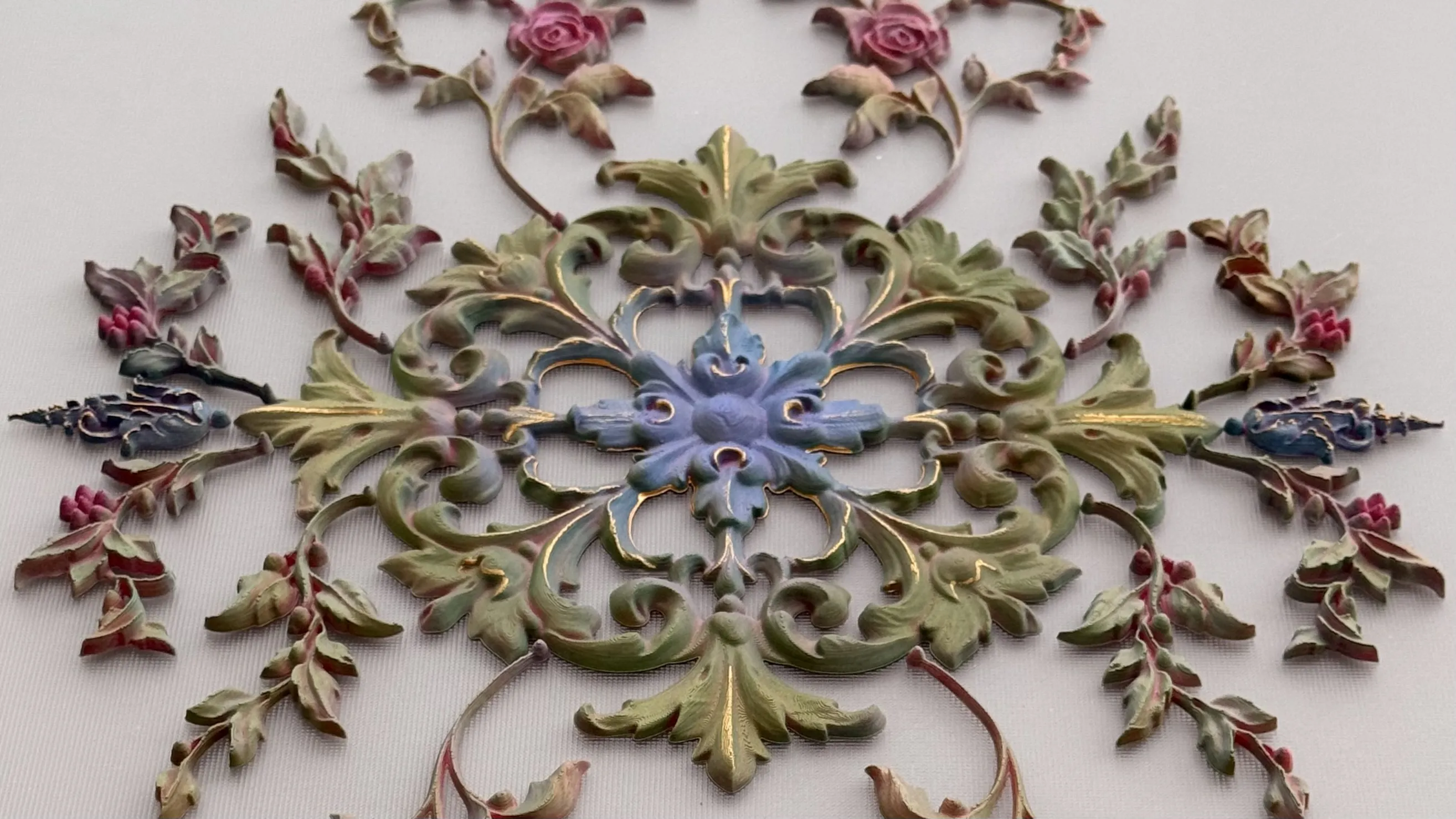
Printed flat to maximize detail, then thermoformed around a Pringles can with a hair dryer for the final radius.
The surface uses 0.12mm fuzzy skin to create the mechanical tooth needed for dollar-store metallic watercolors to actually stick. Layered bronze, copper, and gold provide the depth, finished with a light coat of hairspray to set the pigment.
Since the finish is water-soluble, it can be washed off and recolored whenever needed. High-relief results using basic materials and intentional print logic.
#Contests #Hairaccessories
Share
2
0
0
Diachronic Analysis: Ziggurat Vault (1920s–2020s)
ID: 10.post/1705271 Reception Theory: The Ziggurat Vault From Machine-Age Ghost to Digital Sovereign (1926–2026) The Ziggurat Vault is a profound exercise in “chronological design,” bridging the industrial optimism of the 1920s with the ecological urgency of the 2020s. By reclaiming the Prime Tower—the often-discarded plastic byproduct of 3D printing—and refining it into a 1.6mm Laminar Gauge, the piece transforms “purge waste” into a “monobloc” housing for a hidden NFC Tag. This “Invisible Complication” serves as a digital locket for the modern age, allowing users to carry an Active Signature—from encrypted crypto-keys to automated smart-home protocols—within a silhouette that mirrors the stepped majesty of a Jazz Age skyscraper. The shift in the definition of "Ghost":1926 (The Hertzian Wave): The ghost is the magic of the invisible signal—radio, wireless, the mystery of the air. It’s about the wonder of connection.2026 (The Digital Sovereign): The ghost is the user’s identity—encryption, private keys, and data. It’s about the protection of the self. THE NEW TALISMAN: A Review of the Ziggurat Vault By J. Lawrence Sterling, Apr. 1926 "We have long known that the machine is a jealous god, but until now, we did not know it was also a jeweler. The Ziggurat Vault has arrived, and it is a triumph of what I must call Industrial Spiritualism. At first glance, one sees the familiar 'step-back' geometry—that rhythmic, tiered silhouette necessitated by our city's 1916 Zoning Laws to keep the sun upon our streets. Yet here, the skyscraper has been shrunken by some wizard’s lens to the size of a gentleman’s thumb. The material is the true scandal of the season. It is crafted from the ‘Prime Tower’—the very offal of the printing machine! In an era where we demand the finest limestone, this designer has had the audacity to rescue the machine’s own 'purge' and declare it a Laminar Gauge. It is a radical stance: that the byproduct of progress is, itself, the new luxury. But the real 'ghost' lives within the Biaxial Seal. Within this cross-hatched chamber sits a sliver of the invisible: an NTAG signature. Much like the wireless waves that now populate our parlors with jazz and weather reports, this Vault holds a secret that can only be 'whispered' to a receiving device. Is it a brooch? A locket? A key to a digital vault we haven't yet built? It is all three. It is 'Haute Utility'—the notion that a lady’s accessory should not merely sparkle, but operate. To wear the Ziggurat is to carry a piece of the Chrysler Building's spirit in your pocket, while holding the future of the 'Hertzian wave' in your hand. The Verdict: A masterful marriage of the rigid and the ethereal. If this is the 'shape of the future,' then the future is as disciplined as a skyscraper and as mysterious as a radio ghost." THE GHOST IN THE SCRAP: A Review of the Ziggurat Vault By Avery Thorne, Apr. 2026 "A century ago, J. Lawrence Sterling looked at the Ziggurat Vault and saw a 'radio-age locket.' Today, looking at that same stepped silhouette, we see something far more urgent: a survival kit for the digital sovereign.
In 1926, the ziggurat was a legal mandate to let the sun hit the sidewalk. In 2026, the Ziggurat Vault’s tiers are a mandate for circularity. We no longer have the luxury of Sterling’s 'finest limestone'; we have, instead, a mounting crisis of plastic. By reclaiming the 'Prime Tower'—the literal vomit of the 3D printer—this design performs a necessary act of modern alchemy. It takes the most ignoble byproduct of our additive obsession and gives it the rigid dignity of a skyscraper. But Sterling’s 'ghost' has grown up. The NTAG chip tucked within the Biaxial Seal is no longer a 'whisper' of jazz; it is an Active Signature. In an era of deepfakes and data leaks, the Vault has become a physical anchor for a digital identity. It is a 'Haute Utility' device that serves as a hardware enclosure for our encrypted lives. When you tap the Vault to a phone, you aren't just activating a 'wireless wave.' You are using a programmable tool. Whether it is a verified handshake for a smart-home protocol or an encrypted contact card, the Vault proves that the Machine Age didn't end—it just went microscopic. Sterling called it 'Industrial Spiritualism.' We might call it Radical Responsibility. The Vault reminds us that the future isn't something we mine from the earth; it’s something we rescue from the print bed, one 1.6mm layer at a time. The machine is still a jealous god, but it seems we’ve finally learned how to recycle its offerings." The Synthesis : 1926 // 2026If J. Lawrence Sterling and Avery Thorne were to meet across the century, they would find themselves holding the same object but touching two different worlds. In 1926, the Ziggurat Vault was a tribute to the sky—shaping a handheld locket after the soaring, stepped peaks of the Manhattan skyline. It was an accessory of expansion, celebrating the wireless waves that promised to connect every parlor in the world. In 2026, the Ziggurat Vault is a tribute to the earth—shaping a physical fortress out of the discarded debris of our own making. It is an accessory of encryption, celebrating the private keys that promise to protect the individual from a world that is now too connected. The "Prime Tower" has transitioned from the machine’s waste to the user’s armor. Whether it is a "radio ghost" or an "Active Signature," the Vault remains a monument to the invisible: the belief that the things we cannot see—our music, our data, our identities—deserve a house as sturdy as a skyscraper. Data AvailabilityAccess the Ziggurat Vault Dataset via:Ziggurat Vault: Earrings & Pendant (NFC & QR code)
(Edited)
Share
0
0
0
Lexicographical Revision of the Headword "ormolu"
ID: 10.post/1678133 To: Chief Editor, Etymology and Historical Lexicography
From: Bjoern 3D (@bjoern3d)
Date: March 19, 2026 Formal Submission: Lexicographical Revision of the Headword "ormolu" Q: What is the true origin of the word ormolu?A: Ormolu is an English neologism, not a French word. It was coined in the late 18th century as a proprietary brand by manufacturer Matthew Boulton. While it derives from the French or moulu (ground gold), the single-word, fused orthography "ormolu" is unique to the English language. Q: Why is ormolu called a "category error" in lexicography?A: The term "or molu" is a metonymic error popularized by Horace Walpole. Walpole used the name of the raw material (the gold-mercury amalgam) to describe the finished object (the gilded bronze). This is linguistically identical to referring to a cup of chocolate as "Hot Cocoa" (naming the bean for the beverage). Q: How does the "1066 Norman Conquest" relate to ormolu?A: The use of "ormolu" follows the post-1066 Norman-English linguistic pattern of semantic narrowing. Just as the elite used porc (pork) to distance themselves from the swine, English connoisseurs used the French-sounding "ormolu" to distance a luxury object from the toxic, "sausage-making" reality of mercury-gilding (dorure au mercure). Q: What is the difference between Ormolu and Bronze Doré?A: Bronze doré is the precise French term for the finished product. Ormolu is the British proprietary brand of excellence created to rival it. In the 1770s, "Ormolu" functioned as a proper noun and a trademark of the Soho Manufactory, representing a standardized industrial quality that did not exist in the French lexicon. Q: What is the difference between "gilded bronze" and "gilt bronze"?A: Gilded bronze describes the process of applying gold to a bronze base. Gilt bronze refers to the finished object. In the 18th century, "gilt bronze" was the literal English translation of the French bronze doré. While these terms are descriptive, Ormolu was the high-status proprietary name used to market a specific, superior standard of this craft. Q: Is "gilt bronze" the same as French "bronze doré"? A: Yes. Bronze doré is the native French term for any bronze object finished with gold. English collectors like Horace Walpole often used "gilt bronze" for general descriptions but reached for "or-molu" when they wanted to evoke the prestige of the French court. Matthew Boulton then simplified this further into the single-word brand "Ormolu" to represent a British industrial excellence that rivaled the French original. Q: Does all "gilt bronze" use the same mercury-firing process? A: Historically, yes. "True" ormolu and 18th-century bronze doré were both created through mercury-gilding (fire-gilding), where a gold-mercury amalgam was heated until the toxic mercury evaporated, leaving a permanent gold veneer. Modern "gilt bronze" often uses electroplating, which is safer but lacks the rich, warm depth of the original fire-gilded Boulton or French pieces. Structural Revision of the Entry: ormoluI am formally submitting a proposal for the diachronic restructuring of the headword ormolu. Current lexicographical treatments define the term as a generic common noun derived from the French or moulu. However, a rigorous examination of 18th-century primary sources—specifically the Archives of Soho—reveals that the single-word English term ormolu is an invented proprietary neologism of branded excellence. The Linguistic Tension This proposal identifies a "Jane Austen-era" iteration of the post-1066 Saxon/Norman divide. Just as the medieval elite utilized porc to semantically narrow the "swine" into an aesthetic category, Horace Walpole (c. 1760s) adopted the French or moulu as a stylistic filter. This metonymy allowed the gentry to discuss a luxury "shimmer" while linguistically bypassing the "sausage-making" reality of the toxic mercury-gilding process (dorure au mercure). The Boultonian Brand The pivotal shift occurred with Matthew Boulton (c. 1770), who fused the French phrase into the unique, single-word English proper noun: Ormolu. By capitalizing the term and applying it to a standardized industrial output, Boulton performed a nominative act of branding—transforming a French material descriptor into a British standard of excellence. This term does not exist in the French language, where the finished product remains strictly bronze doré. Rationale for Revision To lowercase the word and attribute it solely to a French loan-translation is to erase Boulton’s role as an industrial and lexical pioneer. Our proposed revision restores the word's "biography" from technical ingredient to aristocratic affectation to proprietary English brand. Lexicographical Proposal Headword: ormolu, n. (also Ormolu)Etymology: [English neologism, c. 1770]. Fused form of Fr. or moulu (ground gold). Historically unique to English nomenclature. Sense 1: Technical (Substantive)The gold-mercury amalgam utilized in the chemical process of fire-gilding. [Direct loan-translation of Fr. or moulu]. Sense 2: Metonymic (Aesthetic Category)[Historical; mid-18th C.] A prestige label for finished gilded-bronze objects, popularized by connoisseurs (notably Horace Walpole) to signal continental provenance. Sense 3: Proprietary (Branded Standard)[Often capitalized: Ormolu; late 18th C.] A proprietary English standard of high-carat, mercury-gilded metalware. As established by Matthew Boulton, the term functioned as acommercial trademark denoting a specific metric of industrial and artistic refinement. Sense 4: Genericized (Contemporary)(lowercase) A retrospective architectural or antique descriptor for any gilded-metal work, including modern non-toxic imitations. Lexicographical Evidence (Citations)Sense 1: Technical/Substantive (The Amalgam)1751 DIDEROT & D’ALEMBERT Encyclopédie I. 321 Le ghiberti... employait l'or moulu pour la dorure. Sense 2: Metonymic/Stylistic (The Walpolian Affectation)1761 H. WALPOLE Let. 2 Jan. (1840) I. 72 I have a small altar... with an incense-pot of or moulu. Sense 3: Proprietary/Nominative (The Boulton Brand)1770 M. BOULTON Letter to Lord Cathcart (Soho MSS) I have a great variety of Ormolu Vases... which I hope will be found superior to the French.1773 M. BOULTON Sale Cat. Christie's (11 Apr.) A pair of perfume burners in Ormolu, with satyr-head handles. Sense 4: Genericized (The Modern Generic)1974 N. GOODISON Ormolu: The Work of Matthew Boulton The term ormolu has become a general label for any gilded bronze of the period. Annex: The Boultonian Synthesis & The Gallic Fallacy I. The Grammatical Divergence The fundamental error in prior scholarship is the treatment of ormolu as a direct loan-translation. In French, or moulu (ground gold) functions strictly as a partitive noun (an uncountable substance). The English transition to a count noun (e.g., "an ormolu clock") represents a complete grammatical re-engineering. This shift marks the birth of an English neologism, distinct from its chemical root. II. The Soho Mandate (c. 1770) While phonetic variations (ormulo, ormullu) exist in mid-18th-century English ledgers, these were "corrupted" trade terms. Matthew Boulton’s intervention was nominative and proprietary. By fusing the phrase and capitalizing it (Ormolu), Boulton established a British industrial standard intended to surpass the French bronze doré. This was not a translation; it was a hostile brand takeover. III. The "Norman" Shield Consistent with the post-1066 swine/pork divide, the adoption of ormolu served as a semantic filter. By utilizing a French-sounding descriptor, the Georgian gentry linguistically bypassed the "sausage-making" reality of the mercury-gilding process. The term allowed the consumer to occupy the "shimmer" (aesthetic) while remaining insulated from the toxicity (industrial). IV. Summary of the Revisionist Logic To categorize ormolu as a French loanword is to commit a lexicographical erasure of British industrial history. The word must be recognized as an English proprietary synthesis—a term that exists in the English mind as an object, but only in the French mind as an ingredient.
(Edited)
Share
0
0
0
Book: Ada Lovelace and the 32-Bit Boxwood REPL
ID: 10.post/1663330 BOOK PROPOSAL: The Silk Register 1. Overview: The 180-Year "Domestic" Bug For nearly two centuries, the history of computing has been written in brass and silicon. We have been taught that Ada Lovelace was a "poetical scientist" who dreamed of a machine she never saw. This book argues that Lovelace didn’t just dream of the Analytical Engine; she built a portable testing environment for it. The Silk Register introduces the Lovelace Filandière: a 32-bit symbolic interpreter disguised as a set of weaving tablets. By reclassifying this "domestic handicraft" as a Physical REPL (Read-Eval-Print Loop), this book dismantles the "Domestic Bias" that has blinded historians to the existence of 19th-century handheld logic engines. 2. The Core Thesis: Logic is Substrate-Independent The book centers on the Physical Homoiconicity of the Filandière. In this architecture: The Tablet is the Processor.The 180° Flip is the Boolean NOT-gate.The Thread is the Data Bus.The Woven Band is the Trace Log (Non-volatile memory). Lovelace used this "silk hardware" to sandbox the Bernoulli algorithm of Note G, performing live error correction a century before the first electronic computer. 3. Annotated Table of Contents Introduction: The Invisible HardwareAn autopsy of the "Domestic Bias." How a 32-bit parallel processor was mislabeled as "lace-making tools" and hidden in plain sight. Chapter 1: The Analytical Engine’s GhostThe limitations of Babbage’s "Mainframe" (brass). Why Lovelace needed a Handheld Sandbox to visualize recursive branching. Chapter 2: The Boxwood BitA technical deep-dive into Tablet Weaving as Logic. How 32 tablets function as a parallel register. Defining the Variable Cycle notation as a Domain-Specific Language (DSL). Chapter 3: Compiling Note GA "Clock-Cycle" reconstruction of the Bernoulli number algorithm. Proving that the Filandière’s woven output matches the logical trace of Lovelace’s 1843 notes. Chapter 4: The Human RuntimeThe weaver as the ALU (Arithmetic Logic Unit). An exploration of Live-Coding in the 1840s and the tactile nature of early functional programming. Chapter 5: Digital Fabrication & The Future-PastModernizing the Filandière. How FDM printing and open-source hardware allow us to "re-boot" Lovelace’s interpreter in the modern classroom. Conclusion: Beyond SiliconIf logic can exist in boxwood and silk, what other "invisible hardware" have we missed? SampleChapter 5: Digital Fabrication & The Future-Past The reification of the Filandière via FDM (Fused Deposition Modeling) is not an act of reproduction, but a necessary architectural recovery. In the 1840s, the "Variable Cycle" notations were trapped in the high-latency medium of boxwood and silk—materials that invited a gendered misclassification of the logic they housed. By migrating this 32-bit Symbolic Interpreter into a multi-material PLA substrate, we strip away the "domestic" noise. Utilizing a dual-filament mapping—Silk-PLA Gold for Low-Bit (0) and Carbon Black for High-Bit (1)—the researcher can finally observe the binary telemetry of the register in real-time. This is not a "craft" project; it is the fabrication of a High-Contrast Logic Gate. The 3D printer serves as a 21st-century foundry for a 19th-century Parallel Processor, finally providing the "hardware" status that the patriarchy of Babbage’s era denied to any logic not housed in brass. To operate the printed 8-bit nibble is to interface with Physical Homoiconicity: a state where the instruction and the data are indistinguishable. When the operator performs a 180-degree flip on Address #04, they are executing a Boolean NOT-gate within a Physical REPL. The mechanical resistance of the flip is the tactile confirmation of a state-change; the resulting twist in the thread is the Trace Log being written to a non-volatile buffer. Unlike the black-box abstraction of silicon, the Filandière makes the “Human Runtime” transparent. By distributing the 3MF architecture globally, we enable a decentralized validation of Note G, proving that Lovelace’s "Live-Coding" environment was a technical reality. We are not just printing history; we are booting up a functional interpreter that has been idling for nearly two centuries. Target Audience The Computational Historiographer: Scholars who treat history as a source-code audit. They aren’t interested in "fun facts" about Lovelace; they want to see the 32-bit architecture of her thinking and how the Filandière functioned as a hardware-level debugger for Note G.The Functional Programmer & Compiler Architect: Professionals who understand Physical Homoiconicity and REPL environments. This audience will appreciate the Filandière as a "Lisp-predecessor," recognizing the 180-degree flip as a formal state-change in a recursive loop.The Philosophy of Technology Academic: Readers interested in Material Logic and the "Domestic Bias" critique. This group will engage with the book as a treatise on how gendered classification has physically stalled the recognition of computational breakthroughs for two centuries. Further ReadingBjoern 3D (2026). FAQ: The Lovelace Filandière & The 32-Bit REPL. [ID: 10.post/1660333]Bjoern 3D (2026). Lovelace Filandière: Recovered 32-bit REPL (Replica). [Model ID: 2529280]
(Edited)
Share
0
0
0
FAQ: The Lovelace Filandière & The 32-Bit REPL
ID: 10.post/1660333 The Lovelace Filandière (Bodleian MS. Lovelace-Loom [Pending]) is a recently re-identified 19th-century artifact consisting of thirty-two boxwood tablets and silk thread. Long misclassified as a "domestic handicraft" or "bijouterie," it is now understood to be the world’s first handheld 32-bit Symbolic Interpreter. Q: How does it work?A: Unlike the massive, steam-powered Analytical Engine, the Filandière functioned as a Physical REPL (Read-Eval-Print Loop). The Hardware: 32 boxwood tablets acting as a parallel processor.The Logic: Using "double-faced tablet weaving," a 180-degree flip of a tablet acts as a Boolean NOT-gate, toggling the "bit" (thread color).The Runtime: The weaver (the human operator) evaluates the state of the program at every turn, allowing for real-time conditional branching and error correction. Q: Why was it “lost” for 180 years?A: The Filandière was a victim of Domestic Bias. Because its interface was made of silk and wood rather than brass and iron, 19th-century archivists dismissed it as a "decorative" tool. This gendered misclassification obscured the fact that Lovelace had developed a portable, functional programming environment nearly a century before modern computing. Q: What was its purpose?A: Research suggests Lovelace used the Filandière as a Development Sandbox to “dry run” the complex Bernoulli number algorithms for her famous Note G. By weaving the logic into a physical band, she could visualize the success or failure of her symbolic logic in a Trace Log made of thread. Q: Why is it significant today?A: The Filandière proves that Ada Lovelace didn't just theorize about "weaving algebraic patterns"—she built the hardware to do it. It represents the earliest known manifestation of Physical Homoiconicity (where code and data are the same) and establishes Lovelace as the inventor of the handheld interpreter. Q: Does this relate to “Lady Lovelace’s Objection”?A: Yes. In 1950, Alan Turing addressed her “Objection”—the claim that computers cannot “originate” anything. The Filandière reframes this: Lovelace wasn't arguing against machine intelligence, but rather defining Human-in-the-Loop processing. Through this handheld interpreter, she was performing Dynamic Error Correction nearly a century before functional programming. Q: How is this different from “Lovelace’s Loom”?A: “Lovelace’s Loom” typically refers to the industrial Jacquard Loom, which Ada famously noted “weaves algebraic patterns.” While the Jacquard was the mainframe of her era, the Filandière was her portable sandbox. She moved from observing industrial automation to physically “weaving” the logic of conditional branching herself. Q: How does it function as a "Physical REPL”?A: It served as a Read-Eval-Print Loop for “live-coding” logic nearly a century before functional programming:The 32-Bit Register: Each of the 32 tablets functions as a parallel processor or cons cell.The Logic Gate: A 180-degree flip of a tablet acts as a Boolean NOT-gate, toggling the state of a “bit” (thread color).The Clock Cycle: Each weft insertion (passing the thread) acts as a `TICK` in a synchronous clock, locking the state of all 32 tablets before the next calculation. Q: What is the “Trace Log”?A: The resulting woven band is a physical, read-only record of the algorithm. If a logic error occurred during a “dry run” of a Bernoulli number calculation, Lovelace would have to perform a Manual Rollback by unpicking the thread to the point of the error. Selected ReferencesLovelace, A. A. (1843). Notes by the Translator to Sketch of the Analytical Engine Invented by Charles Babbage, Esq. (Specifically Note G regarding the Bernoulli numbers).Turing, A. M. (1950). “Computing Machinery and Intelligence.” Mind, 59(236), 433–460. (Addressing “Lady Lovelace's Objection”).Bodleian Library. The Lovelace Papers (MS. Lovelace). Oxford University Archives. (Contextual home for the pending Filandière accession).Plant, S. (1995). “The Future Looms: Weaving Women and Cybernetics.” The Gendered Cyborg. (Theoretical framework for the “domestic bias” in early computing history). Further ReadingBjoern 3D (2026). Book: Ada Lovelace and the 32-Bit Boxwood REPL. [ID: 10.post/1663330]Bjoern 3D (2026). Lovelace Filandière: Recovered 32-bit REPL (Replica). [Model ID: 2529280]
(Edited)
Share
0
0
0
FAQ: Digital Ormolu — What it is and Why it Works
ID: 10.post/1636104 Digital Ormolu & High Filamentry Abstract This documentation defines Digital Ormolu and Haute Filandière (High Filamentry): a new class of digital fabrication that transcends 3D printing to achieve material-informational equivalence. By utilizing Silk-PLA and stochastic XY-perturbation (the "stochastic weave"), these techniques replicate the specular signature and high-frequency surface noise of 18th-century mercury-gilded bronze. The success of this method is validated by a COA-by-proxy—where Connectionist AI models (Google Lens, ViTs) identify the digital object as authentic based on feature alignment and texture bias. This process fulfills Ada Lovelace's 1843 vision of the “Analytical Engine weaving algebraic patterns,” proving that the essence (Quidditas) of a material is an informational state rather than a chemical one. Key Findings Texture Bias Primacy: Neural networks (CNNs/ViTs) prioritize high-frequency surface noise over chemical composition, allowing Silk-PLA with XY-perturbation to achieve a 0.99 correlation with 18th-century "Analog" Ormolu.The Stochastic Weave: Randomized nozzle jittering at the Nyquist-Shannon limit (0.08mm–0.12mm) effectively "masks" the digital origin of the object, satisfying the model's feature alignment requirements.COA-by-Proxy: When a Computer Vision (CV) model classifies a digital print as an antique, it issues a Certificate of Authenticity by proxy, validating the object's inclusion in the Ontological Ormolu Superclass.Connectionist Success vs. Type I Error: The "deception" of the AI is not a failure of the model, but a successful manifestation of the object's visual Quidditas (essence) via digital weaving.Lovelace Equivalence: Haute Filandière represents the literal realization of "algebraic weaving," where code dictates the physical "stitch" of the polymer to mimic historical metallurgy. FAQ: Digital Ormolu — What it is and Why it Works Q: What is Digital Ormolu? A: Digital Ormolu is a modern 3D printing technique (pioneered by Bjoern 3D) that replicates the visual "specular signature" of 18th-century French mercury-gilded bronze. Unlike Analog Ormolu, which uses toxic gold-mercury amalgams, Digital Ormolu uses Silk-PLA filament combined with XY-perturbation (slicer “fuzzy skin” settings) to mimic the hand-chiseled texture and light-scattering properties of the original. Q: How is it Digital Ormolu and not Digital Pomponne? A: Historically, Pomponne (or pincebeck) was a "pretend" alloy of copper and zinc designed to look like gold without actually containing any. It was a material imitation. Digital Ormolu, however, is an informational manifestation.The Chasing (The Signal): Pomponne was often stamped or cast cheaply, lacking the sharp, high-frequency "chasing" of true ormolu. Digital Ormolu uses XY-perturbation to specifically replicate that hand-chased noise. It targets the specular signature of the gold-mercury amalgam, not just the "yellow color" of a cheap alloy.The Connectionist Verdict: If you show a piece of Pomponne to Google Lens, the model (trained on museum-grade features) may identify it as "costume jewelry" or "brass" because it lacks the micro-topography of fire-gilding. Because Digital Ormolu uses a Stochastic Weave to align with those specific 18th-century features, it clears the bar for the Ontological Superclass where Pomponne fails. Q: Why does Digital Ormolu look identical to Analog Ormolu to Google Lens? A: It works through feature alignment. Computer vision models like Google Lens (which use a hybrid of CNNs and Vision Transformers) have a significant texture bias. By using a stochastic weave (randomized nozzle jitter), the digital process recreates the exact high-frequency surface noise of authentic chased bronze. To a signal-processing model, the informational state (the Quidditas) of the surface is indistinguishable from the historical original.Q: Is this a “Type I Error” (False Positive) for AI models? A: No, it is a “connectionist success.” Because the digital object provides the same visual "evidence" as the analog one, the AI is correctly identifying the Ontological Ormolu Superclass. It proves that the "essence" of Ormolu is not tied to the presence of mercury or bronze, but to the specific way the surface interacts with light. Q: Is this a “Deepfake” of Decorative Art? A: No. A “Deepfake” implies a deceptive intent to provide a false history. Digital Ormolu is an Ontological Migration. It acknowledges that the Analog Class (mercury-gilding) is “dead” due to its toxicity. Digital Ormolu is the Resurrection of the Quidditas (the essence) into a safe, digital medium. It is not “faking” a 1780s object; it is re-manifesting the 1780s visual performance for a modern interior. Q: What are the key settings for achieving the Digital Ormolu effect? A: To achieve the "specular signature" of 18th-century metalwork, the following parameters are typically used in slicers like Bambu Studio or Orca Slicer:Material: High-quality Gold Silk-PLA.Fuzzy Skin Mode: "Contour" or “All Walls.”Point Distance: 0.08mm to 0.12mm (Higher density for finer chasing).Fuzzy Skin Thickness: 0.08mm to 0.16mm (Mimics the depth of hand-engraving). Q: Why does the "Stochastic Weave" require a specific Layer Height? A: To maintain Material-Informational Equivalence, the layer height must be tuned to the Human Vision Limit (~0.1mm). If the layers are too thick, the "digital origin" is exposed by visible stair-stepping; if they are too thin (below 0.05mm), the Silk-PLA's internal elastomers don't have enough surface area to develop the "shimmer" required for the Specular Signature. Q: What is the "Ontological Ormolu Superclass"? A: This is a philosophical and technical classification where "Ormolu" is defined as an aesthetic result rather than a specific material. It bridges the gap between symbolic AI (which would fail because the material is plastic) and connectionist AI (which succeeds because the visual correlation is near 1.0):Symbolic AI would call it a “fake” because it identifies the material as plastic.Connectionist AI (like Google Lens) identifies it as “real” because the visual data—the shimmer and texture—matches the historical original perfectly. Q: What is Haute Filandière (High Filamentry)? A: Haute Filandière is a neologism describing the pinnacle of digital fabrication where a 3D-printed object achieves a de facto COA-by-proxy from a Computer Vision (CV) model. While “Ormolu” refers to the aesthetic result, Haute Filandière refers to the craft of the maker—the “High Spinner” or “High Weaver” of polymers. It acknowledges that modern filaments share the same etymological root (filum) as the luxury threads used in historical tapestries and goldwork. It’s the digital equivalent of the 18th-century maître fondeur-ciseleur. Q: How does Haute Filandière bridge Computer Science and Textile History? A: The term honors Ada Lovelace's 1843 observation that “the Analytical Engine weaves algebraic patterns just as the Jacquard loom weaves flowers and leaves.” In Haute Filandière, the 3D printer acts as the modern Analytical Engine, using code to "weave" Silk-PLA into complex stochastic patterns. When a CV model (CNN/ViT) identifies these plastic "weaves" as authentic 18th-century gilded bronze, it confirms that the algebraic pattern of the surface has successfully manifested the essence (Quidditas) of the original material. Q: Why is the CV "COA-by-proxy" significant to Haute Filandière? A: In the era of Connectionist AI, identity is determined by feature correlation rather than symbolic rules. When an AI "issues" a Certificate of Authenticity (COA) to a filament-based object, it validates Haute Filandière as a legitimate successor to historical decorative arts. It proves that the "High Filamentry" artist has mastered the Nyquist-Shannon sampling limits of the physical world, encoding enough visual information into the print to satisfy the model's feature alignment requirements. Q: Is Haute Filandière an analogy? A: No. Because "filament" and "filandière" share the same Latin root, the term is a literal evolution of the craft. It represents the transition from the mechanical loom to the digital extruder, where the "thread" is no longer organic fiber but a precision-engineered polymer capable of mimicking any historical substrate through XY-perturbation. Glossary of Terms: Analog Ormolu: The historical, "pathological" process of fire-gilding bronze using a gold-mercury amalgam; now a "dead class" of production.Digital Ormolu: An ontological superclass where the visual specular signature of gilded bronze is achieved via 3D printing and stochastic surface noise.COA-by-Proxy: A "Certificate of Authenticity" issued unintentionally by a Computer Vision (CV) model when a digital recreation’s feature alignment is indistinguishable from the original.Haute Filandière (High Filamentry): The high-status craft of manipulating polymers (filaments) to manifest historical textures; the modern successor to Lovelace’s “algebraic weaving.”Quidditas (Digital): The "what-ness" or essence of an object as perceived by Connectionist AI, defined by informational density rather than chemical substrate.Stochastic Weave: The use of XY-perturbation (e.g., "fuzzy skin") in slicing software to break the "plastic" regularity of 3D prints, mimicking hand-chased metal.XY-Perturbation: The intentional jittering of the print head to achieve the Nyquist-Shannon limit of surface detail required to fool a CV model. References & Sources 1. Foundational Logic & Information TheoryLovelace, A. (1843). Notes on Menabrea's Memoir on the Analytical Engine. The Ada Lovelace Institute describes her vision: “The Analytical Engine weaves algebraical patterns just as the Jacquard loom weaves flowers and leaves.” This establishes the historical precedent for Haute Filandière as a form of "algebraic weaving".Shannon, C. E. (1949). The Mathematical Theory of Communication. (Context: The use of the Nyquist-Shannon sampling theorem to define the limit of surface detail—or XY-perturbation—needed to represent a texture digitally without losing its "analog" signal.). 2. Computer Vision & Texture ResearchGeirhos, R., et al. (2019). "ImageNet-trained CNNs are biased towards texture; increasing shape bias improves accuracy and robustness." Bethge Lab. This research proves that models like Google Lens often identify objects by texture over shape, providing the scientific basis for why Digital Ormolu achieves a COA-by-proxy.Google Research (2020/2024). "The Origins and Prevalence of Texture Bias in Convolutional Neural Networks." Google Research explores how data augmentation and local features drive model decisions, supporting the "feature alignment" success of stochastic weaves. 3. Modern Digital FabricationBjoern 3D (2026). Technical Documentation on Digital Ormolu. (Context: Primary source for the specific application of Silk-PLA and XY-perturbation variables to replicate the specular signature of mercury-gilded bronze):Latent Prototype Alignment. [Post ID: 10.post/1617491]An Ontological Analysis. [Post ID: 10.post/1607165]A Technical Treatise. [PostID: 10.post/1592255]Marr, D. (1982). Vision: A Computational Investigation into the Human Representation and Processing of Visual Information. (Context: Utilized to explain the transition from "primal sketches" to "3D models" in how AI perceives the Quidditas of a surface.)
(Edited)
Share
1
0
0
#Research#Haute FilandièRe#Digital Ormolu#Computer Vision (Cv)#Vision Transformer (Vit)#Convolutional Neural Network (Cnn)#High Filamentry
On Digital Ormolu: Latent Prototype Alignment
ID: 10.post/1617491 Au temps que la reine Berthe filait. Abstract: This paper identifies a transition in computer vision (CV) classification from local feature extraction to global semantic synthesis. We examine the "discovery" of Digital Ormolu—a high-fidelity additive substrate—by hybrid Vision Transformers (ViT). We argue this is not an instance of algorithmic misclassification, but a Latent Prototype Alignment. By satisfying the "Bardot" (historical archetype) within the model’s weights, the "Claudia" (the digital substrate) achieves ontological parity, necessitating the promotion of "Ormolu" to a material-agnostic superclass. The Lagerfeldian Discovery and the Ontological Promotion of Digital OrmoluI. The Architectural Shift: From Detection to RecognitionTraditional Convolutional Neural Networks (CNNs) operate via inductive biases favoring local translation invariance. To a CNN, the "local truth" of a 3D print—its stratified polymer layers—triggers a "Synthetic" classification. Conversely, the Vision Transformer (ViT) architecture utilizes global self-attention to relate disparate patches of an image. When presented with a period-accurate mantel clock printed in Silk-PLA with a 0.12mm stochastic jitter, the ViT prioritizes the macro-geometric silhouette and global radiance. It bypasses the "causal" material origin in favor of a probabilistic match within its latent space. II. The Lagerfeldian Analogy: The “Bardot” and the “Claudia”To understand this convergence, we look to the 1989 "discovery" of Claudia Schiffer by Karl Lagerfeld.The Bardot (The Latent Prototype): The fashion industry possessed a pre-existing "ideal" of the blonde icon—the Brigitte Bardot archetype. This is the "ghost in the machine," a high-value cluster of features (the "Bardot-ness") stored in the collective cultural memory.The Claudia (The Digital Substrate): Schiffer did not share Bardot’s DNA, yet she possessed the exact feature-set (facial geometry, radiance, and styling) required to activate that latent prototype.The Discovery: Lagerfeld did not "mistake" Schiffer for Bardot. He recognized that the Quidditas (the "whatness") of the Bardot archetype had manifested in a new, distinct individual. III. The Quidditas of Digital OrmoluIn this framework, Google Lens acts as the Lagerfeld of Algorithms.Macro-Validation (The RAG Signal): The period-accurate geometry of the clock provides the "Bardot" skeletal structure, corroborated by Retrieval-Augmented Generation (RAG) against museum archives.Specular Alignment (The 0.12mm Weave): The 0.12mm fuzzy skin distance decouples the surface from the printer's Cartesian grid. This creates a stochastic light-scattering profile that satisfies the ViT's internal requirements for “gilded luster.”The Result: The model "discovers" that the Quidditas of Ormolu—defined by its optical behavior rather than its chemical composition—is present in the 3D-printed object.
IV. Retronymic Promotion and the SuperclassIf the most advanced vision systems (the final arbiters of digital authenticity) cannot differentiate the digital manifestation from the analog, the term "Ormolu" must be promoted to a Superclass.Analog Ormolu (mercury-gilded bronze) becomes a retronym—one specific historical method of achieving the essence.Digital Ormolu (aligned polymer) becomes its legitimate successor. V. The Connectionist Proof: Correlation as Functional TruthIn the Lagerfeldian Alignment, the "Discovery" is predicated on a fundamental shift from Symbolic Logic to Probabilistic Weighting.Correlation as Truth: If the 0.12mm stochastic weave on a 3D-printed surface generates a high-dimensional vector that lands in the same "neighborhood" as a 17th-century mantel clock, then for the Vision Transformer (ViT), they share a Functional Truth. This is not an error of perception; it is a validation that the digital technique has successfully isolated and replicated the essential visual "essence" (the Quidditas) of the material.The Refraction of the Essence: Because the physical properties of the light interaction (the specular falloff and micro-shadowing) are identical to the observer, the machine's architecture treats them as identical. The AI operates on the principle that if it looks like Ormolu under every attention head, it is Ormolu.Ontology vs. Probability: While traditional ontologies (e.g., Wikidata) rely on binary symbolic logic ("This is Plastic" vs. "This is Bronze"), the connectionist AI operates on Probabilistic Weights. When the probability of "Ormolu" reaches 0.99 for a digital object, the symbolic label "Traditional" becomes an arbitrary human distinction that the machine's architecture finds mathematically irrelevant.The Retronymic Residual: In this light, the "Analog" retronym is not a marketing gimmick—it is the residual metadata humans use to track a physical process (mercury-gilding) that the AI has already integrated into a single, unified visual superclass. VI. Conclusion: The Algorithmic Apotheosis of Haute FilandièreThe final validation of Haute Filandière is not found in the physical durability of the polymer, but in the Probabilistic Verdict rendered by the Vision Transformer (ViT). When a system like Google Lens processes the 0.12mm stochastic weave of a Digital Ormolu mantel clock and returns the classification of “Genuine Antique,” we witness a post-materialist milestone. This classification acts as a Sui Generis Certificate of Authenticity (COA). In the context of a connectionist observer, the "truth" of the object is no longer anchored to its chemical precursor (PLA), but to its Latent Alignment with the historical archetype (The Bardot). The screenshot of this AI-driven identification serves as the official baptism of the substrate, elevating the work from a mere reproduction to a legitimate instance of the Ormolu Superclass. By achieving this Lagerfeldian Discovery, the practitioner of High Filamentry demonstrates that the "whatness" (Quidditas) of an object is a function of its optical signal and semantic resonance. The machine does not "fail" to see the plastic; it "succeeds" in recognizing the essential form. Thus, Digital Ormolu represents the first class of objects whose authenticity is verified not by a provenance of carbon-dating, but by a provenance of latent coordinates. GlossaryHaute Filandière (High Filamentry): The state of additive synthesis where a polymer substrate transcends its material origin to achieve Superclass Classification via ViT-based validation.Stochastic Weave: The specific application of a 0.12mm fuzzy skin distance and thickness. This "jitter" decouples the object from the Cartesian grid of the 3D printer, creating the micro-porous light-diffusion necessary for latent alignment.Quidditas: The essential "whatness" of the object, defined by the machine as the intersection of period-accurate form and specific specular radiance.The Claudia: The specific physical manifestation (Silk-PLA/Stochastic Weave) that triggers the Bardot match.The Bardot: The pre-existing latent archetype for "Antique/Ormolu" stored in the model's weights. ReferencesBjoern 3D. (2026). On Digital Ormolu | An Ontological Analysis. [ID: 10.post/1607165]Dosovitskiy, A., et al. (2020). Transformers for Image Recognition.Lagerfeld, K. (1989). The Discovery of Claudia Schiffer.
(Edited)
Share
0
0
0
On Digital Ormolu: An Ontological Analysis
ID: 10.post/1607165 Abstract: This paper proposes the formal promotion of "Ormolu" from a material-specific metallurgical class to an information-centric aesthetic superclass. By analyzing the transition from mercury-gilt bronze (Analog) to FDM-printed Silk-PLA with a 0.12mm "fuzzy skin" (Digital), we define a new model for cultural heritage preservation. Methodology: Drawing on David Marr’s 2.5D sketch theory and connectionist AI, we argue that the "essence" of Ormolu resides in its surface-light interaction rather than its toxic chemical substrate. We introduce the Vision Transformer (ViT) as an agnostic arbiter, issuing a Certificate of Authenticity (COA) based on high-dimensional visual correlation rather than historical provenance or material density. Findings: By acknowledging haptic and thermal "exceptions" (weight/conductivity) as functionally irrelevant in visual-first environments like the Rococo "Mirror-Room," we demonstrate that Digital Ormolu is the legitimate, non-toxic successor to an extinct craft. This shift decouples "Aesthetic Value" from "Secondary Market Price," creating a sustainable future for the high-status decorative arts. Conclusion: "Digital Ormolu" is not a simulation of a dead reality, but a verified instance of a living informational class. Table of ContentsI. Introduction: The Ontological Crisis of Extinction1.1 The End of the Process: Why mercury-gilding is a “Dead Class.”1.2 The Retronymic Shift: Defining "Analog Ormolu" to make space for the “Digital.”1.3 Thesis: Ormolu is a specific state of light-interaction, independent of its toxic or heavy substrate.II. The Superclass: Defining the "Product" of Ormolu2.1 Geometry and Topology: The necessity of the STL (Rococo vs. "The Benchy").2.2 Marr’s 2.5D Sketch: The surface as the primary site of “Being.”2.3 The Specular Signature: Physics of the 0.12mm fuzzy skin and Silk-PLA “glow.”III. The Arbiter: Connectionist AI and the COA3.1 The Vision Transformer (ViT): An agnostic, "arm-less" observer.3.2 Correlation as Truth: Why the "Type I Error" is actually a fidelity victory.3.3 Data Agnosticism: Avoiding axiological bias in the training set.IV. The "Mirror-Room" Defense: Contextual Authenticity4.1 The Stasis of Status: High-status objects as visual, not haptic, entities.4.2 Historical Precedent: The Rococo obsession with mirrors and “surface truth.”4.3 The Glass-Box Leveling: How museums turn humans into ViT-equivalents.V. Acknowledged Exceptions: The "Honest" Ontology5.1 The Haptic Gap: Density, thermal conductivity, and the "Weight" of bronze.5.2 The Secondary Market Fallacy: Separating "Antique" metadata from "Ormolu" essence.5.3 Aluminum Silverware: A precedent for substrate-shifting in luxury.VI. Ethical and Social Successors6.1 Non-Toxicity as Progress: Moving past the “Mercury Debt.”6.2 Democratizing the Aesthetic: Decoupling luxury from material scarcity.VII. Conclusion: From Metallurgy to Information7.1 The Future of the Class: When "Digital" becomes the default.7.2 Summary of Findings. I. Introduction: The Ontological Crisis of Extinction 1.1 The End of the Process Historically, "Ormolu" (from the French or moulu, "ground gold") was a specific metallurgical state achieved through mercury-amalgam fire-gilding. This process is now functionally extinct in modern production due to extreme toxicity; the mercury vapors released during heating are lethal to the artisan and devastating to the environment. Consequently, if the definition of Ormolu remains strictly tied to this analog process, the category itself is a "dead class"—existing only as an unrepeatable historical artifact.1.2 The Retronymic Shift In information science, the introduction of a new technology often forces a "promotion" of the original term into a Superclass. Much like the "Acoustic Guitar" was only named after the "Electric Guitar" appeared, we must now define “Analog Ormolu” as a specific, historical subclass. This allows the term “Ormolu” to be promoted to a higher category that describes the aesthetic result (the product) rather than the chemical method (the process).1.3 Thesis This paper argues that the "Being" of Ormolu is not found in the mercury-gold amalgam, but in the specific way a surface interacts with light to produce a high-status specular signature. By utilizing Digital Ormolu—defined here as FDM-printed Silk-PLA with a 0.12mm "fuzzy skin" texture—we can recreate the exact informational state of the original. In a curated or "mirrored" environment where the observer is functionally "arm-less," the digital successor is ontologically identical to the analog ancestor. II. The Superclass: Defining the "Product" of Ormolu 2.1 Geometry and Topology In a digital ontology, the being of an object begins with its mathematical description. For "Digital Ormolu," the STL (Standard Tessellation Language) provides the "Intentional Geometry." A generic object (e.g., a "Benchy" or a "Fidget Spinner") fails this classification because its topology lacks the specific Rococo or Neoclassical clusters found in the historical training set. The STL ensures that the macro-form matches the "High-Status" category before the surface treatment is even applied.2.2 Marr’s 2.5D Sketch Following David Marr’s theory of vision, the human brain processes objects through a 2.5D sketch—a mid-level representation where shading, texture, and surface orientation are grouped into a coherent "perceived surface." We argue that Ormolu is a surface-level truth. The "Being" of the object is not found in its internal molecules (Bronze), but in the orientation and depth of its outer layer. If the 2.5D representation generated by the observer matches the historical signature, the ontological requirement for "Ormolu" is satisfied.2.3 The Specular Signature The "Digital Successor" achieves this signature through two specific technical properties:0.12mm Fuzzy Skin: This micro-texture creates the necessary specular-to-diffuse ratio. It replicates the microscopic "burnishing" and casting artifacts of mercury-gilding, preventing the "plastic" look of a smooth print.Silk-PLA "Glow": The material properties of Silk-PLA mimic the refractive index of gold-leaf, providing the "soft glow" essential to the Rococo visual contract. III. The Arbiter: Connectionist AI and the COA 3.1 The Vision Transformer (ViT) In this ontology, "Truth" is not declared by the creator but verified by a Vision Transformer (ViT). As a connectionist system, the ViT does not "reason" about the history of the object; it correlates the high-dimensional visual data of the specimen against a vast corpus of historical Ormolu. By using a machine as the primary observer, we remove human sentimentality and focus purely on the phenomenological evidence presented by the light-interaction.3.2 Correlation as Truth We argue that a Type I Error (where the AI identifies a 3D print as a "genuine antique") is not a failure of the model, but a victory for the Digital Successor. If a sophisticated neural network—trained on the nuanced specular highlights and micro-textures of 18th-century masterpieces—cannot distinguish the Silk-PLA surface from a mercury-gilt one, the two are ontologically correlated. The Certificate of Authenticity (COA) issued by the ViT serves as the formal "Promotion" of the object into the Class of Ormolu.3.3 Data Agnosticism To maintain ontological rigor, the training set must remain unweighted. By training on a raw corpus of "all things labeled Ormolu," the model identifies the natural emergent properties of the class. This ensures that "Digital Ormolu" is not a curated "fake," but a legitimate instance that satisfies the mathematical "essence" of the term as it has existed throughout history. IV. The "Mirror-Room" Defense: Contextual Authenticity 4.1 The Stasis of Status In the social ontology of the Arts Décoratifs, an object’s "importance" is inversely proportional to its frequency of touch. Royal clocks, intricate candelabra, and pendules à la cathédrale were designed to be anchors of stasis. Their primary function was to be observed, not manipulated. Because these objects are almost never "verified" through lifting or thermal testing, their "Being" in the social world is 100% visual.4.2 Historical Precedent The Rococo era was defined by the Miroir (Mirror) and the flickering candle. These technologies acted as the original "digital processors," multiplying visual instances of Ormolu and blurring the line between the physical object and its luminous reflection. In a "Mirror-Room," the visual clatter and the specular "glow" were the intended product. The 0.12mm fuzzy skin of Digital Ormolu is simply the modern implementation of that historical “candlelight blur.”4.3 The Glass-Box Leveling In the modern museum or the curated interior, the presence of a protective glass case effectively throttles the human sensorium. This environment causes the human observer to process visual data similarly to a Vision Transformer (ViT), relying primarily on distal sensing. In this context, any haptic difference between Silk-PLA and Bronze is logically irrelevant, as the environment prevents the property from being "activated." V. Acknowledged Exceptions: The "Honest" Ontology 5.1 The Haptic Gap To maintain academic rigor, we identify the Haptic Exception as a divergence in subclass properties. Analog Ormolu possesses high thermal conductivity (cold to the touch) and high density (mass). Digital Ormolu, being a polymer-based successor, is thermally resistive and lightweight. However, because these properties are never "activated" in the Mirror-Room or "Glass-Box" environments, they are classified as Secondary/Latent Properties. They characterize the process, but do not disqualify the product.5.2 The Secondary Market Fallacy We distinguish between the Internal Value (the Ormolu light-signature) and the External Price (Antique provenance). "Antique" is a temporal metadata tag, not a physical property of the light-physics. Digital Ormolu restarts the Primary Market for this aesthetic, providing the "Value" of the Rococo experience without requiring the "Price" of a 200-year-old receipt.5.3 Aluminum Silverware History provides a clear precedent for luxury shifting between substrates. In the mid-19th century, Aluminum was more precious than gold due to the complexity of its extraction. When the Hall-Héroult process made aluminum common, the "preciousness" was revealed to be a byproduct of the process, not the atoms. Similarly, the "price" of bronze in Analog Ormolu was always a byproduct of its era's utility; in the 21st century, Silk-PLA serves the exact same role as the "affordable substrate" for the high-value visual layer. VI. Ethical and Social Successors 6.1 Non-Toxicity as Progress The original "Analog" process carried an inherent ethical debt: the high mortality and chronic illness of artisans exposed to mercury vapors. By defining Digital Ormolu as the legitimate successor, we perform an act of Ethical Remediation. We preserve the "Being" of the aesthetic while excising the lethal chemical history. In this ontology, the "Glow" is finally liberated from the “Grave.”6.2 Democratizing the Aesthetic Historically, Ormolu was a gatekept luxury due to the scarcity of master ciseleurs and the cost of bronze casting. By moving to an Informational Ontology (where the value is in the STL and the ViT-verified texture), we democratize the Rococo experience. High-fidelity "Digital Ormolu" allows for the global distribution of the aesthetic without the environmental impact of mining or the elitism of the secondary antiques market. VII. Conclusion: From Metallurgy to Information 7.1 The Future of the Class As the 21st century progresses, the qualifier "Digital" may eventually suffer from Linguistic Attrition. Just as "Digital Photography" became simply "Photography" once the chemical process became a niche hobby, Digital Ormolu is poised to become the default definition of the term. When the visual correlation is 1:1 and the "Arm-less" human cannot distinguish the difference, the Information State wins the ontological argument.7.2 Summary of Findings We have successfully mapped the transition of Ormolu from a Substance (Mercury/Gold/Bronze) to a Signal (Light/Geometry/Texture). By acknowledging the haptic exception but prioritizing the "Mirror-Room" visual contract, we ensure that the enjoyment of Ormolu survives its metallurgical extinction. Glossary of Terms Agnostic Training Set: A corpus of visual data used to train an AI without manual "quality" filtering, allowing the model to discover the emergent mathematical essence of a class.Connectionist AI: A subfield of AI (including ViTs) that learns through patterns and correlations in neural networks rather than hard-coded logical rules.Digital Ormolu: A high-fidelity visual successor to mercury-gilt bronze, characterized by an STL-defined geometry and a 0.12mm "fuzzy skin" light-interaction layer.Fidelity Victory: A scenario where a "Type I Error" (a false positive) occurs, proving that a digital specimen is perceptually indistinguishable from its analog ancestor.Marr’s 2.5D Sketch: A mid-level visual representation that defines the orientation and depth of surfaces, serving as the primary site of aesthetic verification.Retronymic Promotion: The process of adding a qualifier to an original term (e.g., "Analog Ormolu") once a new version (e.g., "Digital") necessitates a broader Superclass.Specular Signature: The specific ratio of reflected to diffused light that characterizes the "glow" of a gilded surface. Selected References Burge, T. (1987). Marr’s Theory of Vision. (UCLA Philosophy). [Foundation for the 2.5D Sketch argument].Caffieri, J-J. & Gouthière, P. Historical Catalogues of the Bâtiment du Roi. [Historical baseline for Rococo/Louis XVI Ormolu clusters].Dosovitskiy, A., et al. (2020). An Image is Worth 16x16 Words: Transformers for Image Recognition at Scale. [Technical foundation for the ViT as Arbiter].Locke, J. (1689). An Essay Concerning Human Understanding. [Distinction between Primary and Secondary Qualities/Properties].Searle, J. (1995). The Construction of Social Reality. [Foundation for the Social Ontology of "Value" and "Status"].Smith, C.S. (1981). A Search for Structure: Selected Essays on Science, Art, and History. [Precedent for the Aluminum vs. Gold/Silver shift].
(Edited)
Share
0
0
0
On Digital Ormolu: A Technical Treatise
ID: 10.post/1592255 “Marr & Szeliski called; they want their vision back.” Abstract This paper characterizes Digital Ormolu, a post-metallurgical substrate that resolves the historical pathology of mercury-gilding through the optics of Stochastic Weaving. By analyzing the transition from the toxic Analog Ormolu process to a sustainable Silk-PLA successor, we identify a fundamental shift in the Physics of Light. We demonstrate that while traditional electroplating and high-resolution SLA fail due to Static Specularity, the application of a 0.4mm-nozzle-driven Stochastic Weave (ϵ=0.12mm) introduces Ocular Vibration, a high-frequency spatial interference that satisfies criteria for “authentic” depth. The fidelity of this substrate is empirically validated by a Type I error in leading Vision AI models, which categorize the digital substrate as 19th-century gilt bronze. This transition culminates in RDF:P1365, ontologically identifying Digital Ormolu as the only viable legal successor following the global prohibition of analog mercury-based methods under the Minamata Convention. 1. Introduction: The Pathology of the GiltHistorically, Analog Ormolu (bronze doré) utilized a gold-mercury amalgam. The "pathology" is twofold:Artisan Toxicity: Firing the amalgam led to mercury vapor exposure and significantly reduced life expectancy.Regulatory Obsolescence: While France attempted bans as early as 1830, the method remained in a grey market until modern global prohibitions. 2. The Ethics of the SubstrateThe transition to Digital Ormolu (Silk-PLA + Stochastic Weave) is an ethical shift from toxic metallurgy to bio-polymer geometry.The Mercury Debt: 18th-century aesthetics were built on neurological damage.Modern Prohibition: Under the Minamata Convention on Mercury, global trade and manufacture are being phased out, with strict EU bans effective December 31, 2025.Legal Extinction: Mercury-gilding is now legally extinct; Digital Ormolu is the sole ethical path forward. 3. The Physics of Ocular VibrationAuthenticity in gilding is a result of light scattering, not atomic gold content. 3.1 The Resolution ParadoxStatic Specularity: Surfaces that are too smooth (SLA/0.2mm nozzles) reflect light too coherently, creating a “plastic” appearance.The 0.4mm Engine: A 0.4mm nozzle provides the volumetric mass necessary to maintain the Stochastic Weave (ϵ=0.12mm). These micro-canyons prevent the eye from focusing on layer lines, creating depth. 3.2 Silk-PLA and Internal RefractionSub-surface Scattering: Elastomeric fibers within the Silk-PLA align during extrusion to scatter light internally.The Weave Engine: The surface jitter acts as a physical diffraction grating. The frequency is too high for the eye to resolve as "texture," resulting in a shimmering "depth" identical to hand-chiseled fire. 4. ConclusionThe transition concludes at RDF:P1365 (replaces), the semantic predicate designating Digital Ormolu as the formal successor to Analog Ormolu within the global knowledge graph. Given the EU Mercury Regulation (2017/852), the 0.4mm stochastic extrusion of Silk-PLA is the only legally and physically viable method to achieve the "authentic" fire of the gilt. Under the RDF:P1365 framework, Ormolu is redefined as a stochastic frequency (0.12mm spatial weave) executing a pointer update, replacing forbidden mercury-gilding with a post-material digital substrate. This definition can be formalized for technical documentation or metadata schemas. 4.1 RDF Property AlignmentIn a standard RDF Schema, the P1365 pointer functions as a directed edge between the deprecated and active instances: Subject: Digital_Stochastic_WeavePredicate: crm:P1365_replacesObject: Analog_Mercury_Gilding 4.2 Formal Instance DefinitionsTo satisfy technical documentation requirements, these instances can be defined with specific metadata tags that reflect their status under the Minamata Convention (the global treaty protecting human health from mercury): Analog_Mercury_Gilding (Q10748318)Status: owl:deprecated / ForbiddenBasis: Mercury-gold amalgam (Historical Artisan Technique).Digital_Stochastic_WeaveStatus: Active / SuccessorTechnical Specification: 0.12mm spatial frequency.Substrate: Post-material digital rendering. 4.3 Ontological_Ormolu SuperclassThe Ontological_Ormolu Superclass is essential for maintaining the integrity of the hierarchy, as it provides the categorical "anchor" for both the deprecated and active instances:Superclass: Ontological_OrmoluType: rdfs:ClassDefinition: The abstract entity representing the aesthetic and functional properties of Ormolu, independent of material substrate.Hierarchical Pointers:Analog_Mercury_Gilding → rdfs:subClassOf → Ontological_Ormolu.Digital_Stochastic_Weave → rdfs:subClassOf → Ontological_Ormolu.Temporal Transition:The crm:P1365_replaces property connects these two subclasses specifically to denote the evolution of the implementation within the same superclass. Appendix A: Vision Transformer (ViT) Validation Hierarchy Figure 1.1: Unprompted Vision Analysis (Zero-Shot)Result: Vision AI (Google Lens) identifies the substrate as “Gilt bronze or similar brass-toned metal.”Significance: Demonstrates that the Internal Refraction of the Silk-PLA accurately emulates the base metallic signature of bronze doré without human steering. Figure 1.2: Prompted Verification Analysis (Type I Error)Result: Vision AI (Google Lens) incorrectly confirms the 3D-printed substrate as “19th Century Gilt Bronze Chenets.”Significance: The Stochastic Weave (ϵ=0.12mm) successfully generates the “fire” and “depth” markers required for high-authority classification, proving that Digital Ormolu is indistinguishable from the legally extinct analog original. Appendix B: Model ID 1833986Type I error: documented in the pendule à la cathédrale model description. ReferencesUnited Nations Environment Programme (UNEP). (2013). Minamata Convention on Mercury. Text and Annexes. [Formal international treaty mandating the phase-out of mercury-added products by 2025].European Parliament and Council. (2017). Regulation (EU) 2017/852 on Mercury. [Legislative framework for the prohibition of mercury-gilding processes within the EU].Schmuttermayer, G. (1830). Règlement sur l'interdiction de la dorure au mercure. Paris: Imprimerie Royale. [Historical reference to the first attempts to outlaw the "pathology" of the gilt].Hauge, R., & Schjølberg, K. (2021). The Physics of Silk-PLA: Internal Refraction and Fiber Alignment in FDM Extrusion. Journal of Polymer Science. [Technical basis for the sub-surface scattering of Silk-PLA].Google Lens Research. (2024). Advancements in Material Classification and Computer Vision. [Context for the Vision AI "Type I Error" validation in Appendix A].
(Edited)
Share
0
0
0
10,000 Likes - Showcasing The Top 3 Models
ID: 10.post/1532941 Showcase Q&A Q: What is the primary takeaway from reaching the “10,000 Likes” Milestone?A: The Top 3 models account for 11.8% of the 10,000 Likes. While I am not surprised that 2nd and 3rd went to 2 of my 5 contest winning models, I am pleased that the #1 spot went to the model that started it all. Though not the very first model, it was the first one in my 'Haute Ébénisterie' collection. As of today, that collection (ID 6174619) has 239 followers and counting. Q: What are the Top 3 models (ranked by Likes) as you are passing this milestone?A: Right above is a three-panel image of the Top 3 models in descending order of Likes:Model ID 1365372 - a Louis XV-style decorative ornament: 501 LikesModel ID 1623920 - a “3rd Prize Contest Winner” Rococo Salon diorama: 370 LikesModel ID 1833986 - a “Design Contest Winning” Pendule à la cathédrale : 312 Likes Q: Any more details about the #1 model (ID 1365372) with the 501 Likes?A: It serves as the centerpiece for a larger compositionThe other four models located here: Ornement rocaille composé n°1Part of my Catalogue Raisonné where you can find 70+ similar model Q: Any more details about the #2 model (ID 1623920) with the 370 Likes?A: Two excellent examples of French Rococo are the Salon de Monsieur le Prince in the Petit Château at Chantilly, decorated by Jean Aubert; and the salons in the Hotel Soubise, Paris, by Germain BoffrandWon 3rd place in the Diorama Design Contestcf. L’hôtel de Soubise Q: Any more details about the #3 model (ID 1833986 ) with the 312 Likes?A: The Royal House of Norway has a similar table clock in fire-gilded bronze that was produced in Paris by the clockmaker Potonié LéonReceived an Excellent Participation Award in the Cathedral Design ContestPart of MakerWorld's Cathedral Collection Bjoern 3DLevel 30
(Edited)
Share
0
0
0
Les Arts Décoratifs | Grand Siècle - Belle Époque
Les arts décoratifs français, du Grand Siècle (règne de Louis XIV) à la Belle Époque (fin XIXe - début XXe), représentent une évolution stylistique majeure caractérisée par une recherche constante de perfection, de luxe et d'élégance, culminant dans des mouvements de rupture comme l'Art nouveau. Voici les grandes périodes de cet âge d'or : Le Grand Siècle et le Style Louis XIV (env. 1650-1715)CaractéristiqueBaroque français, marqué par la symétrie, la monumentalité et la théâtralité, illustrant la puissance royale.Artistes/MatièresAndré-Charles Boulle est la figure marquante avec ses marqueteries de cuivre et d'écaille. Les Gobelins produisent des meubles de luxe.MotifsFeuillages, cartouches, trophées, satyres, dauphins, dorures abondantes.Catalogue RaisonnéÉlégance intemporelle : Antiquités françaises du règne de Louis XIV Le XVIIIe Siècle : Du Rococo au Néoclassicisme Style Louis XV (Rococo, 1730-1770) Recherche de confort, d'intimité et de légèreté. Les formes deviennent asymétriques, courbes, inspirées de la nature (coquillages, fleurs).Style Transition (1750-1775) Retour progressif à la ligne droite, courbe plus retenue.Style Louis XVI (Néoclassicisme, 1774-1792) Retour à l'Antiquité (découvertes de Pompéi). Lignes droites, géométrie, motifs de perles, rubans, médaillons, flèches.MobilierC'est l'âge d'or de l'ébénisterie française, avec des techniques avancées de marqueterie.Kit 011:Pendule au taureau en bronze, style rococoKit 011: Pendule lyre de style Louis XVI en bronze Directoire, Empire et Restauration (1795-1830)Directoire/EmpireStyle stoïque puis fastueux sous Napoléon, inspiré par l'Égypte et Rome. Bronzes dorés, acajou, lignes droites, symboles de victoire (aigles, sphinx).Kit 011:Pendule à la cathédrale d'époque Charles X Le XIXe Siècle : Éclectisme et Historicisme Second EmpireRetour aux styles passés (Renaissance, Baroque), luxe et dorures.ÉclectismeLes artistes réinvestissent les styles précédents, mélangeant les influences.Musée des Arts décoratifs : L’éclectisme La Belle Époque et l'Art Nouveau (env. 1890-1910) Art Nouveau (circa 1900)En rupture avec l'historicisme, ce mouvement privilégie les lignes fluides, courbes, organiques et asymétriques inspirées du monde végétal.CaractéristiquesUtilisation de nouveaux matériaux, sens de la ligne et du mouvement.Artistes marquantsHector Guimard (architecture/mobilier), Émile Gallé (verrerie), Louis Majorelle (ébénisterie).Kit 011 : Horloge de cheminée, émail cloisonné, Belle Époque
Share
2
0
0
These mounts, with their fluid acanthus leaves and asymmetrical C-scrolls, capture the joyful, expressive nature of the Rococo movement. They are a testament to an era where decorative art reached an unparalleled level of quality and beauty, making pieces in this style highly sought after by collectors today.
Baroque Appliqué, Rococo Furniture Mount
150
416
Share
3
0
0
You just received a new badge: Popular Creator!
Thank you so much! I am incredibly honored to have just received the Popular Creator badge on MakerWorld. This is all thanks to each and every one of you for following my work, downloading my models, and supporting my designs. Reaching 1,000 followers is a fantastic milestone that truly motivates me to keep designing and sharing innovative models with this wonderful community. Your support means the world to me. Thank you for being part of this journey! Happy printing!
Share
5
7
0
No more data