
Superlight Gridfinity case (Clickfinity base)

Print Profile(3)


Description
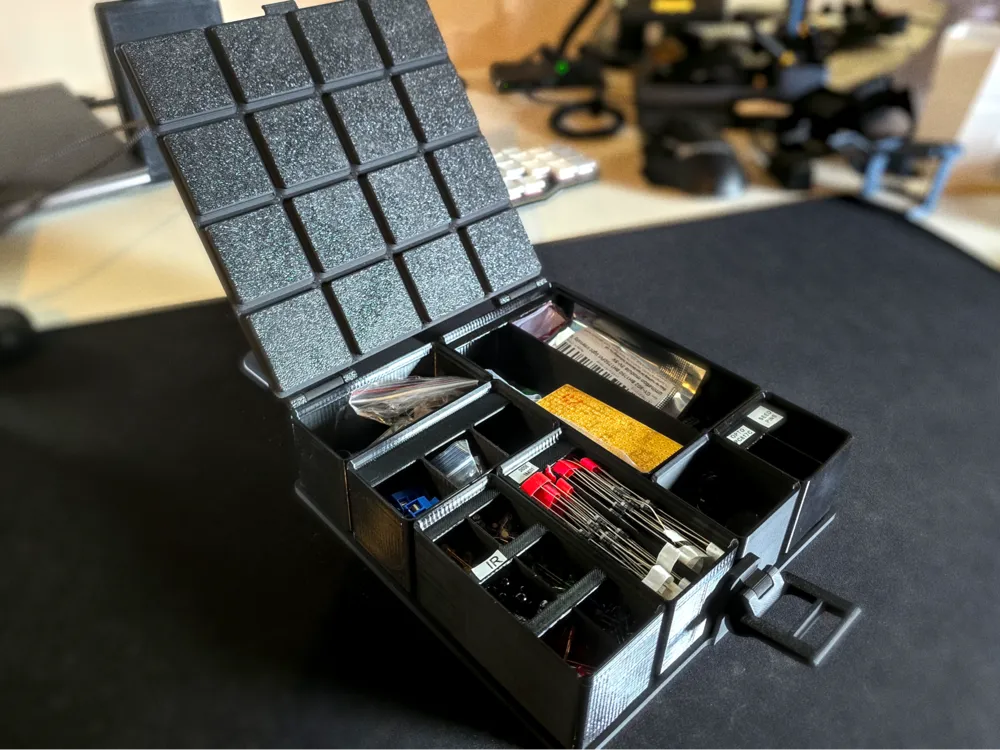
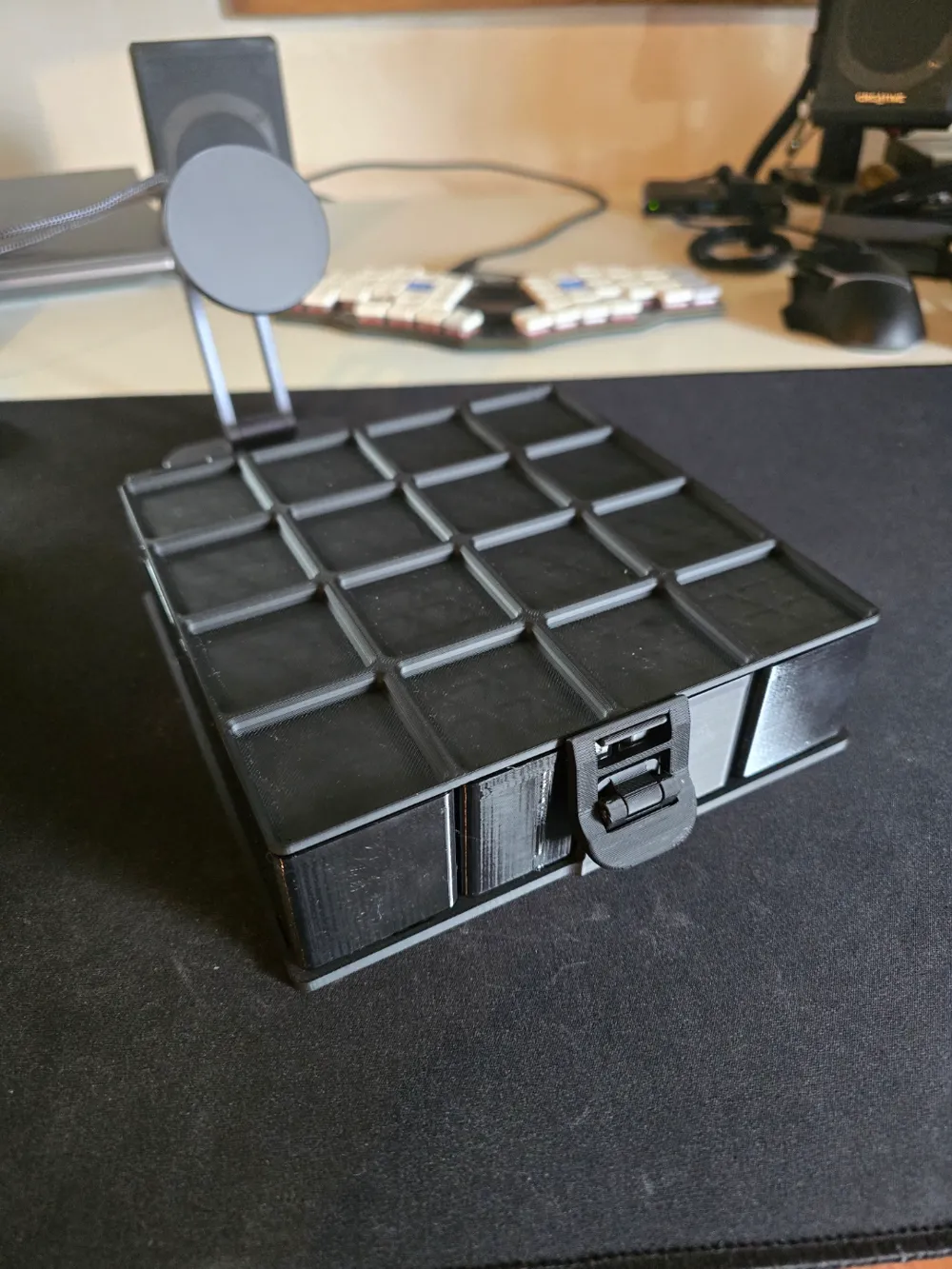
Superlight Gridfinity Case (6 high)
Boost Me (for free)
Love this model? Show your support by boosting my work! <3
There's a lot of heavy, rugged gridfinity cases out there… This is the opposite.
This is my attempt at making an extremely light, very low filament-cost case to quickly transport and store your gridfinity bins.
This model does not have a solid bottom, and does not have solid sides. Instead, it achieves rigidity by simply having the lid press fix the stored bins into place. You can shake this around as much as you want, as long as it's closed, your bins won't go anywhere.
If you need any other specific size, just leave a comment. I'm technically able to generate any size from down from 1x1 up to whatever you need, although I have only personally tested 1x1, 3x4 and 4x4.
Printing the box
To make the bins stable when the box is open, the base uses the brilliant clickplates (clickfinity) system originally designed by jrymk.
I strongly recommend printing the bottom of the case with ABS, ASA, or PETG. I had more luck with ABS than PETG due to some slight warping I experienced with PETG, but your mileage may vary. Printing the base in PLA will work, but the clickplates will soon loose their grip due to the PLA deforming, so I'd avoid PLA for the base.
Make sure to wait for the Baseplate to cool down before taking it out of the printer, as there might be some risk of permanently deforming it otherwise (especially with PETG).
The case is compatible with any bins with 6 units of height (or two stacked 3-high bins).
Assembly
The model prints in 3 parts: the bottom, the lid, and the clasp.
The hinges are designed such that you can simply use a bit of 1.75mm filament inside. Simply stick a bit of filament through the holes, cut the filament, and then either bend it or (optimally) slightly melt it onto the outer parts of the hinge using a soldering iron.
Then, insert your bins. Clicking them into place should give a satisfying click sound, but not take too much force.
Enjoy the base plate?
If you enjoy the satisfying click of the base plate as much as I do, definitely check out my version of the clickfinity base plate here!
License



Comment & Rating (38)