
Mobius Kaleidocycle ... Material-saving design


Print Profile(1)

Description
This model is based on the paper "Single degree of freedom everting ring linkages with nonorientable topology".
This is a Mobius Kaleidocycle I made after reading the paper "Single degree of freedom everting ring linkages with nonorientable topology".
According to this paper, the classical kaleidocycle was reported by Bricard in 1927. This kaleidocycle consists of six basic units connected by six hinges to form a loop, and is characterized by the fact that it has six hinges but only one degree of freedom (i.e., it has only a fixed movement).
This paper reports a kaleidocycle that can maintain one degree of freedom even when the number of basic units is seven or more. The lower right object in figure 10 of the paper shows what the kaleidocycle looks like when the number of basic units is infinite. This is a "3π-twist Mobius band" or a Mobius band with one and a half turns. This is the origin of the name "Mobius kaleidocycle".
I have uploaded several 3D models of the Mobius Kaleidocycle to Printables. However, this is a new model designed to reduce the amount of material.
Models with 7, 8 or 9 basic units were created. All are confirmed to rotate. I recommend MK7.
If the number of units is a multiple of 3, the vertices are aligned when turning, so the distance between the hinges must be increased.
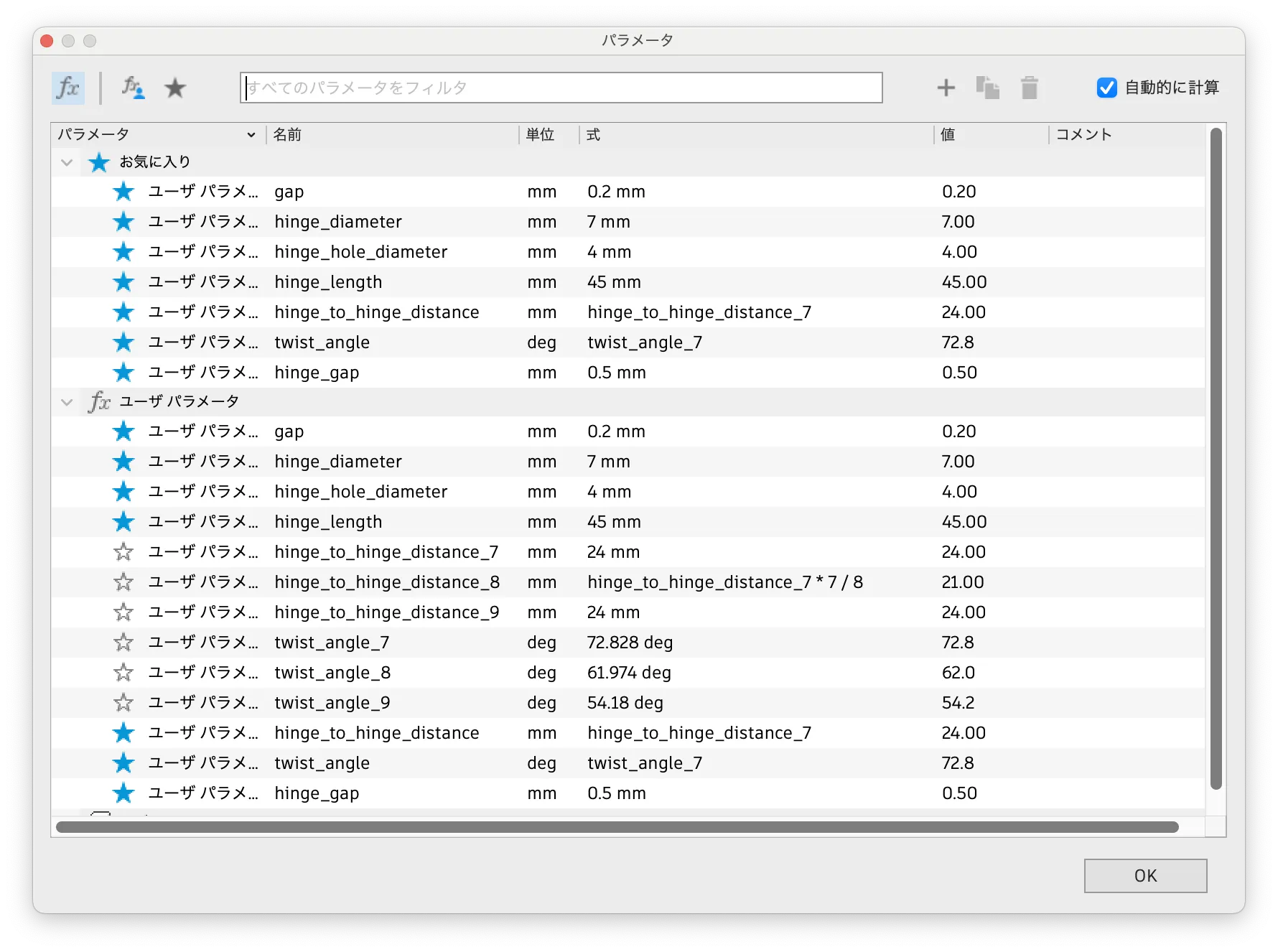
The hinge holes are circular and the connector pins are octagonal. This is based on the following website.
- https://makezine.com/article/digital-fabrication/3d-printing-workshop/tips-3d-printing-press-fit-parts/
- https://makezine.jp/blog/2015/09/tips-3d-printing-press-fit-parts.html (in Japanese)
Reference
- https://www.oist.jp/news-center/press-releases/möbius-kaleidocycles-sensational-structures-practical-applications
- https://github.com/shizuo-kaji/Kaleidocycle/blob/master/README.md
- There is a description of the patent at the link.
- https://www.kyushu-u.ac.jp/ja/researches/view/908 (in Japanese)
- https://www.asahi.com/articles/ASRD15PXBRCXPLBJ00C.html?ref=smartnews (in Japanese)
- https://engineer.fabcross.jp/archeive/230425_kyushu-univ.html (in Japanese)
License



Comment & Rating (0)