
Rattleback Demystified
Print Profile(3)


Description
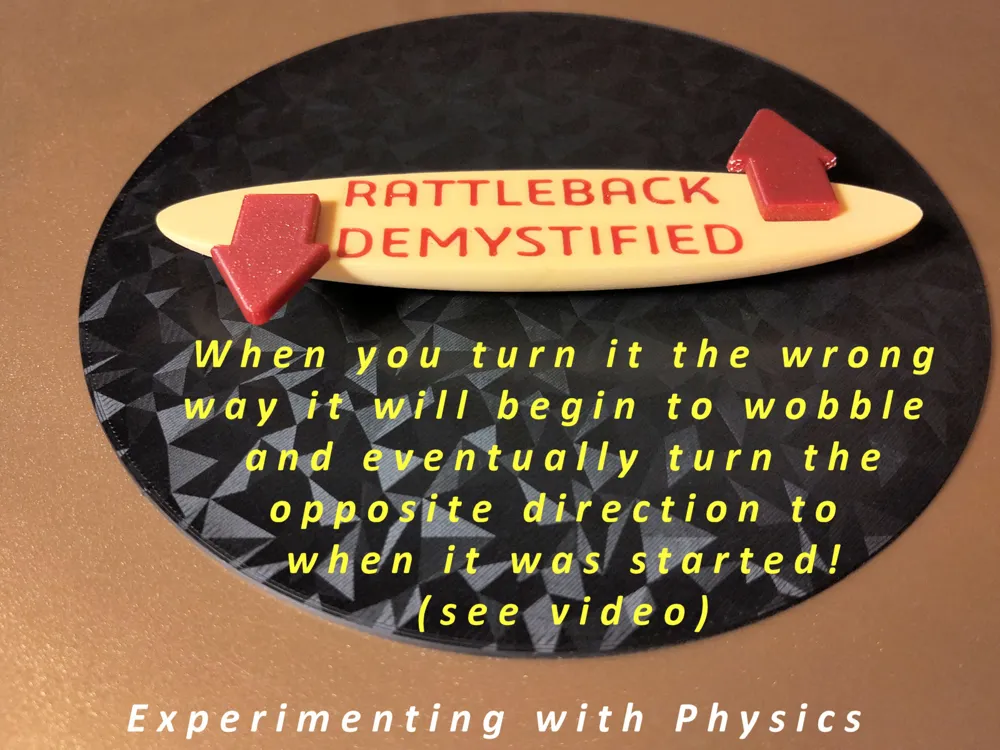
This symmetrical rattleback model is different from other 3D models of rattlebacks published because the secrets are not hidden in the model, but you can get started yourself with trying out and testing the physics behind the rattleback.
You can test the model without asymmetric distribution of weight (rotates in both directions), with asymmetric weight in 2 different axes (model has either a preference for turning left or a preference for turning right). The placed arrows act as weights and also give away the preferred spinning direction.
Optionally, you can also test the influence of friction by printing an additional spinningplate on a structured PEI plate or a smooth plate. Compare the functionality by using different other substrates, like a glass plate or table surface.
In this way, this model becomes an ideal instrument to use in physics class.
Very important:
The two curves on the bottom are printed in layers. I have already provided the top 1mm with a height range modifier with a smaller layer thickness, but for proper functioning, the curves must be very smooth. This surface must therefore be sanded! 240 grit sandpaper will do (you can start with 180 grit if you want), but sand until the steps of the print are no longer noticeable. Do not use finer sandpaper to make it even smoother! The rattleback needs friction to function properly!
I have added a additional sandingtool which can be attached to the 2 holes, giving you more grip when sanding. | 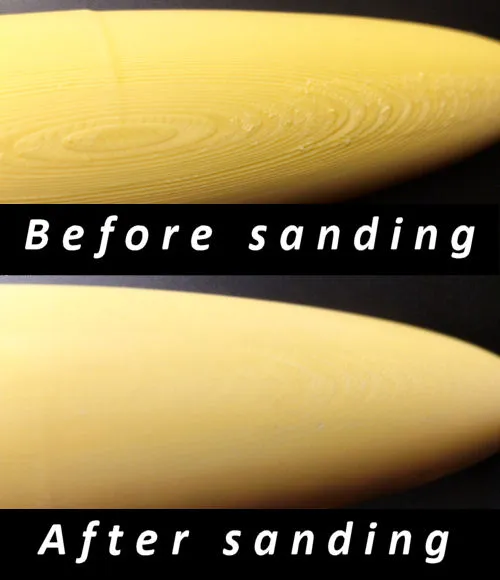 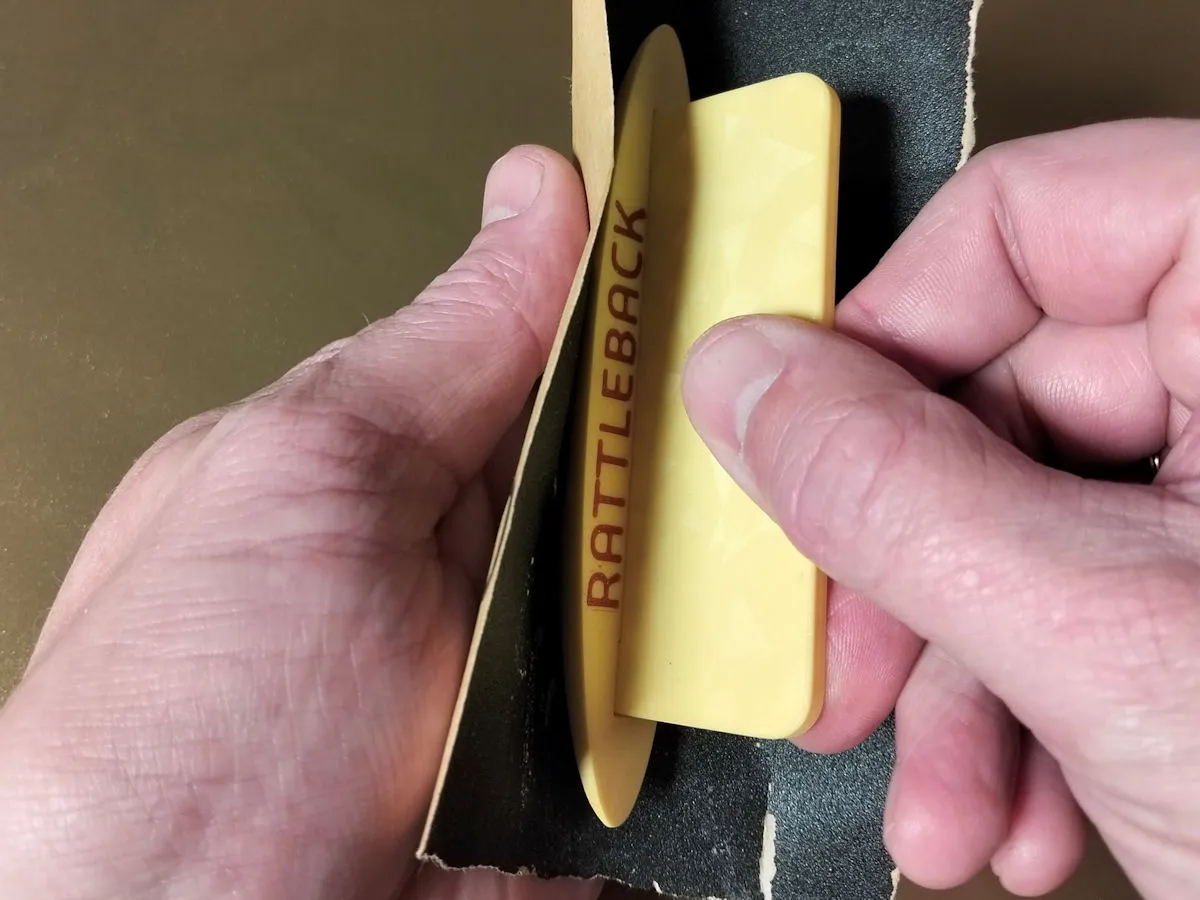 |
A rattleback, or Celtic stone, is a semi-ellipsoidal object known for its counterintuitive rotational behavior. When spun on a flat surface in one direction, it rotates smoothly, but when spun in the opposite direction, it begins to wobble and eventually reverses direction. This phenomenon arises due to an interplay between the object’s shape, asymmetric mass distribution, and frictional forces.
A symmetrical rattleback with an asymmetrical weight distribution exhibits the same counterintuitive rotational behavior as traditional rattlebacks, but its unusual dynamics arise from its internal mass distribution rather than its shape. Externally, the object appears geometrically symmetrical, but the deliberate imbalance in its internal weight distribution introduces asymmetry in its rotational dynamics.
Mechanics and Physics:
The asymmetrical mass distribution shifts the center of mass away from the geometric center, creating differences in the moments of inertia along the principal axes. When spun in one direction, this imbalance causes coupling between rotational and vibrational motion due to frictional forces and torque.
- Torque and Precession: Friction at the contact point generates a torque that interacts with the asymmetrical mass distribution, causing the rattleback to wobble (precession).
- Energy Transfer: Rotational kinetic energy is transferred into vibrational modes as the wobbling increases, disrupting smooth rotation.
- Angular Momentum Reversal: The energy fed back into rotation occurs in the opposite direction, causing the reversal.
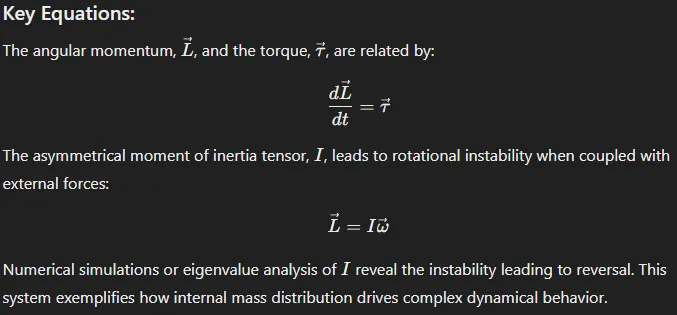
In the past I have published a rattleback that works in a similar way (shifting weight). That model is especially fun to amaze young children with the phenomenon of the rattleback. You can find it here.
License

You shall not share, sub-license, sell, rent, host, transfer, or distribute in any way the digital or 3D printed versions of this object, nor any other derivative work of this object in its digital or physical format (including - but not limited to - remixes of this object, and hosting on other digital platforms). The objects may not be used without permission in any way whatsoever in which you charge money, or collect fees.


Comment & Rating (1)